Workers at a New Jersey Hindu temple allege they contracted lung diseases during construction
Workers at BAPS Swaminarayan Akshardham, a Hindu temple in Robbinsville, New Jersey, claim they contracted serious respiratory diseases from poor working conditions and subpar safety precautions.
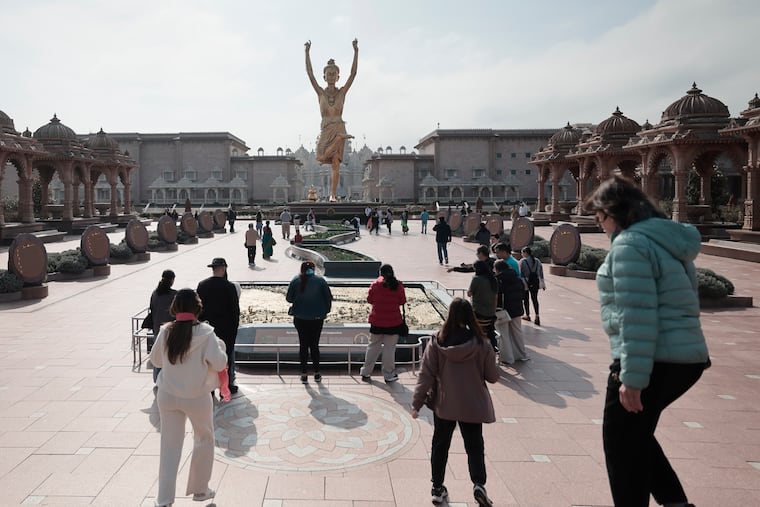
Workers at BAPS Swaminarayan Akshardham, a massive Hindu temple in Robbinsville, N.J., say they contracted a variety of life-threatening respiratory illnesses while constructing the facility, the Guardian reported Thursday.
The structure is the largest Hindu temple in the United States.
The workers interviewed by the Guardian, who spoke anonymously out of fear of retribution, said they believe two of their peers, Ramesh Meena and Devi Lal, died of a lung disease called silicosis that they picked up breathing in silica dust at the worksite.
BAPS Swaminarayan Akshardham refutes the claims.
This isn’t the first time workers have leveraged accusations against the religious group revolving around issues of worker safety and well-being.
Here’s what you should know about the temple and its history with its workers:
What is the temple?
The BAPS Swaminarayan Akshardham is a Hindu temple designed to house expressions of art, language, music, and spiritual learning, according to its website.
It was built between 2011 and 2023 across a 185-acre campus in Robbinsville and is made of marble, limestone, granite, sandstone, and teakwood, among other materials.
Where is it located?
The temple is located northeast of Philadelphia in Robbinsville, Mercer County. It’s about 15 miles from Trenton and about 45 miles from Philadelphia.
What are the workers accusing management of?
The workers allege in the Guardian article they were exposed to unhealthy air particles without being given proper protective equipment, which resulted in a number of them contracting respiratory illnesses including tuberculosis, chronic bronchitis, and silicosis.
Workers said two peers, Meena and Lal, died from silicosis. The lung disease generally develops from breathing in silica dust around mining and construction sites, according to the Cleveland Clinic. It can cause inflammation and scarring of the lung tissue and can lead to death. The disease can be prevented if workers wear tight-fitting respirators, according to the clinic.
Workers told the Guardian they were not given proper protective equipment while carving and weatherizing stones for construction.
What have the workers alleged in the past?
In 2021, several workers filed a complaint in the U.S. District Court for New Jersey alleging various labor issues, including that they were forced to work at the temple for more than 87 hours per week, that their pay was around $1.20 per hour, and that they were forbidden from interacting with temple visitors and cut off from those outside their cohort.
The suit also alleged the temple recruited workers from a class known as Dalit, a historically marginalized group in Hindu caste society formerly known as the untouchables.
After the complaint was filed, New Jersey police and federal agents raided the campus, according to Religion News Service.
The Justice Department closed its investigation into BAPS last year, BAPS North America announced in September.
“The United States government’s decision to end this investigation sends a clear and powerful message in support of what our organization has maintained from the outset: that BAPS Swaminarayan Akshardham — a place of peace, service, and devotion — was built through the love, dedication, and volunteer service of thousands of devotees from all walks of life," BAPS North America wrote in a Sept. 18 statement.
The civil case that started with the workers’ complaint is ongoing.
What does the temple have to say about the allegations?
In a statement to The Inquirer, BAPS Swaminarayan Akshardham refuted the accusations in the lawsuit and the Guardian article.
Respirators, N95 masks, helmets, work boots, and gloves were provided to the workers, said Darshan Patel, a spokesperson for BAPS Swaminarayan Akshardham. A certified Occupational Safety and Health Administration officer was also on site daily to supervise, he said.
The workers were provided with comprehensive medical care inside and outside of the campus grounds, Patel said. Each had health insurance with premiums and related costs covered by BAPS, he said.
“We have no reason to believe that the passing of Mr. Meena or Mr. Lal were connected to their service here in Robbinsville, where safety standards were maintained,” Patel said in a statement.
He also denied the accusations in the lawsuit, characterizing the work environment as insulated and substandard.
“BAPS provided the artisans with government-inspected housing; all meals; round-trip flights from and to India at the beginning, end, and during their service; medical care; health insurance; prepaid phone cards; and unlimited and unmonitored access to the internet,” Patel said. “That is not forced labor; it is not human trafficking; it is not any of the things alleged in the lawsuit.”