Saquon Barkley and other former Penn State players defending James Franklin amid lawsuit aren’t involved in case, attorney says
The attorney, Steven Marino of Philadelphia, represents Scott A. Lynch, who filed suit Aug. 23 against Penn State head coach James Franklin and other parties.
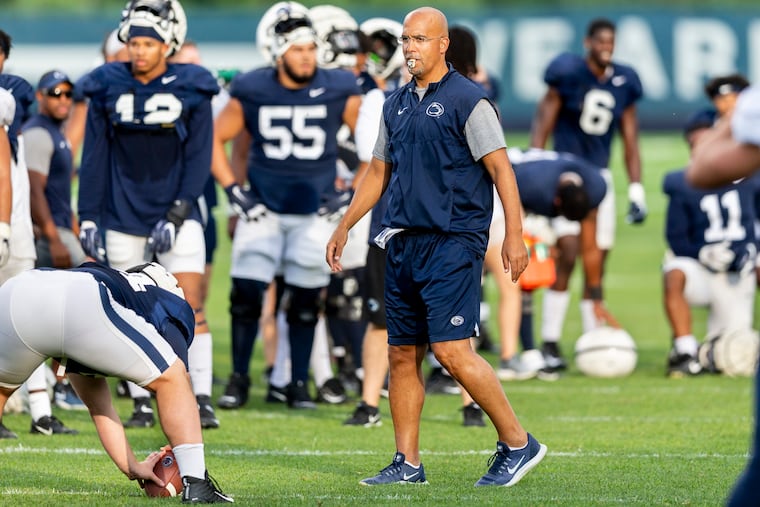
The attorney for a doctor who has filed suit accusing Penn State head football coach James Franklin of interfering with his care of student-athletes and trying to influence when those athletes return to the field said Friday that the dispute does not involve the former football players who have come to Franklin’s defense.
In an email to The Inquirer, Steven Marino called it “understandable that decorated athletes” such as Saquon Barkley, Trace McSorley and Jason Cabinda “may feel compelled to come forward in coach Franklin’s defense” against the lawsuit filed by Scott A. Lynch, the former orthopedic physician for the Penn State football team and the university’s former director of athletic medicine.
Lynch filed suit on Aug. 23 alleging that Franklin hindered his care of the players and pressured him to get his players back on the field as soon as possible. He was removed from his positions last March 1 and claimed he was retaliated against for the complaints he lodged against the head coach.
The suit also names the university, vice president of athletics Sandy Barbour and other parties as defendants.
“The issues which bring this dispute to the forefront involve communications which took place between coach Franklin and Dr. Lynch and medical personnel under Dr. Lynch’s command; communications which athletes may not have had knowledge of, not fully appreciated,” said Marino, of Philadelphia.
“This dispute does not involve the relationships which may have developed and communications which may have taken place between coach Franklin and selected athletes.”
Marino added that attorneys and parties involved in the lawsuit may not make “extrajudicial statements which may have a substantial likelihood of materially prejudicing the adjudicative proceeding.”
“As much as Dr. Lynch may want to further comment on the details of the facts that may support his claim, he is simply not permitted,” he said.
Since the lawsuit was filed, McSorley and Cabinda have come out on Twitter in support of Franklin. Barkley, now a New York Giants running back, said in a published report that the coach was “awesome for me” after making sure he stayed out until a 2015 ankle injury healed.
McSorley, now with the Baltimore Ravens, suffered two injuries at Penn State and said that Franklin never pressured him to return. The second was a foot injury in the Citrus Bowl against Kentucky.
“Coach Franklin and the staff were telling me not to push it,” he said. “It even got the point where they told me I was not going back in, in order to protect my future. Fortunately that wasn’t the case, and I was able to continue to play. Both times I was the one who made the decision to re-enter the game.”