Conshohocken-area AI data center proposal abruptly withdrawn over legal issues
An attorney for developer Brian O’Neill was forced to pull the application after legal-standing issues came to light at a Monday zoning board meeting. They can resubmit another proposal at any time.
A Main Line developer’s plan to turn a shuttered steel mill into a 2-million-square-foot AI data center on the outskirts of Conshohocken was stymied Monday when he was forced to withdraw his application over legal issues.
At the Plymouth Township zoning hearing board meeting, Brian O’Neill’s team had been set to make their case for an exception that would allow a data center to be built at 900 Conshohocken Rd.
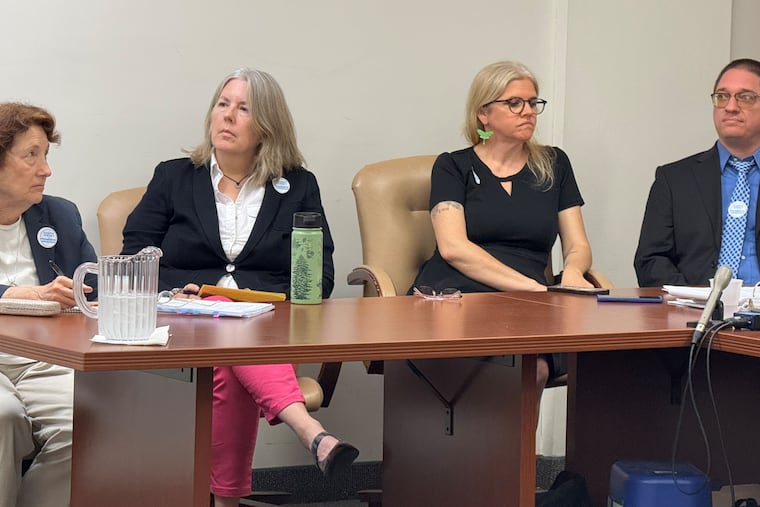
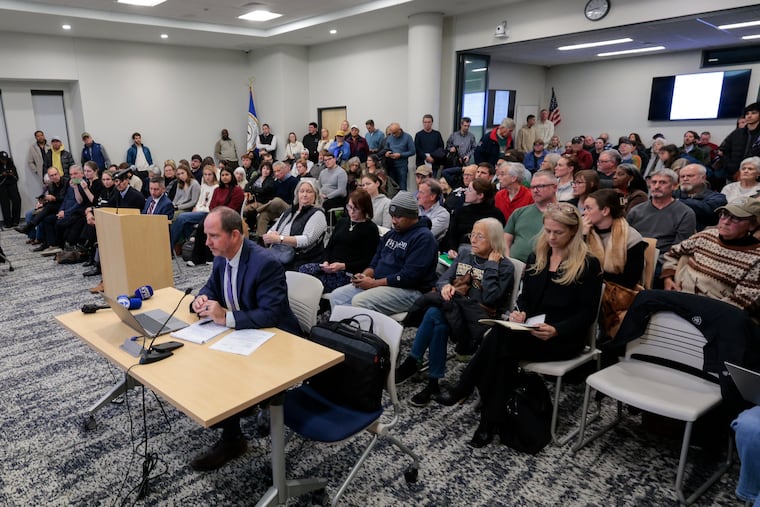
The plan has faced neighborhood pushback, and hundreds of people packed the meeting room on Monday night. O’Neill did not appear to be among them.
Edmund J. Campbell Jr., an attorney for O’Neill, said they wished to move the hearing to the township’s December meeting. Then an attorney for Cleveland-Cliffs, the property owner, said the prospective buyer did not have legal standing to do so.
An agreement of sale had not been approved prior to the meeting, said Heather Fine, the attorney for Cleveland-Cliffs.
Campbell later asked Fine and then the board for permission to withdraw the application. Both declined to provide additional comment.
Residents who had spent more than a month organizing in opposition to the project said they had mixed emotions.
“It is the smallest of small wins, because we’re making it harder for something bad to happen to our community,” said Nick Liermann, an attorney who lives in a neighborhood near the former steel mill. “But we will be back in this room in a few months.”
“Communities can be effective,” said Patti Smith, a neighbor of Liermann who has spearheaded the local data-center opposition efforts. “We have to stand up for ourselves.”
With the withdrawal, the data center proposal is officially off the docket in Plymouth Township, zoning officer Joel Rowe said, but the applicant can resubmit a plan at any time, restarting the process.
What the data center proposal entailed
This latest development in the Conshohocken-area data center saga occurs amid broader controversy about such facilities, which handle cloud-computing and storage for Big Tech companies.
The construction of data centers has been fast-tracked to meet the growing demands of power-hungry AI tools like ChatGPT. Politicians on both sides of the aisle, including President Donald Trump and Gov. Josh Shapiro, have pushed for more centers, while some neighbors near proposed sites have mounted fierce pushback.
In the Philadelphia area, Amazon is building a 2-million-square-foot data center on a former steel mill in Falls Township, Bucks County. And a 1.3-million-square-foot data center has been proposed at the former Pennhurst State School and Hospital in East Vincent Township, Chester County.
In Plymouth Township, O’Neill had not revealed the potential tenant for his proposed data center, but indicated it would be related to the life sciences.
The data center is proposed for a 66-acre property along the Schuylkill in the Connaughtown section of the township. The site is less than a mile from downtown Conshohocken. Its neighbors include the Proving Grounds sports complex, Tee’s Golf Center, and dozens of homes.
Some Connaughtown residents, along with other data center opponents from across the Philadelphia region, have rallied against the proposal. As of Tuesday, more than 1,000 people had signed an online petition urging township officials not to grant a zoning exception for the data center, citing concerns about light, noise, and air pollution; water usage; and electricity costs.
O’Neill, meanwhile, had argued that a data center should be permitted in the “heavy industrial” zone due its to similarity to a warehouse and laboratory, which are both permitted uses under township code. He had also touted the center’s potential economic benefits, saying it could bring in $21 million in annual tax revenue and attract other companies to the area.
“Industry hasn’t come and gone. It’s simply changed,” O’Neill said at last month’s planning board meeting. “What I’m proposing is to put 21st-century industry into an industrial building.”
Why the data center plan was withdrawn
At the start of Monday’s standing-room-only meeting, Plymouth Township officials were expecting a long and potentially tense night.
Solicitor Dave Sander began by warning the crowd that they must maintain decorum, and said he would cut off the proceedings at 10 p.m. Police officers stood outside the room.
Quickly, however, it became clear that Campbell, O’Neill’s attorney, had other plans, requesting a continuance to the Dec. 15 meeting. If granted, it would have marked the hearing’s second continuance: The proposal was initially supposed to be discussed at an October meeting.
“My client would like an additional opportunity to review with [community members] the project,” Campbell said. “When we proceed, if we have had a more robust dialogue with those participants, this hearing on the 15th would be significantly more efficient.”
Neighbors, some of whom had already attended a private meeting with O’Neill last month, objected to the last-minute request, saying that it was unlikely their minds would be changed if no significant changes had been made to the plan.
“Is the proposal significantly different than what was displayed to community members at the Oct. 8 meeting?” asked Smith, who organized neighborhood opposition.
“No,” Campbell responded, later adding that they wanted more residents to be able to attend the meeting and hear from their experts who could speak to concerns, including about noise and emissions.
Before the zoning hearing board could vote on the continuance request, Fine, the attorney for property owner Cleveland-Cliffs, took to the podium.
“There is no standing for the prospective buyer to proceed with the application this evening,” Fine said. “That authority was not extended to the prospective buyer from the owner. There is no LOI [letter of intent] in place.”
“My client delivered a signed agreement of sale to the owner this evening,” Campbell said. “Based on that, we have standing. … We made our application with the express consent of the owner.”
Sander turned to Fine, asking if that was true.
“It’s not entirely true, no,” Fine said. “The signed agreement that was transmitted to my colleague at 5:51 p.m. this evening had redline changes. Those have not been accepted by my client.”
She did not elaborate on what those changes entailed.
The zoning hearing board recessed before returning to accept Campbell’s motion to withdraw the application.
As a neighbor to the site, Liermann said the unexpected turn of events left him with a more sour taste in his mouth about the developer: “The last-minute request in an attempt to obstruct the process and dissuade the public from participating, and then this ‘confusion’ over whether or not an LOI was actually signed between the developer and the owner, is incredibly disturbing.”