A Chester County camp brought these boys together. Decades later, they talk once a week.
During the uncertainty of the pandemic, a group of Camp Saginaw alumni in their 70s and 80s scheduled a Zoom to chat. Now, the weekly call on Fridays has become a kind of sanctuary for the group.
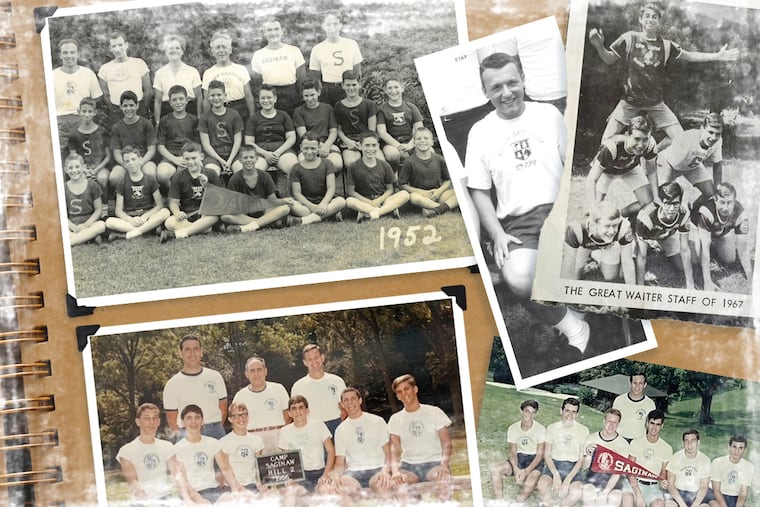
There’s a song about an unexpected triumph in a 1958 baseball game. There’s a legacy of camp leaders’ names inscribed near the bunks for eternity. There’s an unforgettable performance during the annual talent show.
And now, decades after those moments have become camp legends, every Friday, at 4 p.m., there’s a Zoom call.
Brian Redman doesn’t miss it, if he can help it. Neither does Hugh “Hank” Aberman, or Barry Greene, or David Lipstein. For the past six years, they’ve Zoomed in from vacations, hospital beds, and, yes, the car, and yes, to the chagrin of their wives.
They’re not alone; a group of about 20 men, scattered across the country, log in each week to talk.
The connective tissue is Camp Saginaw, the overnight camp nestled in farmland in Oxford, which will celebrate its 100th anniversary next year. The men, now in their 70s and 80s, were once boys who spent eight weeks at the Chester County sports camp over the summer, from the late ’50s into the ’70s. They were young bunkmates playing softball, teenagers getting lunch in the mess hall, or counselors conducting bed inspections.
They came to the camp as young as 10 and were there into their 20s. They learned sportsmanship, had their first meaningful interactions with girls — several of them have married former campers — and took on the first brushes of leadership.
Their bonds didn’t stop at the boundary lines of Camp Saginaw. The men have followed one another to college, stood as groomsmen at one another’s weddings, organized reunions and scholarship programs, and spoken at their fellow campers’ funerals.
And in 2020, amid the isolation and uncertainty that the COVID-19 pandemic brought, Aberman, 88, got a call from a former camper, inviting him to a Zoom meetup. There were just a few of them then, but it was a highlight. Word spread to fellow alumni and soon it had snowballed. The tradition has lived on, seldom a session missed, for six years.
Aberman recalls inviting other campers who said they’d join, but didn’t want to commit long-term. Now, they never miss a call, either.
“It’s really fun to watch,” Aberman said. “They just are so excited to capture something that they thought was lost to them. It’s pretty powerful.”
When Redman, 73, tells “noncampers” about the call, they’re “incredulous” at its attendance, consistency, and longevity, he said.
“They can’t really relate to it,” he said. “Saginaw — is it unique? That’s hard to say, but it’s certainly very unusual, in that the bond that we created and the friendships that we developed over the years is what is sort of the foundation of this whole thing. I mean, if we didn’t like each other, and remember fondly our time together and all that stuff, then we wouldn’t be doing this, but we do.”
And they do remember it fondly. For some, Saginaw is a family affair: Their parents are also alumni, or their siblings and cousins; some of their children or grandchildren have attended.
There’s a website dedicated to capturing the history, run by alumni. You’ll find Aberman’s recollection of the ballad-worthy “Game of 58” — the annual softball game, or how some counselors were anointed “Zeus.” There’s an archive of the annual Mr. Saginaw contest, a talent competition of sorts, which several of the callers have won (but, as a point of contention, not all).
The camp has worked to preserve these histories, said Mike Petkov, Camp Saginaw’s executive director. They honor the past, hosting a “Zeus symposium” where previous Zeuses (and Heras, the girls’ equivalent) hold a Q&A with current campers. It’s one of the campers’ favorite nights, he said.
Petkov, who attended Saginaw as a camper after his father purchased the camp in 1986, lived some of that legacy himself.
He watches each year as parents come back on visiting day and show their kids where their names are etched.
“History is what makes the camp,” he said. “You can’t preserve every ... piece of wood, but there are certain areas and certain cabins that we have not yet touched — and we hope not to touch — because it is so important to preserve the history.”
There’s no other parallel quite like the bonds camp creates, said Lipstein, 76.
“You’re there for a lot of formative things, and a lot of developmental things,” Lipstein said. “... [You’re] more susceptible to the establishment of bonds with people.”
There’s no agenda during the calls, though sometimes someone has a prompt or a suggestion to pick up next time. They flow from Saginaw memories to recent sports moments to questions about aging. They segue to entertainment — TV shows they’re watching, or the significance of the end of Stephen Colbert’s show, and dig into politics. They question, speak frankly to — and occasionally talk over — one another.
Sometimes they have special guests, like professional athletes, journalists, and even a former CIA official, to hear from experts.
There are certain social mores of the group: When one of them dozes off, he won’t hear the end of it for weeks. The more extroverted encourage the quieter members to speak up. But they also don’t want anyone to hog the metaphorical microphone. Ever the Zeus, Aberman has had to cut people off.
But they have forged an unwavering connection. They helped one another navigate grief, after they recently lost two friends from the group.
Both men had kept their laptops with them right until the end, joining the Zoom call each week.
“I just couldn’t believe it, how important that was to them to stay connected to their friendships through that group, even though they were passing on,” Aberman said. “We’ll meet again.”
Greene, 84, called the losses devastating, and the resulting support a “group hug.”
Sometimes, they look directly at that grief and talk about it. Sometimes, they purposefully keep things light (and rib Redman about Mr. Saginaw). But whatever way the conversation takes them, they keep showing up for one another — as they have done for half a century.
“[A] thing about aging is I have mellowed, and I cherish old friends,” Greene said. “It’s just very comforting to be around people who knew me when I was young, and who still know me today. And they’re family.”

Want to get Inquirer Chester County straight to your inbox every week? Sign up here for our guide to the news, stories, and events shaping life in your community.
This suburban content is produced with support from the Leslie Miller and Richard Worley Foundation and The Lenfest Institute for Journalism. Editorial content is created independently of the project donors. Gifts to support The Inquirer’s high-impact journalism can be made at inquirer.com/donate. A list of Lenfest Institute donors can be found at lenfestinstitute.org/supporters.