Data centers are eyeing the collar counties. They’re drawing pushback from residents across the region.
As data center proposals get further into the municipal process, surrounding communities are often pushing back against projects that have regional impacts.
Spring City’s borough council took an unwavering stance against a proposed data center at the historic Pennhurst site, slated for a 125-acre parcel not far from the Schuylkill.
But there’s a catch: The plans for the data center are before the municipality’s neighbor, East Vincent Township — not Spring City’s council.
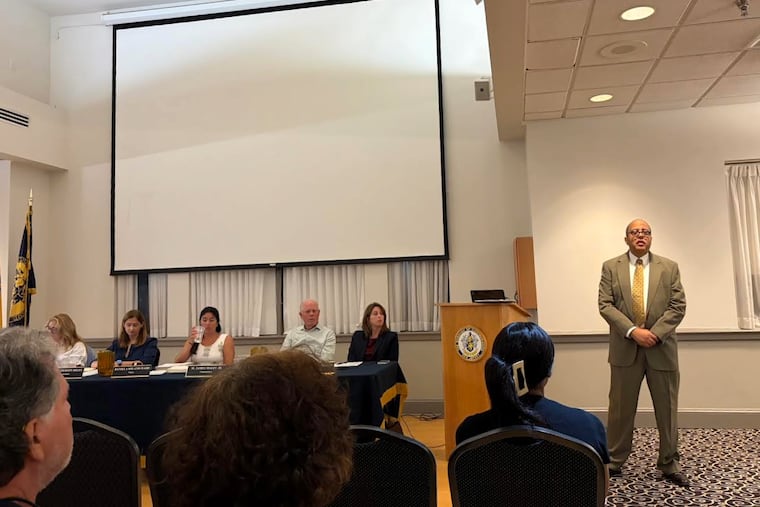
Still, the borough’s residents showed up to Spring City council meetings asking if the elected officials could do anything about it. In a February resolution, the borough told its neighbor its opinion on the matter and asked its own solicitor to look into how the municipality could change its zoning ordinance to address any similar proposals coming before the council in their own borough.
It’s a situation more communities are coming face-to-face with, as data center developers more readily eye Pennsylvania. The boom comes as Gov. Josh Shapiro has sought to ease regulations to make it easier for the projects to flourish.
But Pennsylvania’s emphasis on local control has splintered how residents and local officials can respond to projects that affect them, and municipalities are limited in how they can react once a plan is before them.
“The best we could do was to let East Vincent supervisors know how Spring City residents and Spring City borough council felt about the data center,” said Donald Shaner, the council president. “We took decisive actions, as far as I’m concerned. We have to look out for our residents, whether or not East Vincent does — that’s up to them.”
In some ways, Pennsylvania is ripe for data center projects. It’s not far from Ashburn, Va., which is known as “data center alley,” given the dense number of facilities, and Pennsylvania has open land, available water, energy, and fiber optic infrastructure in place. Statewide, there are at least 55 proposed data center projects, according to Data Center Proposal Tracker, a citizen-run website that tracks data center development.
Counties in the Northeast are seeing some of the highest numbers of proposals, and the Philadelphia region is among those seeing an uptick. There are at least six data centers proposed in the Pennsylvania collar counties.
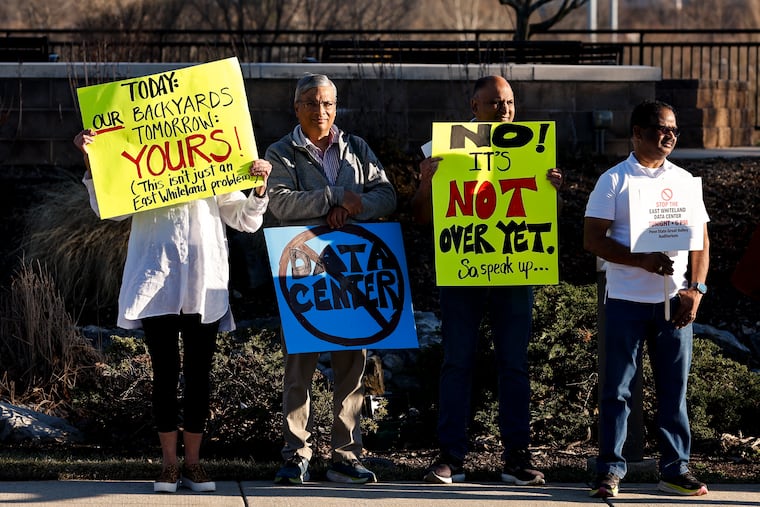
In Chester County, at least two proposals are making their way through the municipal process. The East Vincent project is expected to enter the conditional hearing phase in April, when the board of supervisors will hear from the developer and residents in a quasi-judicial capacity. It will go back before the planning commission after the developer recently amended its plans to expand the project there. Meanwhile, an amended plan to expand a data center project in East Whiteland is now before elected officials. A number of others are proposed in the nearby collar counties: Montgomery’s Limerick Township has a proposal in front of it, and two centers are proposed in Bucks County municipalities.
The projects have stoked pushback from residents, who are worried about the strain and potential cost the data centers will have on the power grid and on water supplies, plus the health and environmental impacts. They’ve routinely shown up to decry the centers and ask their townships to reject them.
Though a December survey indicated more than a third of Pennsylvanians support the centers being built in the commonwealth, 42% of respondents said they oppose having them built near their communities.
The developers for both Chester County projects have separately tried to assuage residents’ concerns. They argue both sites are located in areas allowing for industrial use that had previously been contaminated, and the developers have said the projects will clean up the land and return them to use. (Residents remain concerned about developing on contaminated parcels.)

Want to get Inquirer Chester County straight to your inbox every week? Sign up here for our guide to the news, stories, and events shaping life in your community.
The developer of a North Coventry project was surprised by the number of attendees who showed up last month to the township’s meeting in response to their proposed “boutique” data center. The vehemence actually prompted the township’s board of supervisors to reject the project, which hadn’t been formally submitted yet. But fliers and lawn signs fighting the proposal were already appearing in neighborhoods.
In East Vincent, residents have rallied together online to raise awareness about upcoming meetings regarding the project, and ones in nearby towns, like North Coventry or Limerick.
“We’re definitely starting to feel like we could be surrounded,” said John Binelli, who is raising awareness about the East Vincent project through a Facebook page that has amassed 1,900 users.
“I would like to see our township take a stronger stand,” he said.
In 10 years of community organizing, Ginny Marcille-Kerslake has never seen people so motivated. As a senior organizer for Food and Water Watch, an environmentalist organization, she’s been in communities pushing back against data centers across southeastern and central Pennsylvania.
“Night after night across Pennsylvania, we’re seeing township meetings packed to overflowing, to the point where they have to be stopped and rescheduled, because people care that much,” she said. “They’ve been coming out in all kinds of weather. The opposition to these projects is across the political spectrum.”
As a West Whiteland resident, who sits on its planning commission, she’s attended East Whiteland’s meetings because of the regional reach of the project. She became aware of the proposed data center in 2023, a year before it was ultimately approved. But the plans are now back before elected officials after the developer sought an expansion.
“This is not 2024 or earlier when they were trying to get their original approvals, and people did not have data centers on their radar,” she said. “Now they do, and you’ve got neighborhoods right across the road that are suddenly waking up to the idea of what this would mean.”
The Pennsylvania Municipal League is seeing more officials trying to get ahead of development, said Amy Sturges, deputy executive director of advocacy.
Under the planning code, municipalities have to make sure any type of use — residential, industrial, commercial — is allowed within their boundaries, she said. If a municipality doesn’t update its zoning rules to stipulate where data centers can go, officials can find themselves in a bind where they can’t control where one ends up.
East Vincent’s board of supervisors ran into that problem; officials raced to pen an ordinance after the developer introduced plans to turn Pennhurst into a data center. But they couldn’t impose a new ordinance on an existing proposal, and the developer’s attorney said they wouldn’t follow it because it was too restrictive.
“Municipalities, if they can work ahead and get data centers into their zoning, they’re in a much better position, because they can’t just outright say no to a use,” she said. “They can prescribe where, using zoning, but they can’t say no.”
Kirk Stoner, director of planning in Cumberland County, and his department have worked with eight of their 33 municipal governments in the county to draft ordinances to address potential data center projects. Some have stricter policies to keep data centers out, but others have penned more friendly ones to welcome the projects, he said.
It became top of mind for the county, near Harrisburg, after a massive 750-acre hyperscale data center was proposed there, supported by the Shapiro administration.
As Stoner’s department navigates assisting other communities grappling with this new use and the public sentiment, it may become necessary for the state to provide guardrails, he said.
In a state that emphasizes local control, data centers highlight the challenges with that model, Stoner said. Municipal leaders and their residents can only address what’s going on in their town — to a somewhat limited degree — even though the effects are felt much more broadly.
“Land uses do not stop at municipal boundaries, nor do their impacts, nor does the infrastructure that serves it. That’s what makes it so hard for the way we’re chopped up in these small, discrete units,” he said.
At the state level, lawmakers are crafting bills to try to address it. One measure would direct a center within the state’s Department of Community and Economic Development to write a model ordinance for municipalities to regulate data centers, addressing sound barriers, set-back distances, building design standards, and more.
A different bill would give neighboring communities and residents more teeth for responding to massive developments — including data centers — that are in different municipalities.
Another, which will be introduced by State Sen. Katie Muth, who frequently attends the Chester County data center meetings as one of the area’s lawmakers, would seek to halt hyperscale data center development for three years, arguing that local officials need more time to understand data centers’ impacts to health and environment, update their zoning regulations, and enact ordinances.
Meanwhile, Chester and Montgomery Counties are working together to develop model guidance on data center development, slated for release this month, according to Chester County’s planning commission’s website.
Marcille-Kerslake, the environmentalist, said some kind of moratorium is desperately needed as municipalities race to keep up.
“It’s like drinking from a fire hose in Pennsylvania,” she said. “They’re really scrambling to do this.”
This suburban content is produced with support from the Leslie Miller and Richard Worley Foundation and The Lenfest Institute for Journalism. Editorial content is created independently of the project donors. Gifts to support The Inquirer’s high-impact journalism can be made at inquirer.com/donate. A list of Lenfest Institute donors can be found at lenfestinstitute.org/supporters.