Seeking: A barn? Chester County’s only roller derby league is hitting obstacles while looking for a new space
Brandywine Roller Derby wants to stay in Chesco. But without a stable space, they worry about the league's future.
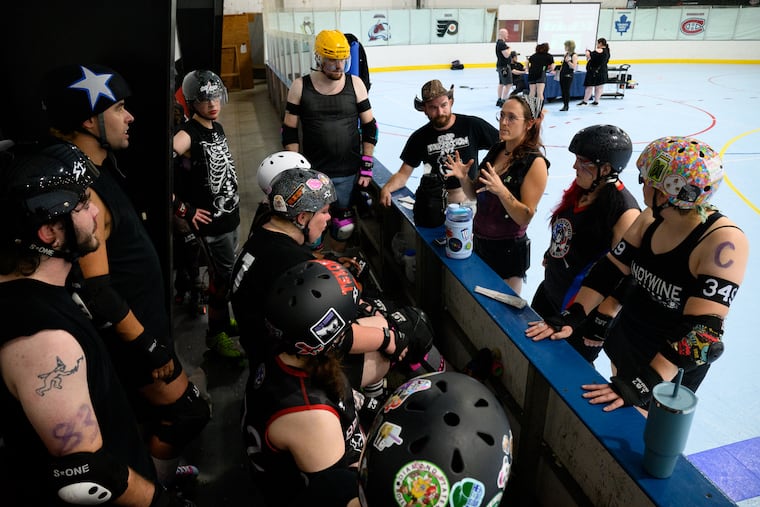
After graduating nursing school and navigating the loss of her mother, Corinne Kucewicz was looking for something positive to focus her energy on. That’s when she found Brandywine Roller Derby, Chester County’s only league.
Now the league’s president, overseeing roughly 26 members, Kucewicz, 28, worries about Brandywine’s future as they struggle to find a permanent and affordable home in Chester County to practice, hold games, and fundraisers. Without any roller rinks in the county, they’ve ended up at their current space at a school facility in Exton. It offers enough room for their track, but with a slippery — and sometimes muddy — floor that can make skating conditions iffy, the location is starting to hurt retention.
“It worries me if we don’t find another space that our league is going to go kaput,” said Kucewicz, who goes by Maria Von Scrapp on the track. “That would obviously be worst-case scenario, but unfortunately, as one of the leaders of the league, that’s something I have to worry about.”
Roller skating has seen its peaks and valleys. There was a boom as far back as the 1880s. More recently it’s been a fixture of school trips or birthday parties. Roller derby, which started in 1935, has a long history itself, transforming from a race, to a full-contact sport, to a scripted professional-wrestling-esque performance.
Today’s roller derby — a DIY, gender-expansive, and LGBTQ+-friendly sport — cropped up in the early 2000s. Gone are many of the banked tracks, the raised, curved oval that was synonymous with derby of the ’70s and ’80s. Many leagues rent spaces and play on “flat tracks,” which is exactly how it sounds.
COVID-19 offered a bit of a paradox for roller skating and derby. The pandemic led to the closing of rinks across the country, as many large venues struggled with shutdowns. It simultaneously put roller derby leagues on pause, with skaters unable to hold practices or bouts (i.e. games), eating into funds they had raised through selling tickets and skaters’ dues. Some leagues collapsed.
At the same time, roller skating spiked, with merchandisers struggling to keep up with demand as people increasingly took up the hobby.
As pandemic restrictions eased, and roller derby leagues were able to practice again, they saw a depleted returning membership but heightened interest in the niche sport.
Kucewicz was among them. She showed up with a cohort of other interested skaters to a 2024 recruiting event. The team took her in despite having no past skating experience, and taught her how to skate, how to fall safely, how to hit, and how to take a hit.
“It was an amazing mix of friendly people and people that I saw myself being friends with,” Kucewicz said. “That was something that I definitely needed at the time, and is still important.”
Before the pandemic, Brandywine had a large league that was doing well, Kucewicz said. When they were able to start skating again after, they were down to six returning skaters but also had a crowd of interested newbies.
Finding a space has proven to be difficult. When the league was founded in 2010 by a group of skaters, they met at the Caln Roller Rink in Downingtown. But a changing of the rink’s ownership ultimately closed the rink.
The league ended up at Collegium Charter School in Exton two years ago, practicing in an outdoor-indoor, climate-controlled space. The floor is, essentially, plastic tiles on top of dirt. When it rains, mud seeps through.
The floor itself is uneven: On one side of their track, it goes uphill; the other, downhill. Aside from scrimmaging, derby is a lot of learning and drilling fundamentals, focusing on agility and footwork. A slippery, uneven floor makes that difficult.
“Members have left and gone to other leagues because they’re afraid, because our floor is so slippery, that they’re going to injure themselves. Or they just want a higher level of derby that we can’t really provide at this moment because our floor is not that great,” Kucewicz said.
As they prepare for a new class of recruits — they’re holding a new skater program Sept. 20 — they want to find something more suitable.
In their hunt, they’ve been priced out of anywhere that can be an option for them, said Christi Tuminelli, a league skater who has been overseeing the search for a new space. Most warehouse spaces are going for $12 to $24 per square foot. Their budget is closer to $2 per square foot. They’ve reached out to more than 30 properties. Most have gone quiet.
Others don’t work, either because the property doesn’t fit the size of the track they need, or the owner isn’t interested in sports. They also have had to contend with worries about damaging the floor, which they say is a nonissue.
The league is open-minded about its future home; Tuminelli was contacting farms about their barns. They need an open space, with minimal columns in the way. The track spans 108 by 75 feet, which is roughly 8,100 square feet. They want to stay in Chester County, with the hope of getting more involved with the community when they have a stable location. Ideally, they’ll be able to host the public for games or fundraising events. Right now, the team hosts its bouts in Pottstown, in Montgomery County. They’re breaking even between renting the space and raising funds from ticket sales, they said.
“Right now we’re at an impasse because we need the space to generate the income, but we can’t afford the space without new people,” Tuminelli said. “We are a working nonprofit that can pay sustainable rent. We just can’t compete with the market rates in Chester County.”
While derby is a sport, it’s also a community.
Tuminelli — or Mother Mayhem, on the track — went to her first bout wracked with nerves but walked away feeling excited and empowered. Tuminelli, 42, was never a “sports girlie” growing up, she said. But if she had known what they offered, maybe she would have joined earlier.
With other teams an hour or so away from the suburbs, it’s an important to have the outlet within their own community, Tuminelli said.
“When I moved here from New York, I didn’t know anybody. And having a kid that was young and being in a new space, it’s scary as a new mom,” she said. “I wanted something for me, and this was great. Derby just allows you to do things. It raises your confidence.”

Want to get Inquirer Chester County straight to your inbox every week? Sign up here for our guide to the news, stories, and events shaping life in your community.
This suburban content is produced with support from the Leslie Miller and Richard Worley Foundation and The Lenfest Institute for Journalism. Editorial content is created independently of the project donors. Gifts to support The Inquirer’s high-impact journalism can be made at inquirer.com/donate. A list of Lenfest Institute donors can be found at lenfestinstitute.org/supporters.