Delaware County upgraded its emergency radio system after years of dead zones and attacks by hackers
Officials have previously called the long-awaited telecommunications improvement ‘the single most important thing’ for emergency responders in the county.
False alarms, poor connection, and interference from TV signals.
Those were just some of the issues that impeded emergency response in Delaware County where, for years, police, fire, and EMS officials worked with an aging telecommunications system.
After years of dropped signals and attacks by hackers, the county last month unveiled a new radio system, replacing its out-of-date model. With the upgraded infrastructure in place, local officials hope they can respond to crises faster, collaborate across county and state lines more effectively, and help keep emergency responders safe.
Efforts to modernize Delco’s emergency response infrastructure began in 2019, when the county council authorized a study examining the system’s shortcomings and what replacement would cost.
Three years earlier, a Folcroft police officer was shot seven times while responding to a drug-related call. During the incident, the county’s emergency response computer rebooted, cutting off communication for four minutes.
The county council allocated funds for new radio infrastructure in its 2020 budget, and in 2022 unanimously approved the purchase of the Kenwood Atlas P25 Phase II radio system, moving the county toward industry standards.
“This is probably the single most important thing for all of law enforcement and fire service and EMS in Delaware County,” Haverford Police Chief John Viola said at the time, according to the Delaware County Daily Times.
The upgrade took 5½ years and cost $36 million ($3 million less than initially budgeted), according to a county spokesperson, and was funded in part by a $4.6 million state grant.
Though Delaware County had completed minor improvements over the years, its system had not been fully upgraded since the 1970s, causing it to fall behind its regional neighbors.
Delco’s P25 system, which was unveiled at a ribbon cutting last month, equipped first responders, including police, fire, and emergency medics, across the county with 3,700 handheld radios.
» READ MORE: As officer screamed 'I'm shot,' Delco's 911 computers failed
The county’s old T-Band radio system “had exceeded its life expectancy‚" said Steve Castellano, Delaware County’s 911 systems manager.
Oftentimes, first responders would try to communicate with their radios, but interfering signals made it so those on the other end could not hear them. Those impeding signals often came from TV stations in Boston and Virginia, a problem that grew after the digital television transition in 2009.
Once, Swarthmore Mayor and Fire Chief Conlen Booth said, the borough’s fire department was responding to a fire alarm that went off in an elementary school at night. As Booth attempted to give instructions to firefighters in the building, he realized his radio wasn’t working. It was not until he got in his car, moved it 20 feet away, and tried again that he was able to connect with the firefighters inside.
“Thankfully, it was not life or death,” Booth said. However, “it made our operation there last longer than it needed to.”
Security became a problem, too.
Civilians were regularly purchasing inexpensive radios and using them to hack into the system and call in false shootings and criminal incidents, which Castellano described as a constant issue.
Hackers would spew slurs and threaten officers and, in one instance, two people challenged each other to a fight over the airwaves, distracting police from an area where they were investigating drug activity.
“This was happening continuously,” he said.
Beyond interference issues, it became difficult to order replacement parts for the aging radios.
With the new system, officials say, communication is faster and more secure. The P25 system utilizes 21 radio towers across Delaware County and has 99% on-street portable coverage, according to county officials.
Delaware County now has greater parity with neighboring counties in Pennsylvania, Delaware, and New Jersey, making it easier to communicate with law enforcement officials in Chester County, Philadelphia, and northern Delaware, where police pursuits can sometimes extend.
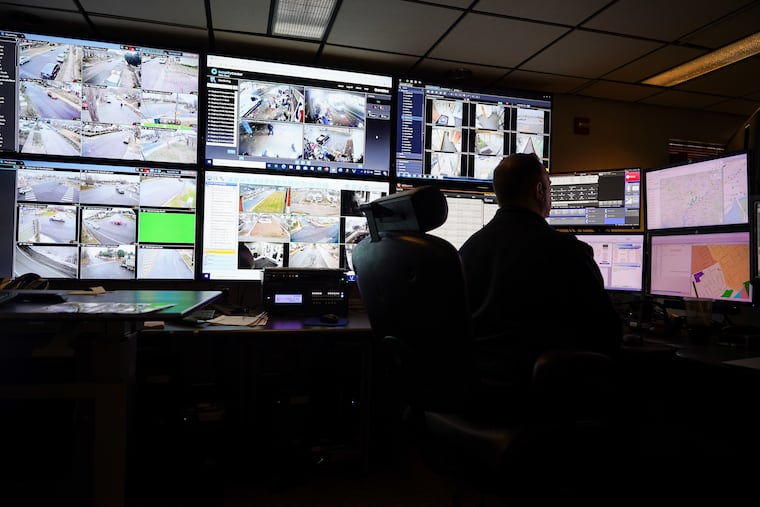
Castellano said the upgrade has allowed his department to build a real-time map of officers’ locations, which has already helped agencies dispatch backup to officers in need of assistance.
The county has also implemented Phoenix by Honeywell, an automated voice dispatch system for fire and EMS personnel. Previously, dispatchers would manually alert fire and EMS units of an emergency and have to wait for paging tones to be completed. During that time, dispatchers were not available to respond to radio traffic from first responders in the field. Now, an automated voice handles the alert function, which Castellano said has shaved the dispatching time from 60-80 seconds to 20 seconds.

Inquirer Greater Media
This suburban content is produced with support from the Leslie Miller and Richard Worley Foundation and The Lenfest Institute for Journalism. Editorial content is created independently of the project donors. Gifts to support The Inquirer’s high-impact journalism can be made at inquirer.com/donate. A list of Lenfest Institute donors can be found at lenfestinstitute.org/supporters.