A developer is seeking to expand its proposed data center in East Whiteland
The developer is asking to increase the footprint of the buildings to 1.6 million square feet, amid a broad pushback from residents.
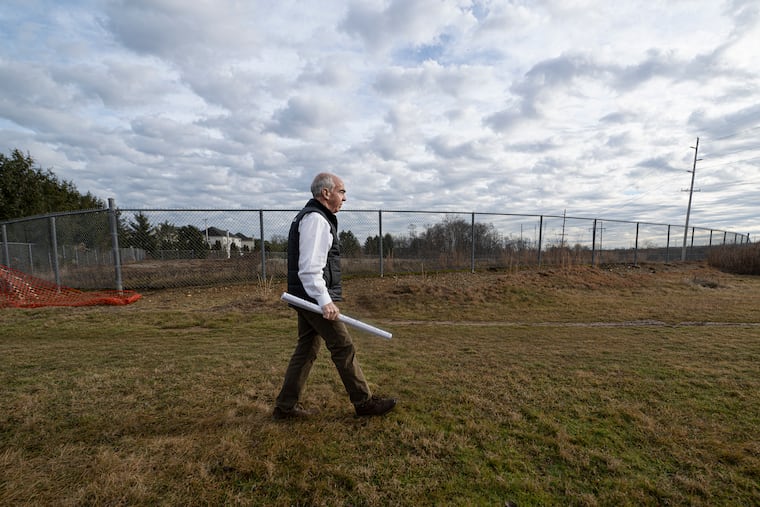
A developer wants to increase the size of its proposed data center on a remediated Superfund site in East Whiteland Township, stoking ire from nearby residents who worry about the increased scope stressing the power grid and driving up costs, along with environmental and health risks.
The facility — which would exceed 1.6 million square feet in the amended plan —would sit on roughly 100 acres at 13 S. Bacton Hill Rd., located along the boundary line for East and West Whiteland Townships, and near U.S. Route 202.
The amended plan, brought before the township’s planning commission Wednesday, would increase the size of the two data center buildings by roughly 61% from what was previously approved.
Other changes in the new plan include:
Scrapping two microwave towers, antenna yards, and ground-mounted cooling towers
Relocating office and loading facilities to face Swedesford Road
Redesigning cooling equipment to use waterless chillers instead of water-consuming cooling towers, reducing water use by about 3 million gallons per day
The applicants are asking the planning commission to approve the modifications because the currently approved plan is outdated, in both technology capacity and what occupants of such centers would need, said Josh Rabina, principal for Sentinel Data Centers, who is working with Green Fig Land LLC on the project.
The planning commission had approved the original plan in 2024, but the project has been underway since at least 2018, when the developer sought zoning changes to OK data center use. After the planning commission’s approval in 2024, Sentinel joined the project, and suggested changes to address water and energy consumption, said Lou Colagreco, the attorney for the applicant.
“They just looked at it with a different set of eyes, and they said, ‘First plan works; this plan probably works better,’” Colagreco told the commission. “It addresses certain concerns that we have heard about regarding data centers.”
But nearly an hour and a half of public comment showed that residents’ concerns weren’t assuaged by the proposed new plan.
“My head’s spinning with what’s going on here. I think you guys are way out over your skis here with what you should be asking, and there’s a lot that appears to me that you don’t even know you should be asking,” said one resident, Dean Prescott.
Across the county — and the region — data center projects have been met with scrutiny from the people who will reside near them. Their opposition clashes with Democratic Gov. Josh Shapiro, who has been championing data center development, promoting a 10-year plan that includes cutting regulatory “red tape” to make it easier to approve them. The governor’s office also recently announced Amazon would spend $20 billion to develop data centers and other artificial-intelligence campuses across Pennsylvania.
Despite the enthusiasm at the state level, 42% of Pennsylvania say they would oppose the centers being built in their area, according to a recent survey.
And it’s creating a bind for local officials, who are limited in what they can do to prohibit development in areas that are zoned for such purposes.
Residents in nearby East Vincent, also in Chester County, are pressing hard on their board of supervisors to reject a proposed data center at the historic Pennhurst State School and Hospital. The board there had sought to impose restrictions on data centers, but last month declined to move forward with an ordinance after the township’s solicitor warned it could lead to a challenge from the developer.
In East Whiteland, as residents called on officials to reject the plan, township solicitor Michael Gill warned it wasn’t that simple.
“This property is zoned to allow a data center use,” Gill said. “From a perspective of sheer outright denial of the use, that is not likely something that the township has the authority to do at this point in time. Nor did the township ever have the opportunity or the legal right to completely say, ‘We do not want data centers at all in East Whiteland Township.’”
The proposed data center would be located at a former limestone mining site that eventually became a lithium ore-processing business called the Foote Mineral Co., which closed in 1991. A Superfund cleanup was completed in 2010.
It is slated to sit across from Malvern Hunt, a neighborhood with about 280 homes and would be intersected by the Chester Valley Trail, a 18.6-mile route popular with walkers, cyclists, and runners.
Residents worried about the noise, the safety of their well water, and whether digging at a remediated site could adversely affect health. They also raised concerns about the stress — and cost — the facility could put on the power grid.
The facility would be adjacent to Peco’s Planebrook substation, and the developer is paying for the upgrades needed to support the project, they said Wednesday. Peco officials said previously that surrounding customers wouldn’t see any impact.
The developers sidestepped questions about resident utility cost increases. The township’s planning director, Zachary Barner, said they had not seen “any sort of detailed analysis of consumer prices or anything like that.”
Chris Fontana, a Wakefield resident who said he works in software and infrastructure engineering leadership at Zillow, the real estate website, said industrial noise, massive infrastructure, and energy demands make buyers hesitate, affecting home values.
“Any tax benefit does not outweigh the permanent impact on our land, the strain on local utilities infrastructure, and the risk to the value of our homes, the single biggest investment most families here will ever make,” he said.
The developer will submit a revised plan and responses to consultant review letters in the coming days, township officials said. The developer will return to the planning commission next month, seeking a positive recommendation from the planning commission to go forward to the township’s board of supervisors.

Want to get Inquirer Chester County straight to your inbox every week? Sign up here for our guide to the news, stories, and events shaping life in your community.