A deteriorating West Goshen house is at the center of a preservation fight
The privately owned house is at the center of residents’ desires to spotlight under-told history and preserve open land in the county.
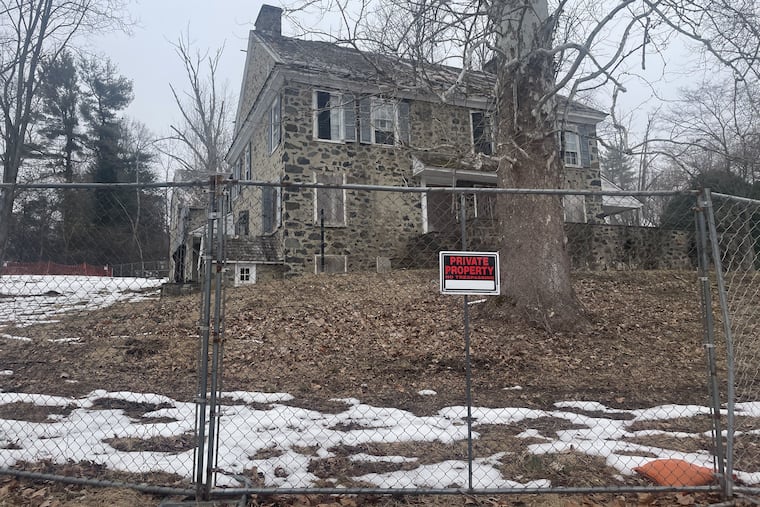
Posts online beckoned urban explorers to creep through a century-old West Goshen home that has sat empty and deteriorating for more than two decades. Police have frequented the property — responding to sounds of gunshots, or finding the doors open, but halting their searches, worried the floor might collapse.
The once-impressive three-story fieldstone house, with its private bridge and stonemason barn, has become something of an “attractive nuisance,” as a court document says, and a safety threat as it deteriorates.
After the township intervened, the future of the privately owned property at 905 Westtown Rd. is now in the hands of a judge, who will weigh whether the property can be restored or if it ought to be demolished.
But a group of residents fear losing the house, even in its much-diminished state, and have launched an effort to save the property. The hope is to halt possible development and instead turn it into a heritage center that would educate visitors on Chester County’s Quaker history and its roots to the Underground Railroad.
It’s one example of a broader push and pull in Chester County, where residents want to preserve open space and history, and hold off development. But with privately owned land, especially land that is not protected for being historic, municipal officials can only do so much.
“It’s a beautiful place. When you spend some time there, it’s like a window through time,” said Stephen Lyons, who is leading the preservation group Save Forsythe Farm, an unofficial name for the property derived from John Forsythe, who lived from 1754 to 1840, eventually owning the land and helping establish Westtown School.
“It has a spirit of beauty,” he said.
After sitting vacant for 20 years, the house has rotted from the inside
The home was built more than a century ago — a structural engineer’s report puts it at 1900, a datestone on the property indicates 1818, and others suggest it may be older.
The property, purchased by Joseph Kravitz in 2003, has descended into disrepair in the last two decades. Kravitz was found to have violated property maintenance codes in recent years. The property went into foreclosure and was listed for sheriff’s sale several times.
But in September, with the property still owned by Kravitz, West Goshen officials submitted a 350-page petition to Chester County Court seeking conservatorship, arguing the house was neglected and in need of substantial rehabilitation.
A judge approved the petition in November and appointed BDP Impact Real Estate as the conservator, which was tasked with creating a plan for abatement. Its final report will be heard in court on March 16, and the judge will determine what path should be followed. To retain ownership, Kravitz can reimburse the conservator and pay a fee, township officials said.
Kravitz did not respond to phone calls or an email seeking comment.
Under the conservatorship, a fence was placed to fend off explorers, and a structural engineer was brought in to assess the structures on the property. The engineer would not go beyond the front door of the house, out of fear of falling through the floor.
But without going inside, the engineer found significant interior deterioration from a leaking roof, according to the report. Plaster, which once covered the ceilings, had rotted, fallen, and created mounds on the floor, revealing the skeletal wooden beams. The gutters have been disconnected, with water saturating the soil near the foundation. Cracks were seen on some windows.
An in-ground swimming pool had “substantial” algae growth. A pool equipment shed was distorted. And a masonry barn structure was “in a state of impending collapse.”
A single-lane bridge, allowing access from Westtown Road across a creek, is “not suitable for permanent use without repair or reconstruction.”
When township solicitor Carl Ewald visited the property with the structural engineer in November, he mistook the swimming pool for a murky patch of grass.
“It’s a very unfortunate situation, because I was able to find online pictures of this property from 20-some years ago, when it last went up for sale, and it was a really nice property back then,” he said.
Along with an estimated $171,730 to install a temporary bridge to ferry equipment to the property, it would cost roughly $121,600 to demolish the main house, the conservator estimated.
The estimated cost of rehabilitation was much higher: $1.2 million. Under that plan, the masonry walls would have to be stabilized and retained, and the interior fully gutted.
It is unclear whether that is feasible and where the money would come from, Ewald said.
“The court will be looking at that and determining whether that’s something that could be done, or whether demolition is the only real option,” he said.
He thinks people might not realize how far gone the property is.
“It’s unbelievable how fast water penetration into a structure really damages it, and how a house like this that stood for many years and, in 20 years, was really reduced to a shell,” Ewald said.
The ability to ‘synthesize all these histories’
With such a difficult path ahead, why not let the property go?
For residents, it represents the region’s deep historical ties, and it offers the potential for preserving open space.
Lyons grew up one mile away from the area. After living in New York as a musician and actor, he returned during the height of the COVID-19 pandemic to care for his parents, and Lyons became immersed in learning about the history of West Goshen, and the abolitionist and Quaker histories entrenched in the community.
The goal for Save Forsythe Farm would be to create an open space that connects to the nearby Barker Park. In the group’s vision, the home would become a historic site that teaches about abolition, Black history, civil rights history, Quaker history, and more.
“Forsythe Farm has a tremendous potential to synthesize all these histories and our connection to land and also First Nations people as well,” Lyons said.
But this experience has prompted a proposed ordinance to address how demolition by neglect is handled amid private property rights, which the township’s board of supervisors and historic commission are set to discuss Thursday.
Still, the hope is to keep the house from being demolished, said Brittany Schugsta, vice chair of the Save Forsythe Farm group. Her family once tried to buy the property, but ended up in East Goshen.
“When I lived in West Goshen … it felt much more convenient. There was all the shopping hubs and all of those kind of places around, but it lacked that richness of history,” she said.
If the owner does not reimburse the conservator, the property would be sold by the court to the highest bidder, Ewald said. The money would pay off the liens, debts, and the conservatorship. Any money left over would go to Kravitz.
The township could buy the property, if officials are willing to spend a couple of million dollars “at minimum,” Ewald said. But it is not yet clear how much the property would cost, or if officials would want to purchase it.
The house is something of a symbol of the past, said Bill Aaronson. He can see 905 Westtown from his front porch on Bob-O-Link Lane, where he has lived since the 1980s. He watched the home sell. He didn’t think much about it, until his son took a stroll and saw how much it had declined.
And then he heard what it could become: a development.
Speaking at a historical commission meeting last year, Kravitz said he envisioned several draftsman-style houses, called “Forsythe’s Homes” or “Barkerville.”
(Though Kravitz has discussed his intentions previously, township officials said no plans had been submitted or were under review.)
The concept prompted Aaronson to become more involved with Save Forsythe Farm.
“The house itself is an extraordinary presence, and it symbolizes what the history here was, more than a plaque ever would,” Aaronson said.

Want to get Inquirer Chester County straight to your inbox every week? Sign up here for our guide to the news, stories, and events shaping life in your community.