A former industrial site making up 10% of Kennett Square could become housing — after it’s decontaminated
Some residents are worried the long-vacant industrial site won’t be safe for development. Federal and state officials shared their process.
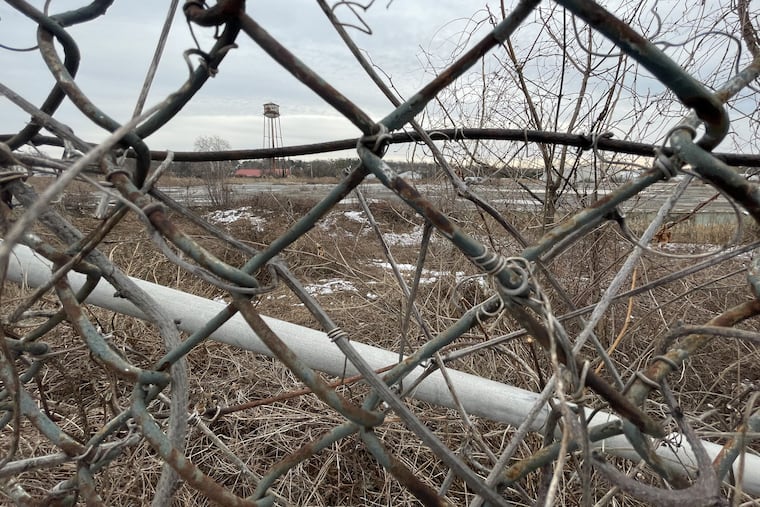
One of Kennett Square’s last remaining sizable undeveloped parcels could get hundreds of townhomes and apartments — once contamination cleanup of a former industrial site passes muster.
But even with the OK from state and federal environmental officials, it would be years — and require more sign-offs at the municipal level — before the developer eyeing a residential complex at the former National Vulcanized Fiber site could break ground.
And the site’s owners face headwinds beyond the governmental approval, as some borough residents worry that the site is not safe for homes.
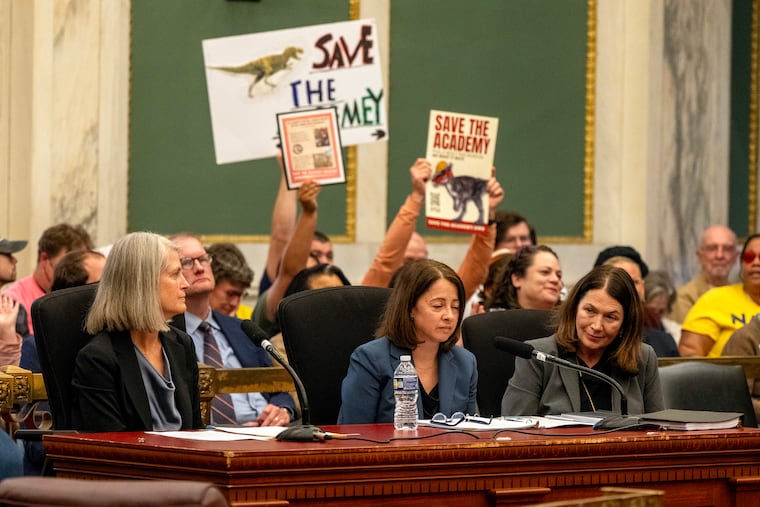
Officials from the U.S. Environmental Protection Agency and the Pennsylvania Department of Environmental Protection, agencies that have to ultimately green-light the land as safe for people to live on, sought to assuage those concerns Tuesday during a town hall that explained the processes for cleanup and the standards the developer would have to meet for any homes to be built.
It was the latest update regarding a proposed residential complex that would feature 246 townhomes and 48 apartments, located at the 22-acre lot on 400 W. Mulberry St., not far from the historic district of the borough, on a plot of land that has languished for almost 20 years.
It’s one of the largest untouched parcels in the borough, making up at least 10% of Kennett Square, which is one square mile. Developers project the residential complex would increase the population of the 7,000-person borough by 15%.
The site, which housed National Vulcanized Fiber from the late 1890s until it shut down in 2007, was purchased by its current owner in 2009 and has been the subject of cleanup efforts for more than a decade after the land was found to be contaminated with so-called forever chemicals.
“It feels like the cart was put before the horse for the public,” one resident, Sarah Hardin, said during Tuesday’s meeting. “I think it’s the fact that we’re all feeling like this was guns a-blazing forward, and we would like to know that all the proper environmental steps are taken.”
What’s the history of the site?
For more than 100 years, National Vulcanized Fiber ran operations on the property, creating a slew of products with vulcanized fiber — a durable, flexible, lightweight plastic-like material that was used to make anything from trash cans to computer circuit boards.
Production of those items led to contamination of the site; polychlorinated biphenyls (PCBs) were identified in the 1980s, after contamination spread into Red Clay Creek. That prompted the EPA to become involved, said Amanda Michel, the agency’s PCB coordinator for the region.
The chemicals are probable carcinogens, linked to liver and breast cancer, melanoma, and non-Hodgkin lymphoma. The chemical is also associated with birth defects, developmental delays, and immune system dysfunction.
Remediation began after the chemicals were found in the 1980s, and NVF folded in 2007. Rockhopper LLC purchased the property two years later and began cleaning the site, eyeing future residential development.
Along with the federal cleanup, in 2010 the owners began a voluntary state cleanup process — which is aimed at redeveloping contaminated, vacant, and unused parcels into productive uses — to target the other chemicals found on the site.
In both cases, the owners have to demonstrate, through sample testing, that contamination has been lowered to a threshold acceptable for human health or that they have the proper barriers in place to prevent exposure.
“Until that happens, there will not be a residential occupant at this property,” said Jonathan Spergel, an environmental lawyer representing Rockhopper.
What is the developer proposing?
Under the proposed development, the property would have 104 stacked and 38 unstacked townhomes, along with 48 one-, two-, and three-bedroom apartments. The owners said the project would comprise affordable and market-value units. A proposed rezoning ordinance would require 15% of the homes to be affordable.
That component was critical for Kennett Square officials, Mayor Matt Fetick said in an interview last week.
“It’s our best opportunity to have an affordable component,” he said.
Alongside those homes, the property would have roughly 732 parking spaces, and 50 would be added to Mulberry Street.
To offset feared bottlenecks, the property’s proposed plan would have five driveways to distribute traffic flow.
The site’s developers estimate that the property would bring in $382,000 for the borough and more than $830,000 for the school district each year.
Another portion of the site serves as a baseball field at the high school, and no further development is planned there, the property’s owners said in 2024.
The project is helmed by Rockhopper LLC, which is led by two development firms, Delaware Valley Development Corp. and Catalyst City. They brought in Lennar, a home-building company, in 2021. Lennar has done at least two similar projects, remediating industrial lots in Phoenixville and in Bridgeport for residential use, a representative said previously.
What are residents’ concerns?
On Tuesday, residents shared stories of loved ones who lived near the site who have been diagnosed with cancer. They worried that the developer could skew data to move the project forward. They wondered why there had been no urgency to clean it up before.
Officials said the developer has to work with an independent environmental professional and their agencies had been on site throughout the cleanup process.
Corey Barber, who lived near the site for 20 years and moved out of the area after her cancer diagnosis in 2021, worried what construction on the site would bring.
“People are going to believe that they’re going to get cancer from the dust kicking up,” she said.
Charla Watson, who lives right by the property, said there was distrust because the community has not seen the work the developer says is happening.
“It’s just been a wasteland,” she said. “Everything looks the same the day they moved out of there.”
What comes next?
The developer is going through two processes simultaneously. As it cleans up the property to get the necessary state and federal approvals for residential development, it is also working at the municipal level for the land to be rezoned so it can build the residences.
The borough is advertising a change to the ordinance that would rezone the land.
If the ordinance is approved, the developer could formally start developing the land — which would come with at least another year of planning and meetings.

Want to get Inquirer Chester County straight to your inbox every week? Sign up here for our guide to the news, stories, and events shaping life in your community.
This suburban content is produced with support from the Leslie Miller and Richard Worley Foundation and The Lenfest Institute for Journalism. Editorial content is created independently of the project donors. Gifts to support The Inquirer’s high-impact journalism can be made at inquirer.com/donate. A list of Lenfest Institute donors can be found at lenfestinstitute.org/supporters.