Stewards of Philly’s vacant lots are organizing against developers to secure long-tended land
They launched the Philadelphia Land Stewards Union on Saturday in North Philadelphia and are seeking more authority to purchase lots from the city's Land Bank.
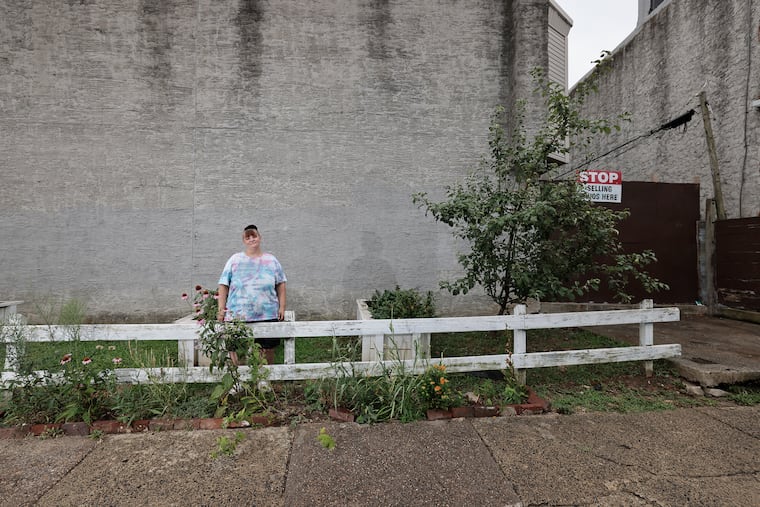
After her neighbor’s home fell into disrepair and was demolished in the 1990s, Debbie Johnson took care of the vacant lot adjoining her own Nicetown property for decades. She turned the space into a garden, she said, and soon it became a space for her family and neighborhood to flourish.
Johnson’s daughter and brother-in-law held wedding services on the lot, and the family organized Easter egg hunts and fish fries and planted vegetables for neighbors to enjoy.
But in November, Johnson learned the plot had been sold.
The now-deceased owner’s daughter purchased it from the city for $9,000, Johnson said, and the woman told Johnson she planned to sell the plot to a housing developer.
“I was devastated and hurt, and I still am,” Johnson said. “All of my 35 years of investment, dedication, and love for this lot is gone.”
Now Johnson hopes a new organization for Philadelphians like her — those who steward some of the city’s thousands of vacant lots — will offer protections for those who want to keep these properties in local hands.
Dozens of lot stewards and their supporters gathered in a North Philadelphia recreation hall on Saturday to launch what they call the Philadelphia Land Stewards Union. The group, formed from Kensington’s Iglesias Gardens movement, says over 80 members have joined so far.
In a city with an estimated 40,000 vacant lots, many in low-income and majority non-white neighborhoods, representatives for the Land Stewards Union say they’re bringing together those who wish to protect properties from “predatory developers” building houses they say neighbors can’t afford.
About one-third of vacant lots in the city are stewarded by Philadelphians, according to the group’s estimate. But most stewards do not legally own the properties they tend to.
The city’s Land Bank owns lots of these properties, or has the power to purchase them. Many of the parcels have liens and can be sold at a sheriff’s sale unexpectedly.
The Land Stewards Union has several goals: for the city to recognize the organization, for more transparency and accountability from the Land Bank, and for those who steward or live near vacant lots to get priority over developers to purchase them.
Dominique Johnson, who lives in North Philadelphia and is not related to Debbie Johnson, said he struggled to purchase a lot he tended to for decades.
Johnson, 36, and his family members have long tended to the vacant “side yard,” he said, picking up trash, spraying weed killer, and cutting overgrown grass — even though the city owned the property.
In 2019, Johnson tried to purchase it through the Land Bank, he said, but the process never moved forward.
Just this month, he said, he learned it had been sold to developers for housing.
“I am not against affordable housing — as long as it is affordable — and I’m not saying these homes shouldn’t be built,” Johnson said. “But if someone like me has a stake in these vacant spaces, allow me the opportunity to fight for it.”
That tension was evident during Saturday’s gathering.
Many speakers said they, too, supported affordable housing in the city. But they shared a skepticism that the homes being built on the yards they tended to would be priced at market rate, which they say most neighbors couldn’t afford.
Quetcy Lozada, the city councilperson for the 7th District, told Land Stewards Union members that she backed their cause. A representative of Mayor Cherelle L. Parker also dropped by and said land stewards had the support of the mayor’s office.
“My grandmom took care of community gardens for most of my life,” Lozada told union members. “She raised most of my family members, my children included, in her garden space.”
Lozada said she had seen firsthand an uptick of developers purchasing stewarded lots in her district, which includes Kensington and other River Wards neighborhoods.
The Council member said she supports rejecting unsolicited applications for housing projects on lots in her district if the projects did not have community support.
“We need housing,” she said, “but we don’t need housing that takes away land that others have been investing in for many, many, many years.”
