An iconic Jersey Shore amusement park wheel is being restored and reconstructed in Phoenixville
The Phoenix Wheel predates the patent for the Ferris wheel and was constructed in Chester County.
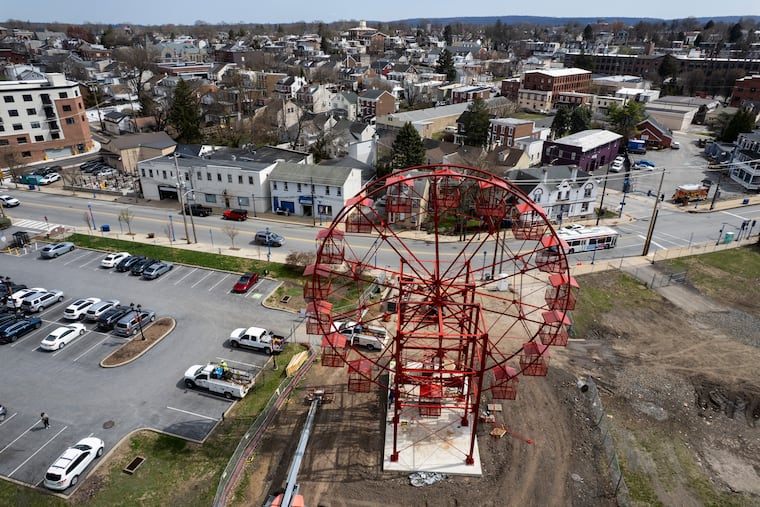
A historic amusement park wheel will rise once more in Phoenixville this spring, again becoming a hulking skyline fixture decades after it first was taken down from its original home in New Jersey.
It is the culminating effort of decades of work, after the 133-year-old wheel — the oldest of its kind, restorers say — has lain dormant in scattered pieces since the late 1990s.
The Phoenix Wheel predates the patent for the Ferris wheel, drawing its lineage back to 1893, when it was originally crafted by steelworkers in Phoenixville as an amusement park ride that carried passengers up and around.
But it was nearly a hundred miles away in Asbury Park, N.J., that the wheel would become an iconic fixture. It has graced postcards, been a focal point on posters, and even aided in the trading of war tactics during World War II. And, yes, it’s also in the background of photographs of Bruce Springsteen from 1979.
The 78-foot-high, 68-foot-wide wheel stood on the Jersey Shore for nearly a century, until it was taken down in 1988. It was disassembled and moved to another amusement park in Mississippi, where it operated for another decade, before it returned back to the Garden State, unused and untouched for another 10 years, said Mike Kajak, a board member for the Schuylkill River Heritage Center, the organization that is bringing the wheel home to Phoenixville.
The wheel is quickly taking shape in Phoenixville. The support frames are up, and the wheel will likely be in place by April, with a ribbon cutting scheduled for early June. (Springsteen will donate a series of signed posters of his 1973 record Greetings from Asbury Park, N.J.)
The wheel will sit adjacent to borough hall on Bridge Street. The heritage center secured a $750,000 state grant plus donations and estimates the total cost of the project to be around $2.2 million. The center is splitting the cost 50-50 with the borough. The wheel ultimately won’t be rideable or oscillating — just acting as a sculpture — due to cost (which would have doubled). A ride feature could be added down the road, Kajak said, with enough funding and added safety measures.
The wheel’s base will be surrounded by glass fencing. It will be illuminated, and signage around it will reveal its long history and recognize the support of donors.
“I think it’s a big focal point in the town,” Kajak said. “It’s going to be huge.”
The center is still fundraising for the remaining roughly $800,000 for the current project.
But after years of the project stagnating, it has been incredible to see it take shape, Kajak said.
“I saw the tower go up [recently]. I was driving my car through town; I immediately did a 180,” Kajak said. “I was stopped dead in my tracks. I had chills coming up the back of my neck. I just remember how that felt.”
Nearly two decades ago, in 2008, the center’s president, Barbara Cohen, acquired the wheel for $50,000 from an “Asbury Park obsessor,” Kajak said. Cohen secured a land easement near the Phoenixville Foundry, where the wheel was originally constructed back in the 1890s. But the project then stalled in 2012, when the location was no longer viable. The dismantled wheel stayed that way, languishing at the University of Valley Forge in Phoenixville for nearly 20 years.
In one of the first meetings Kajak attended as a new member of the center, the subject of the wheel came up. It caught his attention.
“I was like, ‘Do you guys still have that?’” he said.
And so the wheel resurfaced once more.

Want to get Inquirer Chester County straight to your inbox every week? Sign up here for our guide to the news, stories, and events shaping life in your community.
Enter: Gern Jaeger, the owner of Specialty Metals Welding and Fabrication. Jaeger had worked with Cohen on a previous project, making a small sculpture of a bridge from an old product that the Foundry used to make: the Phoenix Column, a proprietary product that ultimately altered construction. It endeared him to Cohen.
“When Barbara said, ‘Do you think you can restore the world’s oldest Ferris wheel?’ I was like, ‘Absolutely,’” he said. “I said it with confidence. In my head, I was like, ‘Oh, boy. What am I saying?’ It’s a challenge. I thrive on it.”
So Jaeger worked with local engineer Tom Zeigler to reverse-engineer the wheel.
First, they needed to collect it, though. Kajak and Jaeger drove around Phoenixville and Schuylkill Township, collecting pieces of the project from where they had rested for decades, including the 16 passenger baskets that were, at one point, restored, but in the years since, had taken more damage.
The pieces arrived at Jaeger’s facility roughly two years ago, where it was “basically a twisted pile,” he said.
“There was a lot of stuff bent, a lot of stuff broken when they took it down,” he said. “We took it all apart, every piece by piece, and we assembled it in my shop.”
It took a lot of time, measuring it, figuring out what was missing that had to be replaced. Any additional steel needed for the restoration of the project was 100% U.S. steel. Over time, they reconstructed the wheel in Jaeger’s shop.
It’s a step outside for Jaeger, who, in his day-to-day work, makes stairs and railings at apartment buildings. But he sees it as a tribute to the community, and the men of the Foundry, which draws its lineage back to the 1700s, where its workers made nails after the Revolutionary War. Later, it would birth the Phoenix Column.
Jaeger recalls one of the last men who worked at the Foundry, which closed in the late 1980s. He used to come to Jaeger’s shop just to see sparks flying.
“The pride they had just from the products they made in the mill resonates because I’m in the steel industry,” he said. “For me, [it’s giving] back something that’s a tribute to some of the men that did it. I even tell my men, if we had to do what the men did in 1890, I don’t know if we could do what they do. We’re not tough enough.”
The products the men made lasted a lifetime, Kajak said — and this wheel has touched many lives over decades.
When NJ.com covered the wheel’s restoration, Kajak got handwritten letters from seniors who remembered riding the wheel at the Shore in the ’40s, wanting to donate to the project.
“A lot of people have memories of this wheel,” he said. “It’s got a big root system in Pennsylvania, and New Jersey.”
This suburban content is produced with support from the Leslie Miller and Richard Worley Foundation and The Lenfest Institute for Journalism. Editorial content is created independently of the project donors. Gifts to support The Inquirer’s high-impact journalism can be made at inquirer.com/donate. A list of Lenfest Institute donors can be found at lenfestinstitute.org/supporters.