Not just a Gobble Wobble: How a Montco amputee hopes to use a 1-mile walk to qualify for a running blade prosthetic
Amputees have to "qualify" for a better class of prosthetics. With the help of her local YMCA, this Montco mom hopes to build her case for a running blade prosthetic at her local Gobble Wobble.
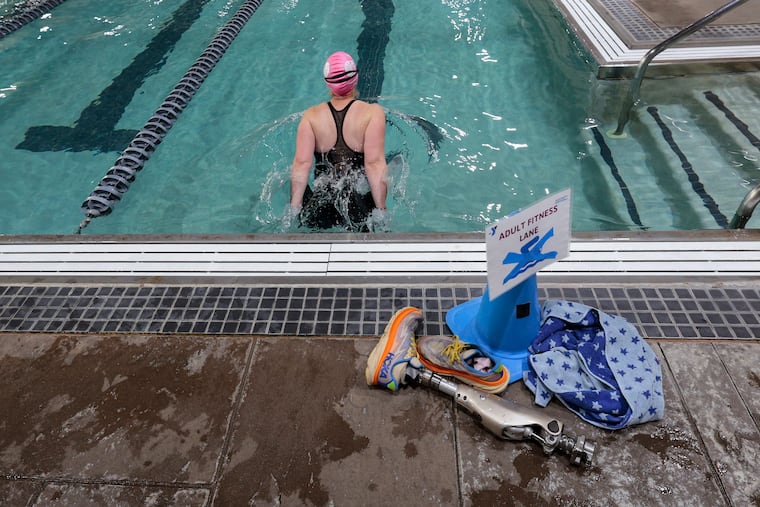
Stephanie Dunn, who at first introduction has the warm disposition and positivity of someone who has never had a bad day, will tell you that a life-threatening, flesh-eating infection in her foot and the subsequent amputation of her left leg are not the hardest challenges she’s had in life.
That distinction she reserves for motherhood.
But the recovery from the mysterious illness that struck Dunn in September 2022 has had its share of brutal moments.
Through the near-death experience, the onslaught of medical bills, and coming to terms with the fact that some aspects of her life would never be the same, the 52-year-old Schwenksville mom has worked to become as mobile as feasibly possible.
In a matter of years, she has upgraded to a prosthetic meant for high-impact use and more mobile amputees. It’s a cumbersome process that involves proving to insurers the patient is active enough to qualify for the prosthetics that offer a broader range of motion and shock absorption. Amputee forums are filled with stories of red tape and insurance rejections, telling patients the advanced prosthetics are not “medically necessary.”
“If I didn’t have two kids, I don’t know if I would have pushed myself to do it,” she said of the daily workout routines she has adopted in the years since her amputation. “I knew I had a responsibility to them and you can’t give up.”
This Thanksgiving, Dunn, who never considered herself athletic before she lost her limb, hopes to put her current prosthetic to the test, walking in her local Gobble Wobble.
Hosted by the Greater Philadelphia YMCA, the Spring Valley event offers a 5k event and a mile walk. For her first Gobble Wobble with a prosthetic, in 2023, Dunn cut some sections of the walk. Last year, she finished the loop but came in last. Dunn believes she can beat that performance this year. She also hopes it will serve as a milestone on her way to an even more ambitious goal: qualifying for a running blade along with a grant to pay for it.
And while Dunn doesn’t see herself as an amputee advocate or role model — she reserves that designation, perhaps incorrectly, to the “super-fit people out there running marathons” — she hopes her story will let people in similar situations know the journey to mobility is hard but possible with the right support system.
This year’s Gobble Wobble is as much of a personal test for Dunn as it is a bit of an ode to the wheelchair-accessible Spring Valley YMCA, which has been a lifeline and refuge in the years following her amputation.
“When [the amputation] first happened, I thought, ‘Oh, my God, I’m on the periphery of society now. I’ll never be able to do anything normal,’” she said, remembering how she avoided grocery stores at first. “But I did. I could come here.”
The challenges facing America’s growing number of amputees
More than 2 million Americans live with limb loss, according to a 2024 study partially funded by the nonprofit Amputee Coalition. The reasons behind amputations vary. Johns Hopkins Medicine reports that about 45% of limb loss occurs after a traumatic injury, such as a car crash. Other people lose limbs amid complications from diabetes, gangrene, cancer, or blood vessel diseases.
For Dunn, a throbbing left foot and waves of bile vomit ended up being necrotizing fasciitis, source unknown.
The flesh-eating bacteria gnawed away at her limb in a matter of days, led to sepsis, and nearly reached her chest. Dunn said the amputation saved her life.
Yet there is much more to an amputation than the operation itself.
The Amputee Coalition says 36% of people living with limb loss experience depression. Many find themselves physically unable to return to demanding jobs that require fast movement or heavy lifting. Dunn, who had been a speech pathologist for 19 years, has come to terms that she cannot do the job full-time without risking an injury, even with her prosthetic.
And while a Government Accountability Office report expects the number of people living with limb loss to double by 2050, online forums remain full of people looking for advice on how to get their insurers to pay for prosthetics that will help with mobility.
Dunn’s experience navigating healthcare is only a snapshot of the challenges facing amputees.
After the amputation, she faced a growing mountain of medical bills and paperwork. As Dunn managed pain and the care of her two young children, she had to go from her home in Schwenksville, Montgomery County, to South Philly to “prove” she had actually had her limb amputated in order to apply for disability benefits.
Then there was the process of qualifying for a prosthetic.
The most basic below-the-knee prosthetics cost $3,000. There is no secondhand market because each is molded to the person. Even so, as limbs naturally change size and swell or contract throughout the day, users will have to adjust. It’s why amputees sometimes stuff socks in their prosthetics.
The more advanced prosthetics provide more mobility but easily run into the tens of thousands of dollars. Private insurance runs the gamut in terms of coverage, with many amputees reporting better luck through Medicare or Medicaid. But going with public insurance comes with other considerations, such as income limits.
“You can’t financially get ahead at all,” said Dunn, who was making a six-figure salary before her amputation. “You can just barely make ends meet.”
In the early post-op days, Dunn said, lying in bed and sitting in a chair were her biggest temptations — they often are for recent amputees. But skipping the at-home workouts assigned by her physical therapist risked muscle spasms and stiff muscles in the remaining part of the limb. To lose flexibility in the limb makes it harder to move with a prosthetic.
Determined to become mobile, Dunn headed to her local Y branch.
A gym offers refuge and resources
To walk alongside Dunn at the Spring Valley Y is to accompany a minor celebrity. Dunn jokes that it’s the prosthetic leg, though that feels like she’s selling herself short. She is at the gym every day for anywhere between 30 minutes and three hours.
“You must’ve had a good night’s sleep,” shouts a lifeguard taking his perch after Dunn completed several laps in the pool. One of the many greetings thrown over the hum of the pool machinery.
Part of the Greater Philadelphia YMCA, the Spring Valley branch was familiar to Dunn before her injury because of the programming her children took part in, which only became more important during her two-month stay at the hospital.
The children participated in the branch’s before- and after-school care, which Dunn credits with giving the boys a routine as she regained her strength.
But the facility was also primed to aid in her recovery in small ways that added up.
Before Dunn renovated her bathroom to be wheelchair-accessible, the Spring Valley Y was the only place she could shower.
Soon, Dunn was navigating the gym equipment and pool. She could park her wheelchair along the pool’s edge and get in the water, where she enjoyed what she described as a weightlessness.
Dunn still had days when she cried in the parking lot or the bathroom, but she kept coming to get on the sit-up machines and for the aquatic dance classes. Not once did she feel out of place, she said.
The mental boosts served to buoy her physical gains and vice versa. It’s a rhythm she longs for other amputees to find.
“I maintained the range of motion in my limb, so that when I did get measured for a prosthetic to see what kind of prosthetic I could qualify for, as far as insurance and what I could use … I got a higher-level prosthetic than if I hadn’t come here,” she said.
That said, a robust support network or gym can’t fix the healthcare system, and Dunn continues to navigate the logistics of getting the prosthetics she needs to live the life she wants with her children.
Dunn said she had to travel to New York City in order to get a one-step procedure that would allow a rod to be embedded in what is left of her femur. Approvals took six months.
And even as Dunn gets more comfortable with her prosthetic, there is tweaking to be done. She has been dealing with pain that is constantly in the background.
Still, Dunn characterizes these as small bumps along the way, as she does with many of the challenges she has navigated postamputation.
She said going through fertility treatments to have her boys and the quandaries of raising them as a single mom by choice weighed much more heavily on her.
Back then, when things felt particularly dire, she would tell herself: If at any time you want to stop, just stop.
In the case of her mobility journey, as with conception, Dunn has yet found a reason to call it.