A landfill shutdown in the 1980s has been leaking chemicals into Chester County well water. Residents will get a public water line next year.
In 2023, forever chemicals were uncovered at the Strasburg landfill in Newlin. Three years later, residents are getting filtration systems for their wells.
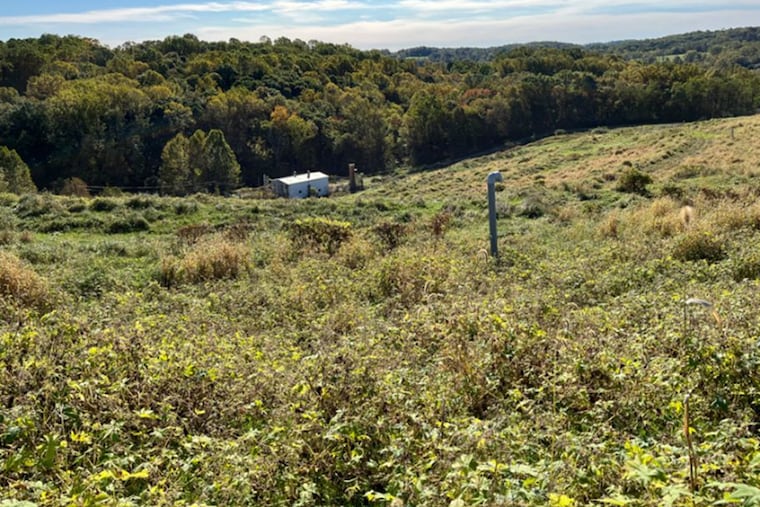
After a discovery roughly three years ago that probable carcinogenic chemicals were flowing from a former landfill to residential well water in Newlin and West Bradford Townships, more than a dozen households are eligible to receive water filtration systems this summer while a federal government agency constructs a public waterline to address the contamination.
It’s a step forward for the community, which has pressed the U.S. Environmental Protection Agency, the department overseeing the remediation of the contaminated landfill, to more quickly implement remedies as it works on a permanent solution, slated for completion in summer 2027.
“I’m happy that we’re getting the [filtration] system,” Chrissie Rissmiller, a resident whose well was found to have higher levels of contamination, said after a public meeting hosted by the EPA in Newlin on Thursday. “It’s taken a very long time for us to get to this point.”
The contamination stems from the Strasburg Landfill, a 209-acre Superfund site in Newlin, which accepted industrial waste for disposal after opening in 1978. The state required the landfill’s closure in 1984, after contaminants — such as leachate, a liquid that forms when waste buried in the landfill decomposes — were found seeping into the soil and groundwater.
» READ MORE: ‘Forever Fields’: How Pennsylvania became a dumping ground for discarded artificial turf
In the late 1980s, it was added to the National Priorities List, which hosts the most serious hazardous waste sites. Cleanup efforts conducted by the Pennsylvania Department of Environmental Protection continued into the late ’90s when a “no action” was issued, meaning it wasn’t believed to pose a threat to human safety because it had consistently low readings for contaminants, and the ground was capped and fenced off. It was eventually removed from the National Priorities List in 2019.
But, in 2023, the state’s routine quarterly sampling of the site uncovered that the leachate contained PFAS, colloquially called “forever chemicals.”
PFAS are probable carcinogens, linked to liver and breast cancer, melanoma, and non-Hodgkin lymphoma. The chemical is also associated with birth defects, developmental delays, and immune system dysfunction. There are multiple exposure routes: through skin, inhalation, and ingestion.
The EPA, which oversees the cleanup of sites contaminated with PFAS, tested well water from roughly 40 homes for contamination. The EPA sampled residential wells at least twice, between December 2023 and January 2024, and again in June 2024. Officials said Thursday they would be testing again as they prepare for the installation of water filtration systems.
About 14 were above the maximum contaminant level regarded as safe by the federal government and Pennsylvania. Those houses are scattershot: One house may have higher levels, and its neighbor may not.
It makes Erin Finnerty nervous. She wishes her home, where she’s lived for eight years, was eligible for the filtration system, too, even though it hasn’t been flagged as being contaminated.
“A couple of our neighbors, right next door, it’s affecting them,” she said. “So that makes me nervous, because I don’t feel like I’m getting tested enough at our house to see, ‘Oh, do you have it this month?’”
The EPA provided filter pitchers and bottled water to the affected homes, but residents argued it wasn’t enough — especially since it’s the water they bathe in and use to water their gardens.
With the residents’ pushback, the EPA will now be installing, maintaining, and, every three to six months, monitoring carbon filtration systems for affected homes. Officials said Thursday during an update meeting that the systems would likely be installed in June.
The filters — a “point of entry treatment system” — are connected to the water lines. Authorities will test the water upon installation, and return every few months to make sure no “breakthroughs” are occurring.
The federal agency will maintain the systems until the public waterline is installed, which will be serviced by Aqua PA. The waterline is in preliminary design stages, officials said. Construction will likely begin in March 2027, with digging starting that summer. Residents have begun receiving paperwork to “opt-in” to the line, and Thursday’s meeting was meant to assuage any concerns with doing so, as the homes have relied on well water for years. If they decide not to opt in, they will assume responsibility for maintaining the water filtration system connected to their wells.
Officials said 21 residents had opted in to the waterline so far, and expect more to do so.
Once the public waterline is installed, residents would be responsible for maintaining the water filtration system themselves, if they decide to keep it.
“Back in the ’80s and ’90s, we didn’t have the technology to test for PFAS, but it was there,” David Greaves, the EPA’s remedial project manager, told attendees Thursday. “Should there be, in another however many years, another emerging contaminant that pops up, you won’t have to deal with it, because you won’t be on that water anymore. This kind of future-proofs your water.”
For 20 years, Rissmiller’s family has lived in their house, drinking the water. When she looks at the timeline of the Strasburg site, she feels disgusted that none of it was disclosed when they bought their home.
“We went about our lives, like any family would, using the water. We have a garden that we water, where we eat our vegetables. Our pets drink the water,” she said. “It’s scary, especially the thought that we’ve been drinking it for 20 years, and our children, who are now adults, have been drinking it for 20 years, and we’re all at risk for cancer.”
» READ MORE: PFAS reporting has shown possible cancer links from athletes to firefighters
This suburban content is produced with support from the Leslie Miller and Richard Worley Foundation and The Lenfest Institute for Journalism. Editorial content is created independently of the project donors. Gifts to support The Inquirer’s high-impact journalism can be made at inquirer.com/donate. A list of Lenfest Institute donors can be found at lenfestinstitute.org/supporters.

Want to get Inquirer Chester County straight to your inbox every week? Sign up here for our guide to the news, stories, and events shaping life in your community.