West Chester restaurants faced permitting woes for outdoor dining this spring
As of Tuesday, 22 permits had been approved and seven were pending, borough officials said.
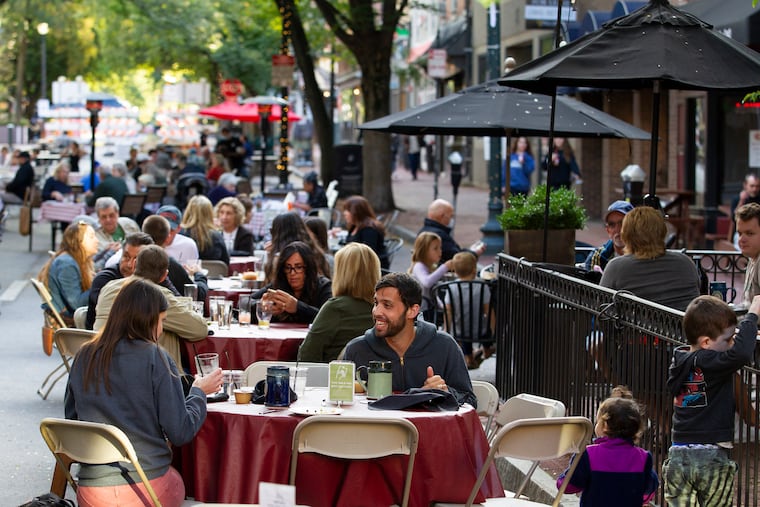
When the warm spring weather began to break through after a long frigid winter, restaurant owners in West Chester faced an unexpected hurdle: securing their outdoor dining permits.
A process that had previously been a relatively easy lift for restaurant owners became cumbersome and unclear after changes to the application, resulting in delays receiving permits, and costing them revenue during the first warm weather days when customers wanted to dine outside, they say.
“We get a wonderful day of weather, and the town is vibrant. It’s alive when people can sit outside. It looks great. We’re absolutely mobbed on these [days],” said Roberto Guadagnini, owner of the Italian restaurant Teca. “I think it was about four days of revenue that we were unable to be a part of here. And for us, that’s significant. Those are profitable dollars that weren’t there, that help pay the bills.”
The permits, which are issued annually by the borough, allow restaurant owners to use sidewalks outside their buildings for additional dining when the weather warms up. At Teca, it doubles the business, Guadagnini said. Owners can also use parking spaces, no more than two per block, to construct outdoor seating platforms.
Teca wasn’t the only spot that faced difficulty; more than 20 applications were caught up in the initial delays.
As of Tuesday, 22 permits have been issued to owners, with seating already showing up outside. Seven are still pending, the borough said.
The holdup came after restaurateurs and officials say that the borough tweaked its application process, requiring more information regarding disability accessibility than it had in years past.
And though business owners were made aware that changes were coming — and didn’t mind adhering to them — several said there was a communication breakdown over the required documentation. It ultimately affected nearly all of the permit applications initially received, said borough council member Brian McGinnis, who was contacted by a number of businesses over the issues.
“We need to do all we can to ensure that our restaurants are going to be thriving,” McGinnis said. “The main reason why a lot of people come to West Chester is because of our diverse restaurants that we offer.”
Many of the applications lacked adequate occupancy information when initially submitted, said Sean Metrick, the borough manager. The borough is awaiting more information from the applicants whose permits are still pending. One of those applications had been received Monday, Metrick said.
The borough said applications can be submitted at any time, but West Chester received most of its applications in March.
“We could have done a better job communicating that to the applicants ahead of time to avoid confusion,” he said in an email.
Adrian Manghisi, the manager for Teca, said the process was “night and day” compared with last year.
Where he could easily submit a few photos in recent years, this year he had to measure the square footage of every dining space. He was running around the restaurant, measuring and counting everything for 48 hours, he said. After the restaurant received a deficiency notice, he went back to the drawing board and resubmitted the materials.
When he didn’t hear back for nearly a month, he followed up and learned that none of the documentation came through correctly. It was frustrating to feel caught in limbo, he said. When they did receive the final approvals last week, a number of their tables in the floor plan had been struck through, meaning they cannot seat people in those spots.
Businesses’ applications have been processed at different times, leading to some restaurants getting the OK to put out their seating or start the construction of their outdoor platforms ahead of others.
“Our legs are sort of cut off when we can’t even compete,” Guadagnini said. “It’s impossible because no one wants to sit inside on these days. It’s a walking traffic town, and people love the people watching, love the ambiance, love the sort of European feel that it brings to the town.”
Next month, the borough will begin its open-air market, where it closes Gay Street to cars every weekend until September, which has historically been a boon for restaurants that can set their tables on the street. The borough is investing $1.7 million into improved safety infrastructure “to make the process easier to close/open, safer, and look better,” Metrick said.

Want to get Inquirer Chester County straight to your inbox every week? Sign up here for our guide to the news, stories, and events shaping life in your community.
This suburban content is produced with support from the Leslie Miller and Richard Worley Foundation and The Lenfest Institute for Journalism. Editorial content is created independently of the project donors. Gifts to support The Inquirer’s high-impact journalism can be made at inquirer.com/donate. A list of Lenfest Institute donors can be found at lenfestinstitute.org/supporters.