Worker absences and flight delays at Philly regional airports could worsen amid the government shutdown
So far, the budget impasse has not led to chronic traffic snarls on the runway at PHL, but absences are already up.
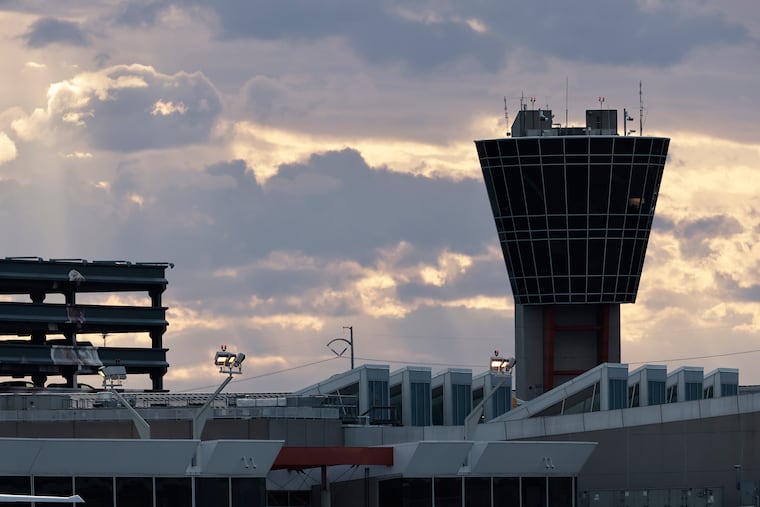
Philadelphia regional airports are contending with staffing shortages as the federal government shutdown drags into a second week — and union officials warn the situation could worsen quickly if the government doesn’t reopen soon.
So far, the budget impasse has not led to chronic traffic snarls on the runway at Philadelphia International Airport. But the Federal Aviation Administration has reported some delays and other issues at the airport and a half dozen other metro travel hubs this week, where many federal employees are expected to work without pay to keep the airspace operating smoothly.
Air traffic controllers are working long shifts on an IOU paycheck, putting strain on an already dire staffing situation at regional air traffic control towers, according to the union that represents the controllers.
Other federal workers who are stationed at PHL have likely been furloughed as a result of the shutdown, complicating logistics at the busy metro travel hub. (Officials at the FAA were not available for comment; communications staffers at the agency are among the furloughed.)
FAA records show there were several ground stops in Philadelphia airspace on Monday. Heather Redfern, a spokesperson for Philadelphia International Airport, attributed delays to bad weather and said airport operations remain stable. Travelers are facing wait times of 15 minutes or less at Transportation Security Administration checkpoints, she added.
But the strain on workers is already visible. Joe Shuker, Region 7 vice president for AFGE Council 100, which represents TSA employees at PHL, said members were coming in late or calling out at higher-than-usual rates.
“I don’t know if I’d fly now,” he said Tuesday.
» READ MORE: Why Philadelphia’s air traffic control tower is fueling national anxiety over flying
Mike Christine, eastern regional vice president for the National Air Traffic Controllers Association, said air traffic controllers are working under financial duress. Many still remember the anxiety of working through the last federal government shutdown, which began in December 2018 and lasted 35 days.
Working on a promised paycheck, Christine said, adds tension to an already demanding job.
“Air traffic control requires 100% focus, 100% of the time,” he said. “This shutdown is a distraction. You’re not just focused on arrivals and departures and overnights. You’re thinking: ‘How am I going to pay my rent? How am I going to put food on the table?’”
With only 10,800 air traffic controllers, the FAA has been battling a chronic staffing shortfall, with about one in four positions unfilled nationwide, he added. Nearly one in five positions in the Philadelphia tower were unfilled, union officials said in June.
The staffing crisis became a subject of national scrutiny earlier this year after a series of high-profile communications blackouts at air traffic control towers.
The shutdown has already added to the strain in some airports across the country, with reports of radio silence from the towers. Some airports had seen up to 50% in staffing reductions, U.S. Transportation Secretary Sean Duffy said Monday. Aviation officials restrict flight capacity at any airport in response to staffing levels.
“If we see there’s issues in the tower that are affecting controllers’ ability to effectively control the airspace, we’ll reduce the rate, and you’ll see more delays, or you might see a cancellation,” Duffy said. “I’m willing to do that before we’re willing to risk anyone’s life in the air.”
The stress placed on airports was largely credited with pressuring politicians to relent and reopen government during the 2018-19 shutdown. When 10 air traffic controllers called out in Virginia and Florida, the ripples were felt across the country, eventually halting travel at New York’s LaGuardia Airport.
Air traffic control workers are paid biweekly, and expect to receive a partial paycheck on Oct. 14. But should the shutdown drag on two more weeks, workers will get nothing on their next pay date, Oct. 28.
“Air traffic controllers did not start this shutdown, and we’re not responsible for ending it,” Christine said. “Politicians started this. … Our focus is to make sure we can get our controllers paid so they don’t have to worry about their next paycheck.”
Questions sent to the FAA were not returned, as agency communications officials were among the reported 11,000 employees furloughed by the shutdown.
“Due to a lapse in funding, the FAA is not responding to routine media inquiries,” a bounce-back email read Wednesday.
Staff writers Ariana Perez-Castells and Fallon Roth contributed to this article.

The Inquirer’s journalism is supported, in part, by the Lenfest Institute for Journalism and readers like you. News and editorial content are created independently of The Inquirer’s donors. Gifts to support The Inquirer’s high-impact journalism can be made at inquirer.com/donate. A list of Lenfest Institute donors can be found at lenfestinstitute.org/supporters.