This South Philly artist turned to sculpture to process his ALS diagnosis
A South Philly artist and motorcycle enthusiast turned to sculpture to help him and his family process his ALS diagnosis. An installation is at the Parkway Central Library until Friday.
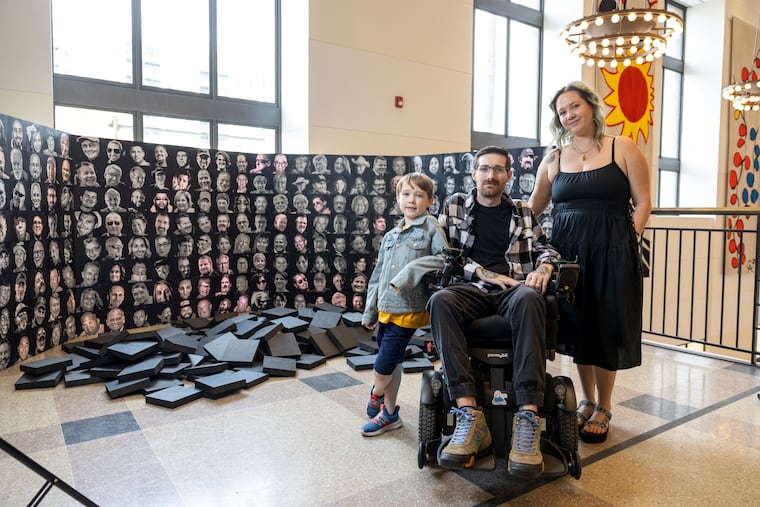
At first, the symptoms were subtle. Eric Brunner had trouble gripping the handlebars on his motorcycle. Then his typing started getting sloppy.
“You’re a new dad,” his doctor reassured the South Philly portrait painter and sales associate. “You’re tired. You ride motorcycles. It’s normal.”
Soon he started tripping and falling on his regular runs.
A few tests later, the diagnosis came. It was amyotrophic lateral sclerosis, the doctor told him, known as ALS. The disease attacks the nerve cells in the brain and spiral cord. Over time, it robs patients of their ability to move their muscles, speak, and eat.
It is also fatal — usually within three to five years.
The date was Nov. 5, 2020. Brunner was 33.
As the disease slowly stripped him of his capacity to ride motorcycles, paint, work, walk, and get dressed, Brunner continued to conceive of vivid and ambitious artworks in his mind.
Those ideas ultimately coalesced into Flickering Souls: Illuminating ALS, an installation featuring 256 portraits of people around the world with ALS. Each is illuminated by flashing lights. Beneath the panels are a scattered pile of black tiles, representing those with the disease who have died.
The sculpture was unveiled at the Central Library of the Free Library of Philadelphia in January and will stay there until Friday. It will travel to Old City’s Two Street Club gallery next month before, likely, touring across the country, said Brunner, 39.
The concept came to Brunner around early 2024 and was inspired by a conversation with his son, Logan, now 7.
He wanted Logan to understand what the disease was doing to his body, but describing how it hijacks messages between neurons and muscles was a bit complicated for an elementary schooler, so he used an analogy — lights and wires.
“We would tell him my wires weren’t connecting anymore,” Brunner said. “The light flickers on and off, and that’s why my legs aren’t as strong or my hands don’t work as well.”
He knew he wanted to depict ALS through the same metaphor of flickering lights. If it could help his son understand the disease, maybe it could raise awareness.
“A lot of the activism lives in an echo chamber. It’s a lot of the same people,” Brunner said. “My goal was to expand it into a different scene.”
But extracting the idea from his brain and developing a three-dimensional creation would be a challenge, especially as his health declined. So he leaned on friends, family, and others with the disease to help pull it together.
He started by reaching out on social media to people in the ALS community, asking them to submit photos of themselves or others who have or had the illness.
Over more than 700 hours, and with help from his family, Brunner 3D-printed 256 of them.
Digital design tools and adaptive technologies could help him with the small pieces, but his fine motor skills were no longer up to the task of constructing the wooden framework he envisioned installing the portrait tiles in.
So he called an old friend.
Alison Chetty met Brunner in high school; he went to Chichester and she went to Garnet Valley. They got to know each other participating in art competitions, Chetty said.
After college, they lost touch until more than a decade later, when Chetty discovered Brunner’s diagnosis through a social media post.
“I didn’t know what ALS was,” she said.
She was stunned to learn what it meant for Brunner’s fate.
So when he reached out and asked her for help on the project, she didn’t hesitate.
“He kind of settled on this idea and I was like, ‘Well, of course I’ll make it for you,’” Chetty said.
Over two years, she constructed a wooden grid framework perfectly tailored to the size of the tiles and drilled holes inside to thread the wiring through.
Brunner’s wife, Allie Brunner, also an artist, helped, as did Logan, who chipped in by attaching wires, installing portraits, and painting the sides.
In a time where their lives felt directionless, the project gave the family a sense of purpose, Allie Brunner said.
“Everyone our age is having more kids, they’re getting different jobs, and what are we supposed to be doing?” she said. “I think it’s really given us that gift of ‘this is exactly what we’re supposed to be doing together.’”
Throughout the construction period, a number of setbacks arose.
Some weeks, Chetty had to prioritize other projects for her job as a carpenter and retail display artist. Other weeks Eric Brunner wasn’t up for it. About a year into the project, he fell and fractured a few bones. It was unclear if he would walk again.
“Everything felt like it was kind of falling apart,” Allie Brunner said. “It’s easy to kind of lose hope along the way.”
Especially when, in the backdrop of it all, people depicted in the piece were dying as the project was coming to life.
But Eric Brunner’s devotion to the work continued to drive it forward.
Without uttering a word, they all knew why, why the piece meant so much.
“It is his legacy,” Allie Brunner said.
At its January opening, people from all across the country — from California, Texas, Washington — lined up to see the installation.
“It was extremely rewarding,” Eric Brunner said.
To Brunner’s knowledge, no one in the piece was able to see it, because of how cumbersome the disease is to travel with.
To him, that is part of why it was worth all the work.
“Being a part of something big is difficult when you have ALS,” Brunner said. “Just managing your energy is difficult because it takes a lot for a lot of us to even get out of bed and return emails.”
With this piece, they could be part of something big. Their legacies could extend further and longer and they didn’t need to lift a finger, just share their story.
On April 3, the piece will debut at the Two Street Club gallery during the First Friday art gallery walk. It will stay there until April 25. Brunner is working out plans to show the piece in Boston, New York, and San Diego.
“It’s really validating to see yourself as a work of art and to see yourself with all of the other people,” Brunner said — and he would know, as he is one of the faces in the piece. “It just reinforces that you matter in this fight.”