For this 135-year-old Germantown piano company to survive, it had to close its doors
Longtime Germantown establishment Cunningham Piano Company is moving to King of Prussia, as the century-old business adapts to modernity.
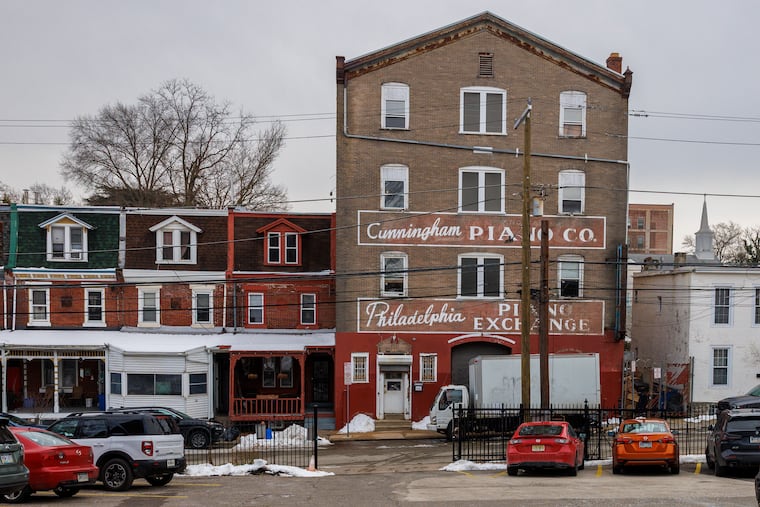
Cunningham Piano Co.’s workshop on Coulter Street in Germantown is haunted by piano carcasses, the sounds of errant keys, and the lingering smell of pungent chemicals and lacquer.
The prewar stable-turned-casket-warehouse is not the most apt locale for a 21st-century business, whose commodity also weighs 800 pounds. While a freight elevator connects the cavernous, drafty floors, the stairs are precariously narrow, twisty, and steep. The floorboards are bent from the tension of a soundboard press. Outside, a moving truck could overwhelm the residential street off Belgian-block-paved Germantown Avenue in a neighborhood that fiercely stewards its history.
So, attuning to modernity, Cunningham Piano is shuttering and selling its restoration depot after more than three-quarters of a century and consolidating its operations to a new King of Prussia headquarters. Amid an industry-wide contraction — fewer than 18,000 pianos sold nationwide in 2024 — the closure may seem like the latest casualty; but co-owner Tim Oliver said it’s a symptom of the 135-year-old business’ longevity.
“Our business is definitely on an upward trajectory,” Oliver said. “In order for us to make it for the next 130-plus years, we needed to make these choices.”
‘Monument to the industry’
The beginning of the 20th century was the piano’s “golden age,” a time when the U.S. public owned a million pianos, according to a 1965 article in American Heritage. Founded in 1891 by Irish immigrant Patrick J. Cunningham — a craftsman with a keen business sense — Cunningham Piano garnered international acclaim, becoming Philadelphia’s most respected piano maker.
“For the highest grade piano made: for a well-made piano: for a medium grade piano: for a cheap piano, for any and all makes … call at the warerooms of the Cunningham Piano Company,” read an advertisement in a 1900 edition of The Inquirer.
During that era, Cunningham Piano occupied a 15-story Western Pennsylvania-brick office tower on Chestnut Street’s “Piano Row” (which, in 2007, was purchased by the Church of Scientology), employed more than 400 workmen, and manufactured 5,500 pianos, totaling about 260,000 feet of lumber annually, The Inquirer wrote in June 1913. Cunningham Piano “stands as a monument to the industry and faith of a single man,” the newspaper said.
The company thrived until the Great Depression, according to its website; just before the beginning of World War II, it ceased production, later reopening under new ownership among Germantown’s bustling five-and-dime and department stores, restaurants, and theaters. And the business took on a new tenor: restoration.
“Germantown was a major, major retail destination for people,” Oliver said. “Today, that’s King of Prussia.”
Attuning to modernity
The move to King of Prussia will key the company into what a recent report called the largest concentration of retail in the Southeastern Pennsylvania suburbs. Its new, 15,000-square-foot space, which will house its warehouse, workspace, a showroom, a performance venue, and teaching studios, is better equipped to serve the Philadelphia-area market.
Dissonant with the decline in American piano manufacturing and dwindling piano sales, Cunningham Piano is expanding, Oliver said. He attributes this to Philadelphians’ proclivity for antiquities and music, and the closures of chief competitors in the region.
The space also has contemporary efficiencies, like a loading dock and private parking for an 18-wheeler, making it more amenable to roughly 500 sales and 30 complete rebuilds — like repairing pianos gnawed on by South American termites or overhauling the Chickering grand piano in Atlantic City’s Boardwalk Hall — a year. Second- and third-generation artisans painstakingly labor over a piano’s 5,000 moving parts to revive its bright and clear or rich and velvety tones.
Cunningham Piano finalized the sale of the Coulter Street building in March; after selling off some inventory and machinery, the company will vacate the property this month. The KOP facility is expected to open this fall.
Of the Germantown locale, Oliver said he is “not going to miss the cobblestone road. I’m not going to miss anybody complaining about my truck being parked out front.”
But “I am going to miss the people of the neighborhood,” he said.