Many Philly roads have faded or missing lane markings and crosswalks due to a ‘combination’ of factors
Philadelphia’s level of traffic, weather, and snow plowing can speed up the fading process.
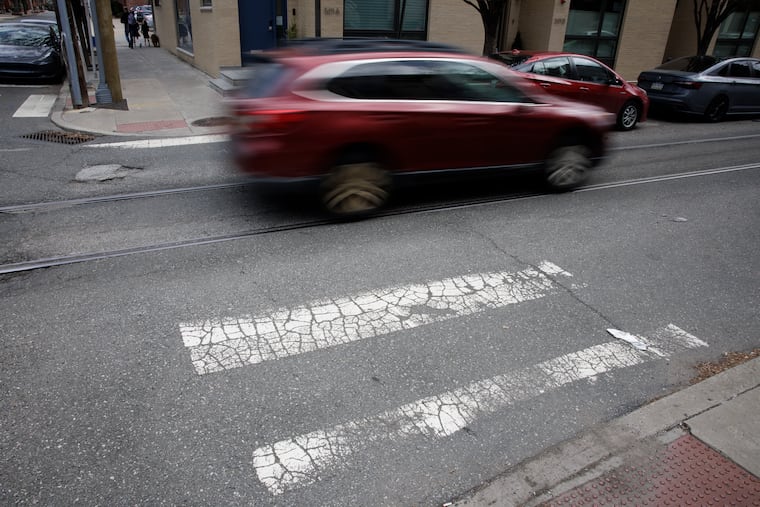
Philadelphia has more than 2,500 miles of roadways, including small streets and wide, large-volume routes. Their pavement markings, however, sometimes go missing in action.
Living near Center City, reader Timothy Derr is well acquainted with faded road pavement markings. The situation, he stresses, “puts pedestrians at risk.”
Struggling to understand the markings’ half presence, he asked Curious Philly, The Inquirer’s forum for questions about the city and region: Why are roads so often in Philly absent of any lane markings, even months after new paving? Many of the heaviest-traveled roads, with equally heavy foot traffic, especially in Center City, have no crosswalk markings, either. What gives?
» ASK US: Have something you’re wondering about the Philly region? Submit your Curious Philly question here.
Unlike Philly’s passion for cheesesteaks, pavement markers fade over time, or need to be redone after a street is repaved. That situation can make it hard to discern where pedestrian crossings, bike lanes, and driving lanes are.
The Department of Streets acknowledges that “many of our roads have faded or missing pavement markings,” said spokesperson Christopher Young, attributing this to “a combination of many factors.”
The city was not able to provide further information on the characteristics that lead to faded pavement markings, or explain the delays in repainting newly paved roads.
Chris Gallagher, owner of C&C Super Seal, a company that specializes in asphalt jobs and various types of line striping, said the longevity of pavement marking depends on the material.
“Philadelphia usually does thermoplastic,” Gallagher said.
Thermoplastic line striping is a hardwearing material for pavement markings that uses heat to make pigments and glass beads adhere to the ground.
Despite its endurance, ”it’s a wearable item, so they don’t last forever,” Gallagher added.
The material tends to fade within eight years. But Philadelphia’s level of traffic, weather, and snow plowing can speed up the fading process, resulting in local markers lasting “three to five years,” Gallagher said.
“Roadways that see high rates of travel also see the highest rates of wear and tear on the markings and roadway surface,” said Young.
For Derr, the problem isn’t that they fade. It’s the lack of maintenance that makes him feel like “the city isn’t doing enough to ensure safe walking.”
The city was not able to say how long it takes to replace markings. According to Gallagher, the process is rather speedy — once it starts.
“It’s a quick process once you are out there, but you just have to be able to get out there and do it,” Gallagher said. “There is no average, you can do a foot per second, it’s not a how long you can take, it’s quick.”
In the meantime, the Department of Streets asks Philadelphians for patience, Young said. Requests for line striping can also be reported through an online form at phila.gov.
“We encourage anyone with questions or concerns about roadway conditions to please report them to 311. Help us make your community and your commute safer, cleaner, and greener,” he added.