After a momentous season, these Philly-area wheelchair ballers are looking to ‘do something big’ at the national championship
Katie's Komets are on a historic run ahead of the wheelchair basketball national championships. The team teaches its players sportsmanship and conviction, while fostering community and inclusivity.
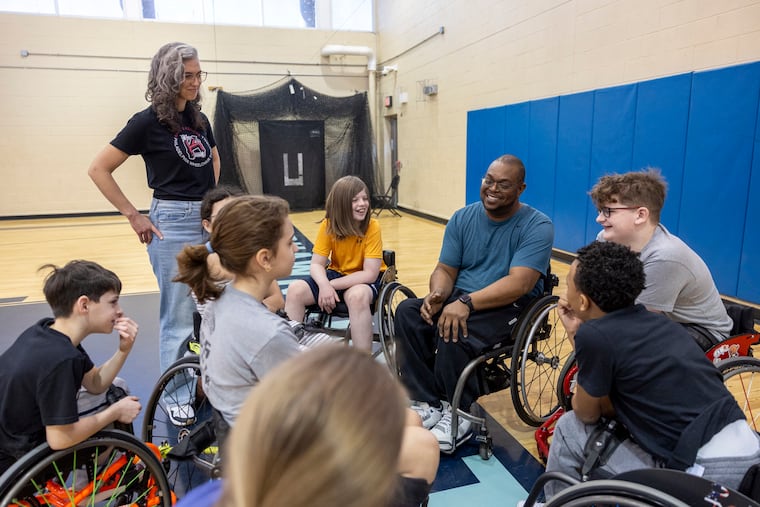
Celeste Russo raced toward the corner, hungry to make a play. Mid-dash, she crashed, toppling over her wheelchair.
Bang. A dissonant sound of metal scraping metal echoed throughout the Rhawnhurst gymnasium.
“That’s a foul! That’s a foul!” the other players chanted. In the stands, Russo’s mother, Monica, winced. A teammate helped Russo upright.
“Back on D, back on D,” coach Chris Kile urged, as teenagers rushed toward the hoop. Then, Russo was back in the scrimmage.
Saturday was one of the final practices for Katie’s Komets, Philadelphia’s coed youth wheelchair basketball team. The Komets have had a momentous year, which culminates next week in West Monroe, La., at the National Wheelchair Basketball Association’s championship tournament. For the first time in recent history, the Komets’ varsity team will compete in the main draw; meanwhile, the prep division — 13 years old and under — is seeded 10th in the nation.
» READ MORE: ‘Like a family’: Wheelchair basketball competition in West Philly is fierce (but in a good way)
“We really think we can do something big,” said Russo, 17, who is the lone senior on the Komets squad. “It’s really a season that we haven’t had in a long time, and it’s a once-in-a-lifetime opportunity. We just have to grab it.”
Varsity coach Kile attributes this season’s success to the team’s new players, rounding out the squad’s skills and creating camaraderie on the court. New hire, prep division coach Chris Noel — who commutes from Manhattan — brought his New York City swagger to the Komets, helping instill confidence in the youngest players, Noel said. His team is undefeated heading into nationals.
“We’re like the underdog favorites,” said Noel, who coached the New York Rolling Fury to a second-place finish last year. “Everyone knows the Komets organization for being more recreational, fun. … Competitive? Maybe not.
“But now people are looking at them, like, ‘Wow, these kids really got some game.’”
The five-player teams use brute arm strength to propel and swivel their specialty chairs — designed with angled-inward wheels for durability and speed — across the length of a regulation basketball court, all while dribbling, passing, shooting, jostling, and dodging blocks from their opponents. The sport is open to anyone with lower-body impairments: Some of the kids have limb differences or paralysis; others are ambulatory wheelchair users who can walk or stand.
It’s a feat in athleticism that’s sometimes overlooked: “People need to see us as athletes just as much as able-bodied athletes,” Russo said. Russo started on the Komets just before her 13th birthday; next year, she’s committed to play wheelchair basketball at the University of Illinois. Eventually, she wants to be a Paralympian.
“We work so hard, we put in the hours, we eat well,” she said. “All the work we put in, people shouldn’t feel pity for us — they should celebrate us.”
Teammate Ciarlo Liples, 15, of Doylestown, loves the physicality of defense. Dreaming of Paralympic gold, the teen starts his days with a hundred pushups. Later, he tries to make at least a hundred baskets. Some practice days stretch on five or six hours, he said. Recently, Liples was hospitalized for more than 50 days, but he still managed to fit in agility drills — weaving and dribbling through cones during rehab at Children’s Hospital of Philadelphia.
“It’s harder than able-bodied basketball — it’s more impressive, you can easily get hurt,” he said. “It’s a lot more intense, and it’s just more fun.”
The “swoosh” of a crisp three-pointer is the highlight of prep player Robert Deegan’s game. Deegan, 13, didn’t think he could aspire to be a professional athlete, until he found adaptive sports.
“Wheelchair basketball and other para-sports are the gateway to success,” said Deegan, who lives in Gloucester County.
At least the last eight seniors who graduated from the Komets have gone on to play collegiate basketball at schools from Edinboro, to Auburn, to the University of Texas at Arlington, according to founders Joe and Roseann Kirlin. The South Philadelphia couple created the Katie Kirlin Fund in memory of their daughter, who excelled in wheelchair sports before her death in 1989 at the age of 12. Now, the nonprofit sponsors the Komets and subsidizes training, equipment, and travel costs for its players.
“They’re great athletes in chairs,” Joe Kirlin said.
The Komets also foster community and inclusivity and teach kids advocacy, discipline, and conviction. For the players, it’s a formative experience to be around peers with disabilities; for the parents, it’s a support system and a resource.
“It’s transformed my life,” Russo said. “It gave me a whole new purpose, gave me where I wanted to go to college, made me a better person in every single way, and made me more comfortable with my disability.”