Kratom and hemp advocates clash with Philly lawmakers over smoke shop crackdown
Philly lawmakers are weighing a pair of bills that would tighten regulation of city smoke shops.
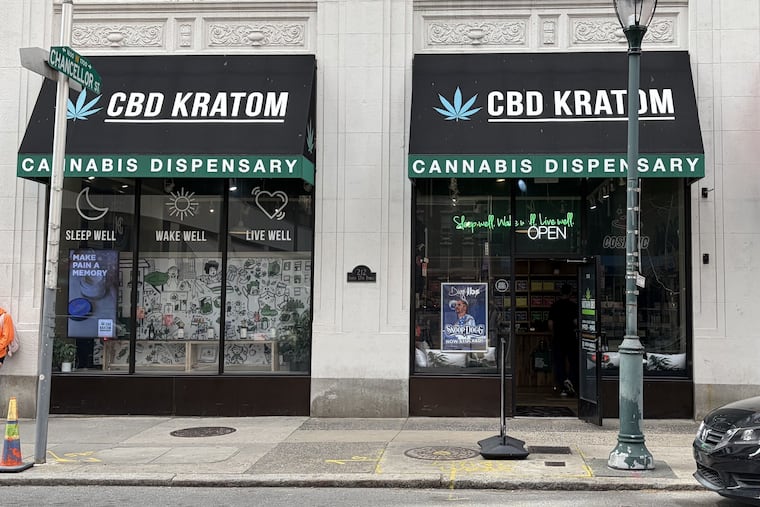
Civic leaders clashed Thursday with kratom and hemp industry advocates in City Hall over two bills that would make it more difficult for smoke shops to sell unregulated drugs across the city.
The most contentious bill under consideration would define kratom and hemp-based THC as “intoxicating substances” and require those who sell them to obtain a special license. It would also implement testing requirements and restrict smoke shop buyers to people over age 21.
“These businesses fuel crime,” said Councilmember Katherine Gilmore-Richardson, who introduced the legislation and has waged a yearslong crusade against smoke shops. “They are putting profits over our safety.”
Another bill under consideration Thursday would allow the city to cite landlords who rent to smoke shops operating without the proper licensing.
Yet Council’s smoke shop focus has shifted in recent years amid public health concerns about the smorgasbord of drugs available on the shelves — from potato chips infused with synthetic cannabinoids to chocolate bars packed with mysterious psychedelic compounds.
» READ MORE: ‘It latches on and doesn’t let go’: 7-OH kratom is fueling addictions across Philly
Thursday’s fierce testimony, spanning more than three hours and nearly two dozen speakers, was largely dominated by kratom.
In low quantities, natural kratom acts as a stimulant — and in higher doses, as a pain reliever. Public scrutiny has intensified in recent years amid an explosion of ultra-concentrated alkaloids extracted from kratom, such as 7-hydroxymitragynine, better known as 7-OH. These synthetically enhanced products act on opioid receptors in the brain and run a high risk for dependency.
The law of the alkaloid
Bella Kalayilparampil, a physician and assistant professor at the University of Pennsylvania Perelman School of Medicine, said she has treated more than a dozen patients for kratom addiction in the last two years.
She described her patients as “highly motivated and hardworking individuals” who started using natural kratom powders. Because these products are marketed as natural, they “did not view it as dangerous,” she said.
Yet as their tolerance grew, she said, the patients gravitated to stronger concentrated extracts like 7-OH. And soon, they faced intense withdrawal symptoms that rivaled those of powerful opioids like OxyContin.
“This was 10 times worse,” said Danny Rosenberg, a recovering kratom user who testified Thursday in favor of banning products like 7-OH. “Four days in detox, I could not get out of bed.”
» READ MORE: Kratom makers are tweaking their ‘gas station heroin’ formulas to evade pending bans in Pa. and N.J.
Ed Boyer, an Ohio-based physician at the Ohio State University Wexner Medical Center, testified that while he thought “regulation is desperately needed,” he had fielded only seven calls about kratom-related addiction since last July.
“That doesn’t sound like a public health catastrophe,” he said. “It’s not like Kensington.”
Pressed by lawmakers about why he flew to Philadelphia to give testimony on the bills, Boyer acknowledged doing product liability consulting for the law firm Frost Brown & Todd, which advertises services to kratom companies navigating regulatory hurdles. Boyer said he did not know the firm’s clients.
The kratom industry has been heavily lobbying lawmakers to make clear distinctions between natural and synthetic forms of kratom. Pennsylvania and New Jersey are both considering legislation that would ban 7-OH at the state level, yet those bills would not outlaw milder natural leaf kratom products.
Allison Smith, of the Global Kratom Coalition, argued that the Council bill would be a de facto ban of all kratom products in Philadelphia, requiring sellers of natural leaf kratom to abide by federal regulations meant to govern pharmaceuticals. She said a middle ground was needed.
“Do not turn regulation into prohibition,” she said.
Battling the smoke shop boom
Community leaders from West Philly to Strawberry Mansion to Queen Village testified in support of the bills, saying their neighborhoods have been inundated by smoke shops peddling unregulated drugs, some violating city licensing rules and regulations meant to curb 24-7 operations.
Such shops are vectors for crime and do not represent “the best our communities have to offer,” said Crystal Morris, head of the Wynnefield Residents Association.
Philadelphians’ quality of life has suffered due to shop owners who exploit “legal wordplay” in state and federal drug laws, Morris said. Children walk past these stores on their way to schools. Small landlords struggle to lease apartments located nearby. Senior residents are frightened to go out at night when large crowds congregate around the stores.
Health concerns and ease of access to the products also concerned neighbors. One speaker cited a 2025 Inquirer investigation into unregulated hemp products, which found many products were contaminated with mold, pesticides, and other toxic substances that are typically banned in regulated cannabis markets — products sometimes deliberately marketed toward children.
Several members applauded after civic leaders spoke in opposition to the smoke shops.
However, some speakers, like 8th Democratic Ward leader Elaine Petrossian, noted that at least four different bills that sought to crack down on these operations had largely failed to result in adequate enforcement.
“What is the plan for enforcement? 911? No one comes,” Petrossian said. “The neighborhood is left in a ‘Squid Game’ of who is supposed to hold the shops accountable.”
Richardson agreed that enforcement had been difficult. Store owners apply for convenience store licenses, only to turn around and sell unregulated drugs. When the city does succeed in shutting down stores, some owners change LLCs and reopen.
The two bills now advance for a first reading before Council.

The Inquirer’s journalism is supported, in part, by the Lenfest Institute for Journalism and readers like you. News and editorial content are created independently of The Inquirer’s donors. Gifts to support The Inquirer’s high-impact journalism can be made at inquirer.com/donate. A list of Lenfest Institute donors can be found at lenfestinstitute.org/supporters.