A Mount Airy retaining wall has been collapsing for 8 years, and the city has been slow to repair it
The city agreed to help homeowners in 2023. Little has happened since.
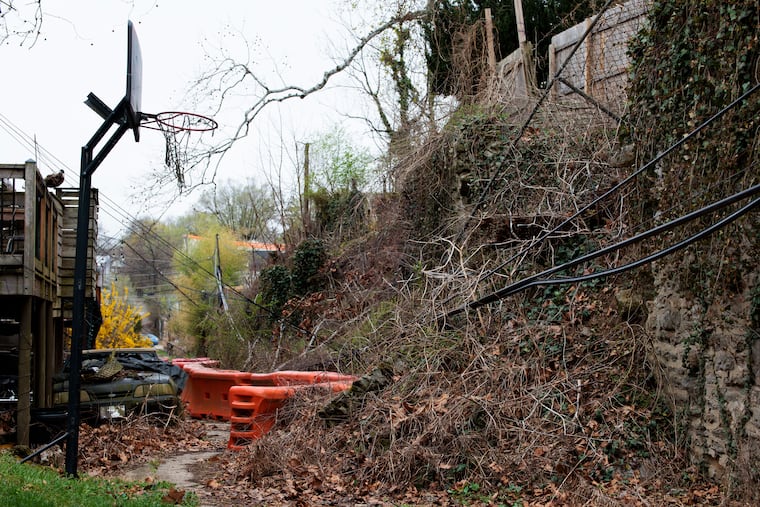
A retaining wall holding back sediment and trees across 26 homes on a West Mount Airy block has been slowly deteriorating since 2018, with no end in sight.
The city entered a settlement agreement with the homeowners living on the 300 block of Glen Echo Road in 2023, promising to “swiftly abate the unsafe and/or immediately dangerous conditions” of the wall. But residents say the city’s actions have played out at a snail’s pace.
In the years since the settlement, the retaining wall — the main barrier holding back what would otherwise be a slope leading down to the residents’ alleyway — has become overgrown and difficult to clean safely. One resident said he could not easily pull permits for important home renovations because of the unresolved wall issue.
The epicenter of the collapse remains blocked off by orange safety barriers, a crushed car, and downed wires that render the alley behind the 300 block of Glen Echo unusable.
“Nobody goes out in the back alleyway because the wall is buckled in so many areas, it’s super unsafe to be back there,” said Nicholas Huber, who grew up on the block and purchased his home in 2021, three houses from the main site of collapse.
Beyond the safety concerns, residents expressed frustration with how attempts to get updates from city offices have led to radio silence since autumn. Equally unsuccessful were efforts to get the attention of Councilmember Cindy Bass, who represents them.
Desperate for any sort of update and worried the city was quietly backing out of the agreement, some residents took their experiences to a reporter at the Chestnut Hill Local in January, which yielded no response from the city or their councilmember, and later to The Inquirer.
Bass’ office did not respond to The Inquirer’s requests for comment. The city offered an update through Mike Carroll, deputy managing director for the Philadelphia Office of Transportation and Infrastructure Systems, which was overseeing the program meant to fix retaining walls that had become public safety issues. The intervention process has been complex, “but the City has remained involved in driving solutions,” Carroll said in a statement.
The design work is expected to be completed this summer, Carroll said.
David Trapp, who moved into his home on the block months after the collapse, was relieved to hear the city was still committed to helping. Yet he remained frustrated that the block had to resort to extreme measures, like going to the media, to get the city’s attention. It was why they spent thousands on attorneys and sued in 2022.
“A lawsuit felt like a last resort and it was a long process,” he said. “And even that didn’t do it.”
The city’s decades-long retaining wall problem
Glen Echo Road residents say there is much to like about their location. They are on a tree-lined street, an easy jaunt to Germantown Avenue, and another short walk to a commuter rail stop.
Huber said he knows of people who have been in the neighborhood for decades. Still, many on his block did not register the quirks of being next to a retaining wall until a portion of it collapsed.
Retaining walls can be used in smaller landscaping projects, as well as on highways, in an effort to keep soil stable and prevent erosion.
In areas like Northwest Philadelphia, century-old retaining walls helped people build homes on slopes and are considered private property.
Maintenance falls on the property owner, according to the Philadelphia Streets Department.
“Even if only parts of an alley, driveway, or retaining wall need repair, all responsible property owners must share the cost of the repair,” the department’s website reads, meaning all 26 property owners on the 300 block of Glen Echo were on the hook for repairs. Estimates for a potential fix on the block varied wildly, from low six figures to just over $1 million.
Due to the unpredictable and exorbitantly high costs of repairs, residents living in Northwest Philadelphia, where many of these century-old walls stand, have long called for changes to this setup.
Until the 1960s, the city handled the repairs by hiring a contractor and later billing homeowners. But that model crumbled as more residents could not pay the city back, and by 2015, the city was considering other ways to address the burdensome bills of repairing deteriorating walls. Proposals at the time included adding surcharges to real estate taxes that would help pay for repairs and providing homeowners with loans they could repay over time.
City Council tried to address the retaining wall conundrum in 2020, along with other priorities like housing production and eviction prevention, through the Neighborhood Preservation Initiative, which was later budgeted with $400 million. Retaining wall repairs were eligible for funding this way.
By making the legal case that the collapsed retaining wall was a health and safety issue, residents were able to get the city to agree to help plan and pay for the repairs. But complicating their victory was a new City Council makeup and mayoral administration in 2024. By then, residents were beginning to express frustrations over what they saw as spotty updates.
Other problems arise, while communication drags
Matthew Turley bought his home on the 300 block of Glen Echo with a renovation loan at the start of 2024, under the impression that the city would be taking care of the fix soon because of the settlement.
Yet when Turley’s contractor tried to pull permits for the renovation, he couldn’t because his property, along with the 25 others on the block, had outstanding violations from the Philadelphia Department of Licenses and Inspections due to the very safety issues that allowed the city to step in and help with the fix. It took about four months and hiring a permit expediting company for thousands of dollars to circumvent the red tape, pull permits, and begin to make his home habitable.
“It was blocking me from fixing things that were genuinely unsafe with my house,” Turley said. “The previous owner still had a boiler from the 1960s, the firebox was rusting out, which was a [carbon monoxide] risk, and I had knob and tube wiring that was uninsurable because it’s a fire risk.”
As Turley struggled with his permits, residents fought to get issues with the trees above the wall addressed, worried any major storm could bring them down along with the wall. By the fall, they grew increasingly desperate while the city continued to urge patience.
“The Empire State Building was designed, permitted, and fully constructed in 20 months and we can’t get a clear or timely update after six years,” another resident wrote in an email.
Huber said residents had been told designs for the wall were expected to be 90% done by the end of the 2024-25 winter.
By September 2025, the Neighborhood Preservation Initiative program in charge of the repairs had been sunsetted and one of the main people communicating with Glen Echo residents had their position eliminated.
Upon hearing the update on design work, some residents still had questions about which program would act as their main point of contact — the city did not say.
Huber hopes the update from the city means residents will have something positive to bond over soon, instead of constantly talking about their retaining wall.
“It’s been such a detriment to this block, which was a really great community for so many years,” he said. “I’m not saying it’s not now, but it’s been negatively affected.”