The National Constitution Center’s head departed after a leadership dispute, The New York Times reported
A leadership dispute and chaotic board meeting preceded Jeffrey Rosen's departure as head of the National Constitution Center, according to a New York Times report.

An escalating management dispute and chaotic board meeting preceded Jeffrey Rosen’s departure as head of the National Constitution Center, according to a report from the New York Times.
The center publicly announced on Jan. 9 that Rosen had stepped down as president and chief executive after more than 12 years leading the private, nonprofit institution at the north end of Independence Mall. Rosen will remain as CEO emeritus; Vince Stango, a 26-year veteran of the center who has served as its executive vice president and chief operating officer, has assumed the role of interim president.
The Times reported Friday, based on interviews with people who spoke on the condition of anonymity, that friction arose over how Rosen’s and Stango’s roles intersected: Rosen was the center’s public-facing leader, while Stango handled day-to-day operations, according to the Times.
» READ MORE: Jeffrey Rosen steps down as head of National Constitution Center
A spokesperson for the center declined to comment on the Times’ article and referred The Inquirer to a previous news release, which says Rosen’s new position enables him “to devote his full time and energy to his scholarship and public dialogue.” Rosen — a constitutional scholar, law professor, and author — did not respond to a request for comment via email.
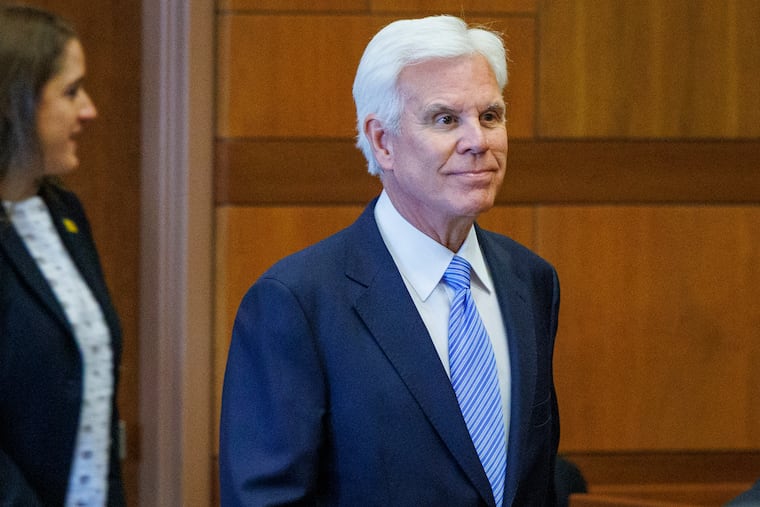
The leadership system was breaking down, the Times reported, when board members Doug DeVos (former president of Amway) and Mike George (former president of QVC) “quietly intervened” in November, hiring an employment lawyer and pushing Rosen to cede the title of president to Stango.
According to the Times, Rosen reluctantly agreed in mid-December, but by late December, talks of compromise had collapsed. Rosen submitted his resignation, conditional on the full board accepting it, “while making clear he hoped the board would instead reject it,” the Times article says.
Rosen had the backing of board member J. Michael Luttig, a retired federal appeals court judge, who portrayed DeVos and George in emails to the board as trying to unfairly oust the center’s top executive, according to the Times. Luttig threatened to step down if the board accepted Rosen’s resignation, the Times article says.
The tension boiled over at a board meeting in early January. The Times reported:
Rosen wanted to address the board, but George prevented him.
Luttig sent an email to the board threatening to file a lawsuit for what he called a violation of Rosen’s due process rights.
The meeting then devolved into a debate over Luttig’s involvement and possible conflicts of interest.
Luttig continued to participate and withdrew his offer to resign.
As of Sunday, the center’s website no longer listed Luttig as a member of its board.
The center will conduct a national search for its next leader, The Inquirer previously reported.
The alleged quarrel comes as the center prepares for the nation’s 250th birthday. The nonpartisan museum is known for awarding the annual Liberty Medal to notable figures such as Ukrainian President Volodymyr Zelensky; legendary boxer Muhammad Ali; and then-Supreme Court Justices Ruth Bader Ginsburg and Anthony M. Kennedy.
The center was also the stage for the only 2024 presidential debate between former Vice President Kamala Harris and Donald Trump.