What it’s like to be one of Philly’s 6,500 block captains
A reader asked Curious Philly what a block captain is and what they do. “Sometimes you are a counselor, sometimes a babysitter, or the police, or a social worker,” one North Philly captain said.
Andrew Smith, 38, can still remember his 18-year-old self, clipboard in hand, knocking on neighbors’ doors, asking: “Can I be your block captain?”
“Aren’t you already the block captain?” some neighbors questioned the teenager, while others were unsure of what the role meant.
Twenty years later, the confusion surrounding block captains hasn’t ceased, prompting a reader to ask Curious Philly, The Inquirer’s forum for questions about the city: What are block captains and what do they do?
“Sometimes you are a counselor, sometimes a babysitter, or the police, or a social worker,” Smith said.
» ASK US: Have something you’re wondering about the Philly region? Submit your Curious Philly question here.
What is a block captain?
For Sanitation Commissioner Crystal Jacobs Shipman, block captains are invaluable collaborators who work as the city’s “eyes and ears.”
No, they aren’t spies trying to meddle in your business. Block captains are liaisons between their neighbors and Philly resources.
“I can’t be on every single block of the city and know every single challenge that a block has, but a block captain does,” Jacobs Shipman said. “A lot of times, they know who to call, when to call, and when to escalate a situation.”
Out of Philly’s 25,000 blocks, only 6,500 have registered captains, Jacobs Shipman said.

- Organizing clean-ups
- Putting together events that support their blocks (mainly block parties)
- Bringing resources and information back to their block, as well as cleaning supplies, and support families in various ways
Smith himself began performing block captain duties on his North Philly block at age 15, picking up trash and helping elderly neighbors shovel. It wasn’t a quest to earn the title, he said, just a desire to help his community.
“My mom always said, ‘If you don’t see a leader, that leader is you,’” Smith said.
By the time he became a senior at Central High School, he was ready to knock on the doors of his block’s 38 houses to get the signatures required — 51 percent of households — to become the official block captain.
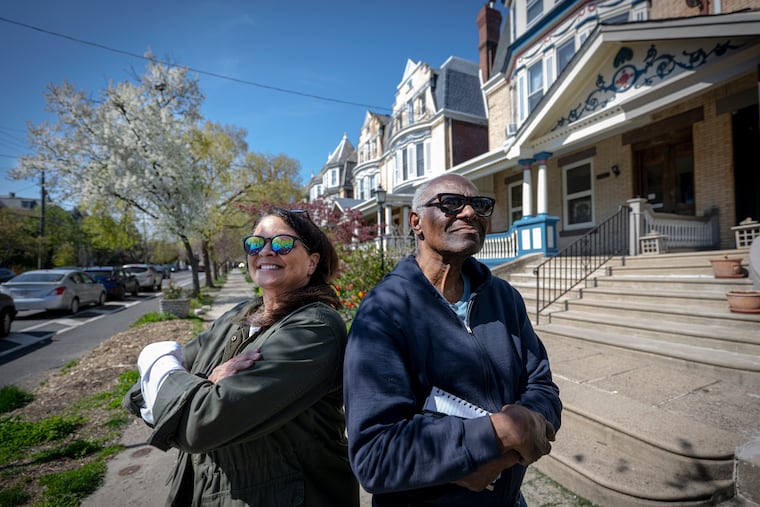
In two adjacent blocks of West Philadelphia, retirees Theresa Feo and Michael Williams are well acquainted with what it takes to be block captains. And, in Feo’s case, what it’s like to do the duties without a title.
Planning a block party, orchestrating a leaf cleanup, or dealing with flooding? For the last six years, Feo’s was the first door neighbors knocked on for answers.
However, she has only held the block captain card since 2025, when Williams, 75, convinced her to register. He has been a block captain since 1997.
Feo wanted to help her block look pretty and support her older neighbors. That’s why the work of a block captain — managing people, bringing information to neighbors, organizing cleanup days — matters, Williams told her.
“We are stronger together than individually,” Feo said.
Duties of a block captain
A predecessor of the block captain program began almost 90 years ago. In 1938, Swedish immigrant Sigrid Craig started the “Clean Up, Paint Up, Fix Up” campaign as a way to beat Philadelphia’s reputation as a dirty city.
By 1953, the police sanitation unit and the sanitation department joined Craig’s campaign. And in 1965, the Philadelphia More Beautiful Committee formed, leading the block captain program.
Mainly, block captains arrange cleaning in between city-provided cleanups, Jacobs Shipman said.
Block captains can schedule additional curb-to-curb cleaning, get a water-pressure machine to clean sidewalks, and get cleaning supplies from the city.
The last one in particular came as a relief to Feo, who was spending her own money to buy trash bags and other supplies.
“It gives you that official [title], and we can approach the city and have more credibility now,” Feo said.
Every block captain gets assigned a sanitation department worker as the main point of contact for needs like trash pickup after cleanups or permits for block parties.
- Request a block captain petition online.
- Once it arrives by mail, fill it out and collect signatures from at least 51% of your neighbors agreeing for you to be the block captain. Only adults can sign, and no more than one person per household.
- If the petition is approved, a clean block officer contacts you, and you get a block captain card.
More than just cleaning
Despite all the work, block captains don’t get paid. They are considered volunteers and can give as much or as little of their time as they deem necessary, Jacobs Shipman said.
For Smith, who holds two paid jobs while parenting two babies younger than 16 months, “It’s a 24/7 job.”
“If a neighbor comes up with a flat tire or they need to jump-start their car at 2 a.m., you get those texts; you get those calls,” Smith said.
In 2019, he brought back block parties to his street, following a 14-year halt. His block has held a party on Memorial Day or Father’s Day weekend every year since the pandemic, and placed third in a citywide block-cleaning contest in 2023, Smith said.
Seeing his neighbors happy to live on their street keeps him going.
In West Philadelphia, Feo and Williams have more flexibility as retirees. Besides making themselves available, they spend six hours a week doing cleanups in the spring.
“The busiest season is the spring, then the fall,” Feo said. “In the summer, a lot of people are on vacation, but it picks up in the fall with a lot of leaves, and you need to be ready.”
Winter isn’t exactly easy either. Last year’s snowstorms left Feo’s block unplowed, leaving her to organize her neighbors with a snow blower and shovels.
Why become a block captain?
After almost 30 years, Williams sees the job as worth it for the sense of ownership it brings, and a block that loves him back.
“This is a community that cares. We are block captains because someone had to take the position and say, ‘OK, I will take charge,’” Williams said. “Even if it’s just cleaning the curb, putting trash on the curb on the right way, getting up in the morning to see your block clean, it’s a sense of ownership, of caring.”
That care has paid off, Feo said. Last summer, more than 100 neighbors from her block, Williams’ block, and surrounding areas closed the street to throw Williams a surprise 75th birthday party.
The display of affection reminded Feo of the importance of their role as block captains.
“They know that we are watching on the street for each other, that we will come and help you,” Feo said.
The sentiment resonates with Smith. In North Philly, he is also trying to pass the generational baton to his two junior block captains.
“It has to be done because when you don’t care, the city doesn’t show up.”