Why Philadelphia city and county are the same
Riots and perhaps the desire to be number one fueled the Consolidation Act of 1854.
If government structure were a hoagie, counties would be the bread. Cities and towns would be the ingredients inside. But every Philadelphian knows if you want a classic Philly hoagie, you can’t be pulling things apart.
In Philadelphia, the city and county are one.
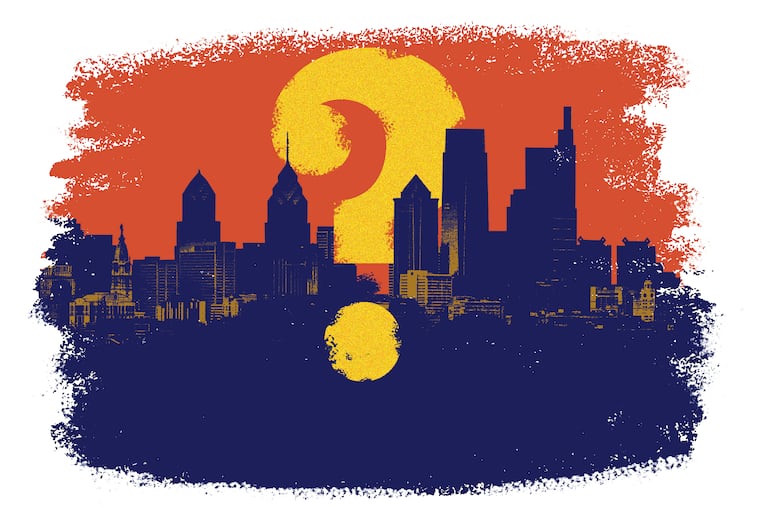
Wondering how this came to be, a reader asked Curious Philly, The Inquirer’s forum for questions about the city and region: Why did the City of Philadelphia merge with the county?
» ASK US: Have something you’re wondering about the Philly region? Submit your Curious Philly question here.
Riots and perhaps the desire to be number one are, in a nutshell, what fueled the consolidation in the 1850s that created the roughly 135-square-mile metropolis Philadelphia is today.
Philadelphia before the Consolidation Act
There was a time when Philly, as a city, fit in the two-square-mile radius envisioned by William Penn, originally bounded by the Delaware and Schuylkill Rivers and the current South and Vine Streets.
» READ MORE: How Philly came to call its downtown ‘Center City’
Residents in the surrounding 25 boroughs, districts, and townships that made up Philadelphia county outnumbered city folks as early as the 1820s, according to The Encyclopedia of Greater Philadelphia.
The areas that made up Philadelphia County tended to be more impoverished than Philadelphia city, and there were also political differences. The city pulled toward the Whigs, while the counties tended to side with the Democrats.
The desire not to let New York surpass Philly in the race for metropolitan power pushed opposing party members together to rally for a merger in 1825. The idea was that a consolidated city and county could have a higher chance of competing with New York.
The plan didn’t go beyond a desire, and in the years to come, unity proved to be a challenge.
Two anti-Catholic riots in then-suburbs Kensington and Southwark in 1844 seemed to provide a push for unity.
The situation was so dire that the militia stepped in when anti-immigrant mobs targeted Irish American homes and Catholic churches.
The anti-Catholic riots
For decades, tensions between Catholics and Protestants had been brewing.
Thousands of Protestants rallied in Independence Square and Kensington amid contention over which Bible to read in public schools, according to the Encyclopedia of Greater Philadelphia. After a May 6 fight left two people dead and multiple wounded, the First Brigade of the Pennsylvania Militia arrived at a sheriff’s request. But the violence didn’t stop.
The homes of Catholic residents, seminaries, and churches were damaged.
It took the U.S. Army, Navy troops, vigilantes, and Philadelphia city police, joining the militia, to put an end to the attacks on May 10.
July brought more violence, this time with a large-caliber gun.
In Southwark, a crowd of Protestants arrived at Queen Street, demanding a Catholic priest surrender the weapons he was hiding in the basement of St. Philip Neri Parish, according to the Encyclopedia of Greater Philadelphia.
The militia dispersed them, but the Protestants returned with a cannon. They overpowered the authorities, seizing the church and taking prisoners.
When the militia returned, the Protestants hit them with stones, bricks, and bottles. The militia counterattacked with gunfire, killing at least two and wounding several.
A cannon battle unfolded in the streets of Southwark, leaving four militia officers and about a dozen protesters dead, according to the Encyclopedia of Greater Philadelphia.
The Consolidation Act of 1854
As a result of the riots, Philadelphia newspaper The Public Ledger invited readers to consider merging the county and the city.
The winter of 1844 brought a citizen meeting at Congress Hall, and a bill on consolidation was drawn. But some Philadelphians still feared the merger.
Philadelphia officials and residents worried about how the Democratic beliefs would affect the policies in their Whig-led jurisdiction. Some saw consolidation more as an economic burden than prosperity, according to the Encyclopedia of Greater Philadelphia.
Unable to reach common ground, new legislation was born. Each city and district of Philadelphia County was required to have at least one police officer for every 150 people who paid taxes in their jurisdiction.
After another riot in 1849, the Philadelphia Police District was born the following year to look after the city and some of the surrounding towns like Kensington and Southwark. Politicians began pushing for consolidation in Harrisburg, and three years later an Executive Consolidation Committee put together the bill.
» READ MORE: What is going on with Philly’s police district numbers?
By February, The Consolidation Act of 1854 unified the city and the county into one Philadelphia.
Southwark, Northern Liberties, Kensington, Spring Garden, Moyamensing, Penn, Richmond, West Philadelphia, Belmont, Manayunk, Germantown, Grankford, Whitehall, Bridesburg, Aramingo, Passyunk, Kingsessing, Blockley, Roxborough, Bristol, Oxford, Lower Dublin, Moreland, Byberry, and Delaware joined the city of Philadelphia, under a county with the same name.
The measure forever changed the access to open spaces, riot prevention, and the political makeup of the city, but that‘s another story.