Philadelphia police officers have begun wearing their new midnight blue uniforms
The police department is switching over from the powder blue look they've had since the 1970s.
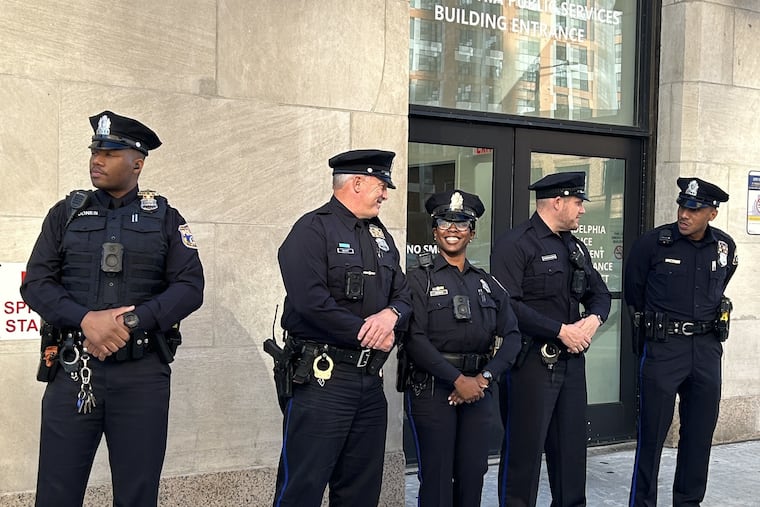
Philadelphia police officers began wearing their new midnight blue uniforms on Wednesday, the police department announced.
The dark navy look is a return to a more “traditional” uniform that evokes “professionalism, authority, and familiarity; qualities that the public expects from its officers,” Sgt. Eric Gripp, a police spokesperson, said in a statement.
The darker shirts are also designed to pair with the department’s new ballistic vests of the same color, according to Gripp.
“A new day for us,” said Police Commissioner Kevin Bethel. He recalled that the department has been talking about changing uniforms since he first joined it nearly 40 years ago, and said that he was “pumped” for the switch.
While most members of the police department have already received their new uniforms and were to begin wearing them on Wednesday, some officers may still be waiting for their shirts. Those officers will continue to wear powder blue until the new uniforms are in.
All officers are expected to be in dark blue by the end of the year, according to the department.
The updated outfit, as well as other uniform changes including the issuance of blouse coats for formal occasions for the first time since 2000, will cost taxpayers $1.3 million. Those funds will come from the unspent portion of last year’s police department budget of $877 million.
» READ MORE: Bye-bye, baby blue: Philly police are getting new uniforms. Not everyone is happy.
Bethel said the uniforms were also intended to boost officer morale. Aside from the updated look, officers were excited about the midnight blues because the material is more breathable and flexible, he said. The uniforms can be machine washed, which wasn’t the case for the powder blues.
While the shirts are new for the current members of the force, the Philadelphia Police Department largely wore dark blue for more than a century before switching to their powder blue look in the 1970s.
Other departments, including the New York Police Department, made similar changes at the same time to give police a softer look after the social unrest of the 1960s. How people perceive police based upon their uniform color has been a focus of academic study, but findings have been mixed.
Bethel was not convinced that the color of an officer’s uniform conveys much about their interactions with civilians.
“If you’re friendly, you’re friendly,” he said. “The color doesn’t make the individual. It’s who we are and how we act.”
The switch has irked some Philadelphia firefighters and paramedics, who already wear navy and have expressed concerns that people would mix up the first responders. Gripp previously told The Inquirer that the police department was not concerned about confusing civilians because both departments already wear dark blue jackets in the winter, and they carry distinct equipment.
Higher-ranking officers will continue wearing white shirts so that they stand out among other officers. Previously, those ranked as sergeants and above wore white, but new for this fall, corporals, who rank below sergeants, will also wear white shirts.
Bicycle officers will continue wearing their light blue shirts as a safety precaution, Bethel said. The department is still planning updates to their uniforms.
But the powder blue look will still make occasional appearances. Gripp previously told The Inquirer that the light blue shirts would be worn during ceremonial events underneath the new blouse coats.