Philly Judge Scott DiClaudio says he didn’t try to influence a case. His colleague disagrees.
The state Board of Judicial Discipline is weighing whether to suspend Judge Scott DiClaudio without pay amid allegations that he tried to influence a fellow judge's decision in a criminal case.
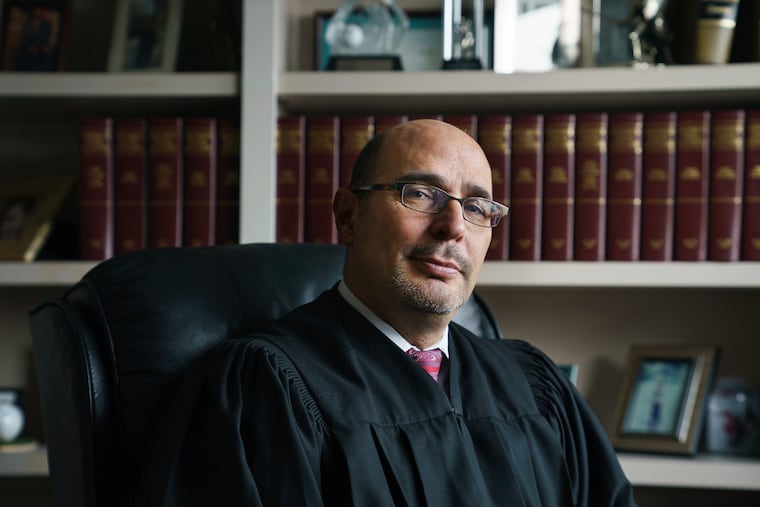
HARRISBURG ― Philadelphia Common Pleas Court Judge Scott DiClaudio says the allegations that he attempted to influence a colleague’s decision in a criminal case are a complete misunderstanding.
At a hearing Monday before Pennsylvania’s Court of Judicial Discipline, DiClaudio took to the witness stand and said fellow Philadelphia Judge Zachary Shaffer had mischaracterized the conversation that now threatens his judgeship.
When Shaffer came to his courtroom in June, DiClaudio said, he mentioned a recent conversation he’d had with a man Shaffer was soon set to sentence.
Dwayne Jones had approached DiClaudio at the Roots Picnic earlier that month, he said, and mentioned his criminal case before Shaffer. DiClaudio testified that he simply relayed to Shaffer what he told Jones: that his colleague was “a good judge who would do the right thing.”
“It was made to give a compliment to a friend,” DiClaudio said.
Shaffer saw it very differently — and with great concern.
“It was dead clear to me what he wanted,” Shaffer testified — a favorable outcome for Jones, a friend of Philadelphia rapper Meek Mill. Mill, too, is a friend of DiClaudio’s.
The two accounts played out publicly for the first time Monday in a Harrisburg courtroom, after the state Judicial Conduct Board filed formal charges against DiClaudio last month, accusing him of a host of ethical violations and for bringing the judiciary into disrepute. Supervisors in Philadelphia’s courts have placed him on administrative leave, and the board has sought to suspend him without pay as the proceedings play out.
The disciplinary panel will decide whether to grant that request in the coming weeks.
DiClaudio and Shaffer’s accounts clashed in nearly every way — from how Shaffer came to end up in DiClaudio’s courtroom to the specifics of their conversation once inside.
Shaffer testified that he and his clerk, Nicole Vernaccio, wanted to buy T-shirts from the cheesesteak shop owned by DiClaudio’s wife and had been in touch with the judge about that throughout the week. On June 11, Shaffer said he gave an envelope with $10 inside for the shirts to DiClaudio’s court administrator.
The next morning, Shaffer said he was in his courtroom when DiClaudio’s assistant, Gary Silver, came in and said DiClaudio wanted to see him.
Shaffer said he and Vernaccio walked to DiClaudio’s courtroom shortly before noon, and joined the judge in his robing room, expecting to pick up the shirts. They spoke briefly, he said, before DiClaudio asked Vernaccio to leave the room. Vernaccio also testified that the judge asked her to step out.
After she left, Shaffer said, DiClaudio pulled out a piece of lined paper with “Dwayne Jones, courtroom 905, and Monday’s date” written on it.
DiClaudio held it out at his side, he said, then looked at him and said, “OK?”
Shaffer said he was confused, and hesitantly said “OK.”
Then, he said, DiClaudio ripped up the paper and threw it away.
The judges then spoke casually about unrelated topics for a few minutes, he said. Then, as he started to leave, Shaffer said, DiClaudio said “something along the lines of, ‘You probably would have done the right thing anyway.’”
Shaffer was initially in shock, he said, then came to believe the comments were an attempt to influence the case. He reported the conversation to his supervisors the following morning, and they referred the matter to the judicial conduct board.
DiClaudio said Shaffer’s testimony “was completely wrong.”
He said he met Jones at the Roots Picnic in Philadelphia on June 1 and Jones told him he had recently pleaded guilty to illegal gun possession and would soon be sentenced by Shaffer.
“I said, ‘Judge Shaffer is a good judge, he’ll do the right thing,” DiClaudio said he responded. “He gives me his card, I put it in my wallet.”
He said he forgot about the conversation until he saw Shaffer 11 days later.
He denied having sent his assistant to summon Shaffer to his courtroom. And, he said, Vernaccio left the room on her own, not at his request.
As Shaffer was leaving, he said, he remembered he had Jones’ business card in his wallet, took it out, and relayed the brief conversation he’d had with him. The card, he said, had nothing written on it, and he threw it away.
“I was relating the story to Judge Shaffer to give him a compliment. I wasn’t trying to influence a case,” he said.
DiClaudio’s attorneys, Michael van der Veen and Bill Brennan, suggested that Shaffer was paranoid and confused, and pointed to inconsistencies between his testimony and summaries of the conversation written by the judicial conduct board and its investigators.
Shaffer said he didn’t write those summaries or review them before they were submitted as evidence. His testimony, he said, is the truth.
And DiClaudio’s remarks to him that day, he said, were inappropriate.
“That’s law and Ethics 101,” he said. “... That’s putting your thumb on the scale of justice. You’re not allowed to do that.”
Elizabeth Hoffheins, deputy counsel for the judicial conduct board, agreed and said DiClaudio’s intent was clear.
“Judge DiClaudio and Mr. Jones share a personal and social acquaintance in the form of the rapper Meek Mill,” she said.
The interaction was “a deliberate approach to influence a decision in the case by invoking a personal connection,” she said, and that “threatens to cast a long shadow on the judiciary.”
She said the board had referred the matter to the FBI for a potential criminal inquiry, and that, for reasons that remain unclear, federal investigators have since sent it to the state Attorney General’s Office. She was unaware of the status of any ongoing criminal inquiry.
While the inquiry continues, she said, the judge should be suspended without pay.
Throughout the hearing, DiClaudio at times struggled to contain himself, interrupting witnesses and insulting members of the judicial conduct board.
At one point, as DiClaudio’s testimony meandered, an exasperated van der Veen threw his pen on the ground and yelled at the judge to stop talking.
His client, he told the court, “is tough to control” and “talks in a stream of consciousness and talks without regard to understanding the entire context of what’s going on as being perceived by people around him.”
But, he said, DiClaudio is a highly respected and reputable judge who would never seek to influence a case.
The five-member panel will decide whether the judge should go without pay in the coming weeks as it considers its ruling in the case.