A Mummers wedding on Market Street | Weekly report card
This week’s Philly report card, grading the good, bad, and weird news coming out of our region.
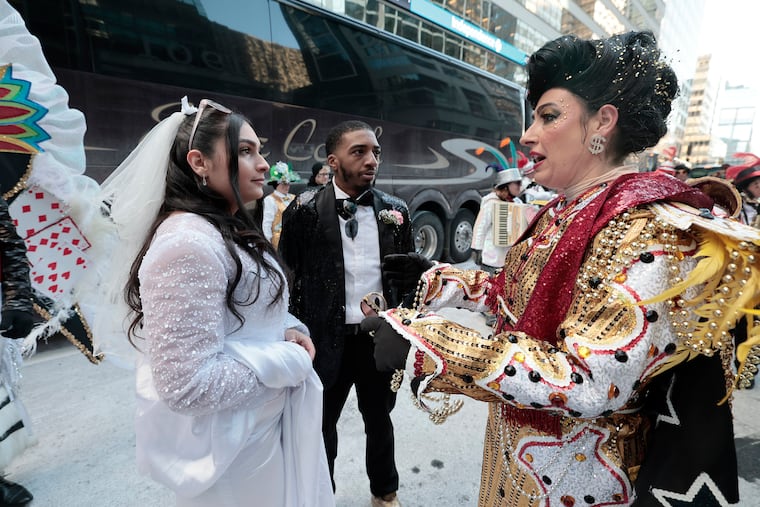
A Mummers wedding on Market Street: A+
If you’re going to get married in Philadelphia, this is the correct way to do it: sequins, sneakers, a string band, bitter cold, delayed schedules, and a crowd that didn’t ask for romance but got it anyway.
A couple saying “I do” in the middle of the Mummers Parade is the purest expression of this city’s personality. Equal parts earnest and unhinged. Romantic, but only after everyone’s been standing around freezing for hours. Vegas chapel energy, but filtered through South Philly logistics and Broad Street chaos.
This wasn’t a viral stunt or a look-at-us wedding. It was two people already marching, already committed, deciding that if they were going to wait around in the cold anyway, they might as well get married while they’re at it. Honestly? Efficient.
The details make it sing: golden sneakers instead of heels, a flask for warmth and nerves, vows practiced on a bus, Elvis officiating, and the inevitable Philly closer, “I’m glad it’s done so I can get warm.” That’s love, but realistic.
And of course it happened at the Mummers. The parade that routinely features feathers, fake arrests, grown adults sobbing at saxophone solos, and more sequins than dignity. If any institution could absorb a full wedding without breaking stride, it’s this one.
Mummers devotion, no notes: A+
Yes, we’re grading two Mummers stories this week, and no, that’s not an accident.
Between a couple getting married mid-parade and a 93-year-old woman flying from Wales to finally meet “her Mummers,” this New Year’s Day delivered a reminder of what this thing actually is: unshakable, irrational, deeply sincere devotion.
Avril Davidge didn’t come to Philadelphia for irony or spectacle. She came because she fell genuinely, deeply in love with the Mummers through YouTube — learned the string bands, picked favorites, developed opinions — and decided, at 93, that she needed to see it in person. That alone clears the grading curve.
What makes this story land isn’t just the transatlantic trip. It’s how naturally Philly met her energy. A museum tour. A surprise meeting with her favorite band captain. A golf cart to the parade. No skepticism, no gatekeeping … just, “Yeah, of course. Welcome.”
And then there’s the wedding: sequins, sneakers, vows exchanged in the cold on Market Street, because if you’re already marching, why not also get married? It’s unhinged. It’s beautiful. It’s extremely us.
No notes.
Philadelphia’s cost of living vs. the suburbs: C (with math and feelings)
On paper, this sounds like a win: It’s up to 26% cheaper to live in Philadelphia than in places like Ardmore, King of Prussia, and Phoenixville, Philadelphia Business Journal reported. Congrats to the city for clearing the extremely low bar of not being the suburbs.
The problem is the second half of the equation: income.
Suburban households make dramatically more money, which means they somehow pay more and end up with way more left over. Ardmore residents, for example, are apparently out here saving more than $50,000 a year, which is a number that sounds fake if you live south of Girard.
So what we really have here isn’t a victory lap. It’s a familiar Philly paradox. The city is more affordable because it has to be. Lower costs don’t feel like a flex when they’re paired with lower wages, longer commutes, and the constant background hum of “maybe next year.”
Pennsylvania Turnpike food options: C+
If you’ve ever pulled into a Pennsylvania Turnpike service plaza hoping for something modern, exciting, or even just predictable, you already know how this ends: Roy Rogers is back, Sbarro is waiting, and time is a flat circle.
This isn’t just personal bitterness; it’s structural. The Turnpike’s dining lineup is effectively locked in by a decades-old contract, which explains why eating on one of the state’s busiest roads feels less like a pit stop and more like a museum exhibit titled Fast Food, 1998. Auntie Anne’s. Burger King. Dunkin’. Starbucks. Repeat until New Jersey.
To be clear, this isn’t about disrespecting Roy Rogers. Roy Rogers has survived longer than many of our friendships. But when New Jersey and New York travelers are choosing between Shake Shack and Pret a Manger, and Pennsylvanians are debating whether this Sbarro feels better or worse than the last one, something has gone off the rails.
A C+ feels right. The food won’t kill you. It will fill the void. It might even unlock a memory of your mom liking Roy Rogers, which is sweet in its own way. But if the Turnpike is going to keep charging premium tolls, it might eventually want to acknowledge that the rest of the world moved on from mall food courts, and took better rest-stop dining with it.
Eagles resting the starters (and trusting the vibes): B+
This is one of those decisions that feels smart, responsible, and completely terrifying all at once … which means it’s extremely on brand for Philadelphia football.
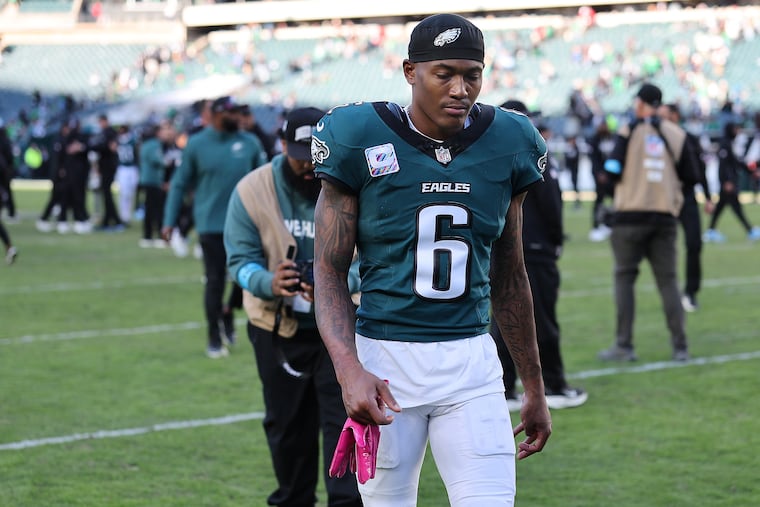
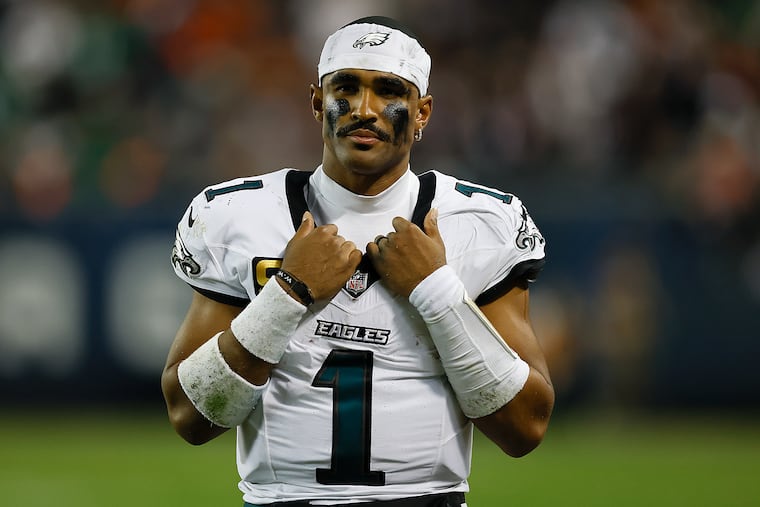
The Eagles are essentially turning Week 18 into a spa day for Jalen Hurts and most of the starters, handing the keys to Tanner McKee and asking the football gods to be normal about it. On paper, it makes sense. They’ve been here before. Sirianni keeps pointing out that the two Super Bowl runs came with byes, rest, and fresh legs. He’s not wrong. The scars from 2023 — A.J. Brown getting hurt in a meaningless finale, Hurts dislocating a finger — are still very much part of the group chat.
But this is Philly, so we can’t just rest people quietly.
Because technically, this game still matters. There’s still a path to the No. 2 seed. There’s still a chance to build offensive momentum, which has been… inconsistent, let’s say. And instead, the Eagles are choosing peace. Or at least the idea of it.
Enter Tanner McKee, who is suddenly the most important man in South Philadelphia for one afternoon. He’s calm. He’s saying all the right things. He’s talking about “playing fast” and getting reps and embracing the moment. This is both encouraging and deeply dangerous, because Philly fans have never met a backup quarterback they didn’t immediately project into a full-blown controversy.
If McKee plays well, WIP will combust. If he struggles, everyone will retroactively insist the starters should’ve played. There is no outcome where this doesn’t get litigated.
SEPTA’s very bad year (again): C-
Yes, we know. We’re grading SEPTA. Again. And no, this isn’t piling on. SEPTA did that to itself all through 2025.
If you rode transit even semiregularly this year, you don’t need a recap. You felt it in missed connections, sudden service cuts, mystery delays, and that low-grade anxiety that comes from not knowing whether your train is late, canceled, or quietly on fire. Five Regional Rail fires. A trolley tunnel that closed, reopened, and closed again. A budget cliff so real it had a dollar amount attached to it. Near-strikes. Court-ordered service reversals. Emergency money parachuting in at the last second like SEPTA is a reality show contestant who keeps surviving elimination.
The most Philly part? SEPTA technically survived. Barely. With duct tape, emergency funds from Gov. Josh Shapiro, and the kind of last-minute labor deal that had everyone holding their breath. There’s something almost admirable about how resilient the system is — not because it’s thriving, but because it simply refuses to collapse on schedule.
To be fair, some things improved. Serious crime dropped. Fare evasion finally got gates and consequences. SEPTA moved hundreds of thousands of people for the Super Bowl parade without melting down, which honestly might have been the most impressive transit achievement of the year.
But none of that erases the larger truth: SEPTA spent 2025 lurching from crisis to crisis, stuck in the same funding limbo it’s been warning about for years, with riders paying the price in time, stress, and reliability. The money fixes were temporary. The politics were familiar. And the promise for 2026 is essentially: please let us just do the basics.
That’s a low bar… and one SEPTA hasn’t consistently cleared in a while.
New Jersey’s minimum wage lapping Pennsylvania: D (for us)
We love to say we’re better than New Jersey. Spiritually. Culturally. Hoagie-wise. But on minimum wage? Absolutely not. Not even close.
New Jersey is heading into 2026 with a $15.92 minimum wage, adjusted for inflation like it’s a normal, functioning place that occasionally updates laws to reflect reality. Pennsylvania, meanwhile, is still parked at $7.25 — the same number it’s been since 2009, back when we all thought flip phones might be making a comeback.
That gap isn’t just embarrassing; it’s structural. You can cross the bridge and make more than double per hour doing the same work. And while yes, New Jersey is more expensive overall, that doesn’t magically excuse Pennsylvania paying wages that don’t come close to covering basic needs. Even the MIT living wage calculator, which is not exactly a radical think tank, says Pennsylvanians need far more than $7.25 to survive. Shock.
Philly has been stuck in the same frustrating loop for years. The city wants the power to set its own minimum wage. The governor supports raising it. Bills exist. Rallies happen. And yet nothing changes, leaving workers watching Jersey do the thing we keep promising to “get to.”
Philadelphia-to-Atlanta supercommute: A+ (unhinged, aspirational, deeply Philly)
Some people complain about a 33-minute commute. Philly’s Daniel Rodriguez gets on two planes, two trains, and a bus every week, by choice, because he loves Philly too much to leave it. That’s not transportation. That’s loyalty.
Flying to Atlanta twice a week so you can keep living in a Jewelers’ Row apartment with your wife, avoid owning a car, and still make your job work is the kind of stubborn, impractical devotion this city respects. It’s extreme. It’s exhausting. It makes no sense on paper. And yet it somehow feels more reasonable than moving to the suburbs.
This isn’t about hustle culture or going viral (though he did). It’s about refusing to uproot your life because the job market is broken, SEPTA is unreliable, and cities don’t always make it easy to stay. Instead of leaving Philly, Rodriguez made the commute worse. Heroic behavior.
Is it sustainable? Questionable. Is it environmentally clean? Debatable. Is it the most Philly response imaginable to a bad system? Absolutely.

- The world will be coming to Philly this year to celebrate America’s 250th birthday. We’re ready.
- How to have a Perfect Philly Day, according to 92.5 XTU’s Nicole Michalik
- Here are the 21 best things we ate in 2025
- Citywide Quest: Do you know where in Philly these New Year-themed photos were taken?
- Charm City eats, museums, and waterfront stays in Baltimore | Field Trip
- After walking away during an inspection, she rebounded with a two-bedroom in Newbold| How I Bought This
- My New Year’s resolution is to not let Philly team losses ruin my day. Any advice?
- A Mummers wedding on Market Street | Weekly report card
- Capturing the ghosts of 2025 and the future memories of 2026