City Council seeks new license system for loosely regulated smoke shops
Philadelphia City Councilmember Katherine Gilmore Richardson introduced legislation that would more tightly regulate smoke shops and the products they sell.
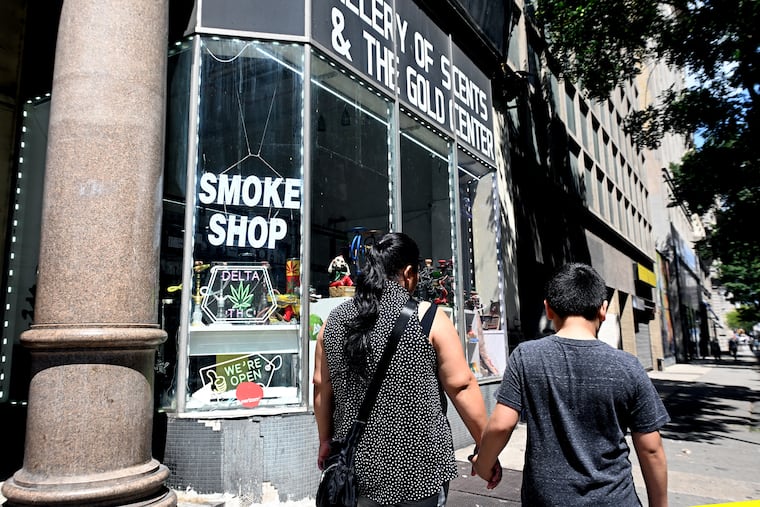
From Bryn Mawr to Bensalem, Abington to Kensington, and West Chester to West Philly, smoke shops are everywhere. So much so that authorities who’ve grown concerned about the booming business model have struggled to track them all.
In Philadelphia, City Councilmember Katherine Gilmore Richardson on Thursday introduced legislation that would establish a permit process, allowing the city to more closely monitor shops that sell unregulated drugs and crack down on those that flout the oft-hazy laws governing them.
The bill would establish a new license requirement for selling “intoxicating substances,” while implementing a series of restrictions around the sale of products like hemp-based THC and kratom. It would also update the city code to define intoxicating products and establish a 21-plus age restriction for purchases.
Gilmore Richardson proposed a second bill that would authorize the city to penalize landlords who rent space to stores selling tobacco products without a license.
“Nine times out of ten these products are being marketed to our children,” Gilmore Richardson said. “We have to do all we can to add a new section in our code.”
» READ MORE: From undercover stings to a marijuana museum: Inside the haphazard crackdown on Pennsylvania’s smoke shops
The new legislation would further require shops to have their products tested by a licensed lab in Pennsylvania and prove that the products are free from heavy metals, pesticides, solvents, mycotoxins, microbials, and other contaminants.
An Inquirer investigation last year found that hemp products sold at smoke shops throughout the region are often rife with harmful contaminants, and many contain substances that are blatantly illegal. Some of the products The Inquirer tested were, in fact, black-market weed that was labeled as legal hemp.
Shop owners defended the sales with lab results from the manufacturers indicating the products are both legal and toxin-free. Yet The Inquirer found that at least some of the reports were fraudulent or doctored to conceal the truth.
The bills are the latest proposals from Gilmore Richardson to rein in shops selling these products — many of which the city has labelled as nuisance businesses. Such shops have flourished since a 2018 change in federal law allowed for the over-the-counter sale of certain hemp products that are often indistinguishable from traditional marijuana.
How the proposed new regulations would be enforced remains unclear. As written, the license system and testing requirements would only apply to products that the U.S. Food and Drug Administration has deemed “safe.” Some smoke shop products products are marketed as nutritional supplements, which the FDA does not regulate.
Region-wide, the crackdown on smoke shops has been haphazard, with law enforcement officials often saying they are constrained by nebulous federal drug laws.
“You discover a gray area or a loophole that folks try to exploit, and you have to do another bill to deal with that,” Gilmore Richardson said.
» READ MORE: Inside Pennsylvania’s Wild West of unregulated weed
A federal ban on hemp-based THC products could take effect within the next year. Meanwhile, state lawmakers in Harrisburg have done little more than explore the idea of regulating the hemp-based THC market. Other states, including neighboring New Jersey, have for years had a regulated and taxed system of recreational marijuana.
State-issued tobacco permits are needed to sell nicotine products, but there is currently no permit required to sell hemp, kratom or similar smoke shop products in Pennsylvania. A grand jury report unsealed in Montgomery County last fall had to rely on Yelp to estimate that there are likely more than 240 smoke shops in Montco alone. That report called on Harrisburg to establish a permit system and an age restriction on hemp products containing THC.
In Philadelphia, many shops operate under convenience store permits, even if they aren’t selling many groceries. The city’s crackdown efforts have been largely limited to citing shops for fraudulently operating under this permit.
Gilmore Richardson said the intoxicating substances permit is a long overdue solution. The bills head to committee for review.
The second bill introduced Thursday would grant the city power to fine landlords who “knowingly lease” commercial property to a business that sells tobacco products without a permit. Currently, only the business owners face penalties for selling cigarettes without the proper permit.
Gilmore Richardson said she would consider expanding that legislation down the road to include the intoxicating substance permit — should it become law.
“You can’t manage what you don’t measure,” the lawmaker said. “We need to understand where these businesses are located.”
This article was supported by the Fund for Investigative Journalism.

The Inquirer’s journalism is supported, in part, by the Lenfest Institute for Journalism and readers like you. News and editorial content are created independently of The Inquirer’s donors. Gifts to support The Inquirer’s high-impact journalism can be made at inquirer.com/donate. A list of Lenfest Institute donors can be found at lenfestinstitute.org/supporters.