Putin says Europe out of step with an increasingly Moscow-friendly U.S.
Russian President Vladimir Putin told Europe it was out of step with the new priorities of the United States during his marathon year-end call-in show Friday.
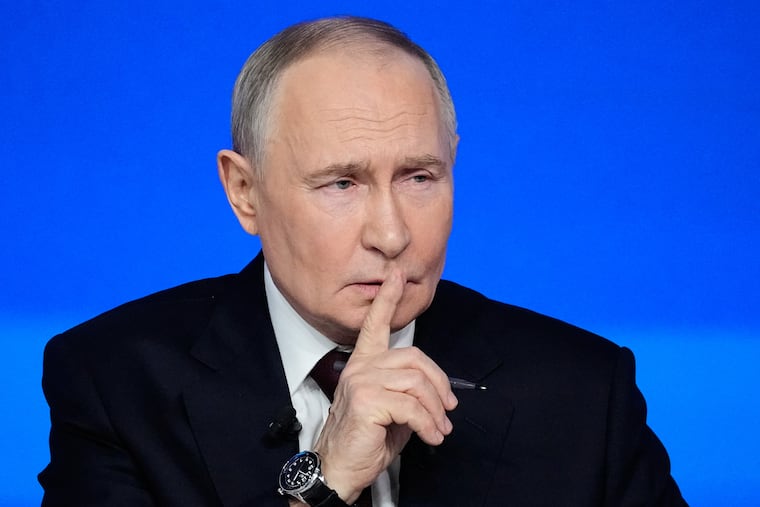
MOSCOW — Russian President Vladimir Putin told Europe it was out of step with the new priorities of the United States and painted a picture of the world in which America was closer to Russia than its traditional Western allies, during his marathon year-end call-in show Friday.
Over the course of several hours, Putin answered questions from journalists and the public, playing up the economy, expressing confidence on the Ukraine war and denying responsibility for the massive human casualties taking place. He also blamed the West for the invasion.
He ridiculed NATO Secretary General Mark Rutte’s warning this month that Russia could attack a NATO country in the next five years by saying such sentiment contradicted the new U.S. National Security Strategy, which does not identify Russia as an adversary to the U.S. and instead seeks “strategic stability.”
“The United States is the creator of NATO, its main sponsor. All the main resources come from the U.S. — money, military technology, weapons, ammunition, everything,” Putin said. “And in the new U.S. National Security Strategy, Russia is not named as an enemy or a target. Yet the NATO secretary general is preparing for war with us. What is that? Can’t you read?”
The Kremlin said earlier this month that the security document, which alarmed U.S. allies in Europe, was “largely consistent” with Russia’s vision.
Putin said that the conflict between U.S. President Donald Trump and European leaders was because “European political elites openly supported the Democratic Party” and its 2024 presidential candidate Kamala Harris, and said these same elites were hoping Republican losses in the midterm elections would put pressure on Trump.
The combined-format event, blending a large news conference with a “Direct Line” call-in from citizens that often runs for four hours, marks Putin’s most significant public address this year and one of his rare moments of engagement with the public. He skipped the traditional state-of-the-nation speech, normally held in the spring.
While Putin did say he was ready for peace with Ukraine and would compromise to end the conflict, he still repeated his well-worn lines blaming Kyiv for refusing to end the war — although it was Russia that invaded Ukraine. He also said Ukrainian forces were retreating “in all directions.”
Putin, who has taken a hard line on peace negotiations in recent days, said that Russia was ready for peace — on terms suitable to Moscow that eliminated what the Kremlin calls “the root causes” of the conflict, which would see a Ukraine subservient to its Russian neighbor.
Putin denied responsibility for human casualties in the war, “as we did not start that war.”
He said that he had told Trump that Russia was willing to compromise in peace talks when he met him in Alaska in August, although the Russian leader this week insisted that Russia would take more Ukrainian territory — which he called Russia’s “historical lands” — through military force if it failed to gain these through negotiations.
“When I arrived in Anchorage, I said these would not be easy decisions for us. But we agree to the compromises being proposed,” Putin said, adding that “to say that we reject anything is absolutely incorrect and has no basis.”
“The ball is entirely in the court of our opponents, so to speak, and, first and foremost, the leaders of the Kyiv regime and their, in this case, and above all, European sponsors,” Putin said.
Asked by the BBC whether there would in future be new “special military operations,” the Kremlin’s euphemism for the war — Putin said: “Western leaders created this situation themselves and continue fanning the flames by saying they are preparing for war with Russia,” adding it was “nonsense” that Russia wanted to go to war with Europe.
During the conference questions from Russians flashed up on screens in the hall, including one that suggested that Russian elections were “a fiction” and another that asked why ordinary Russians lived so badly.
“When you will return the ‘normal internet?’ It’s impossible to even send a question to the president!” one asked. Another asked, “Are you going to nominate yourself to run for president in 2030?”
When the Levada Center independent polling agency asked Russians last month what questions they had for Putin, 21% wanted to know when the war would end, and 16% wanted to ask when pensions and benefits would increase.
Putin adopted a triumphalist tone, boasting that Russia would have new military successes before year’s end. “I have no doubt that you and I will witness new successes of our armed forces, our troops on the contact line before the end of this year. That’s the plan.”
Putin also rolled out a list of statistics to show the economy was doing well, including an unemployment rate of just 2.2% and a national debt that he boasted is among the lowest of developed countries. While growth this past year was only 1%, he maintained it was deliberate.
“This was done in the course of targeting inflation,” he said. Inflation has dropped from nearly 10 percent down to 5.7%, he said. He added that an increase in sales tax on Jan. 1 from 20% to 22% was needed to balance the budget and would not be permanent.
But in a sign that Western sanctions are taking a real toll on Russia’s economy, questions addressed high prices of chicken and other essential items, as well as a shortage of fish.
“Stop price increases!” said a message from one Russian displayed on the screens in the hall.
“There really isn’t enough fish on people’s tables. We’re not meeting the standard here,” Putin admitted.
A question from a child was read out asking, “Why the pastries in the cafeteria rise but my parents salary does not?”
The press marathon comes amid a burst of diplomatic activity as Trump pushes for a deal to settle the conflict in Ukraine. Trump’s special envoy, Steve Witkoff, and his son-in-law Jared Kushner are expected in Miami this weekend for talks with Kirill Dmitriev, Putin’s key investment envoy and a central figure in back-channel discussions, Axios and Politico reported.
On Thursday, the Kremlin confirmed Russia is preparing for American contacts to clarify details from recent U.S. consultations with Ukraine and Europeans held in Berlin earlier this week.
Putin’s address comes after European leaders agreed Friday to give Kyiv nearly $105 billion in a loan backed by the bloc’s budget, after the failure of a last-ditch effort to tap Russia’s $246 billion in frozen assets to finance Ukraine’s state and army. Putin called the attempt to tap the assets “open robbery” during the event.
Moscow had stepped up anti-European rhetoric and vowed retaliation against any seizure, warning that without fresh funding, Kyiv’s resources could dry up within months.
The Kremlin said about 3 million questions had been received by Friday, according to spokesman Dmitry Peskov. Putin’s approval rating remains steady at 84%, according to a Levada poll in October and November published last month.
But as the Ukraine war — planned by the Kremlin to last just a few days — approaches its fourth year, war fatigue has set in, with casualties skyrocketing as Russia presses on with limited territorial gains.
More than 65% of people surveyed by Levada in mid-November believed it was time for peace talks instead of continued military action, a four-percentage-point increase over the previous month. Tellingly, 55% in a separate Levada poll the previous month said they would not want a family member to sign a military contract to fight in Ukraine, 14% higher than in May 2023.
According to the recent Levada poll, 65% of Russians believe the country is heading in the right direction, down from 74% in March, while 21% feel Russia is on the wrong path, compared with 16% in March.
With Russia’s economy under intense pressure amid sanctions, declining oil prices and high interest rates, dozens of Russian companies have laid off workers or cut wages, while residents grapple with inflation and a rising cost of living. According to the poll, 25% said their life had gotten worse in the past year.
In the lead-up to Putin’s question session, residents in villages and towns across Russia recorded videos complaining of local issues: a lack of heating in their homes; terrible roads; public transport failures; odorous smoke from local landfills; and other matters that will probably be featured during the event.
Dixon reported from Riga, Latvia. Natalia Abbakumova in Riga, Latvia contributed to this report.