Who is Shane Hennen, the high-stakes Philly gambler at the center of the latest sports-betting indictment?
A Philly-based pro gambler and "betfluencer" once again looms large in a federal gambling investigation into the NCAA
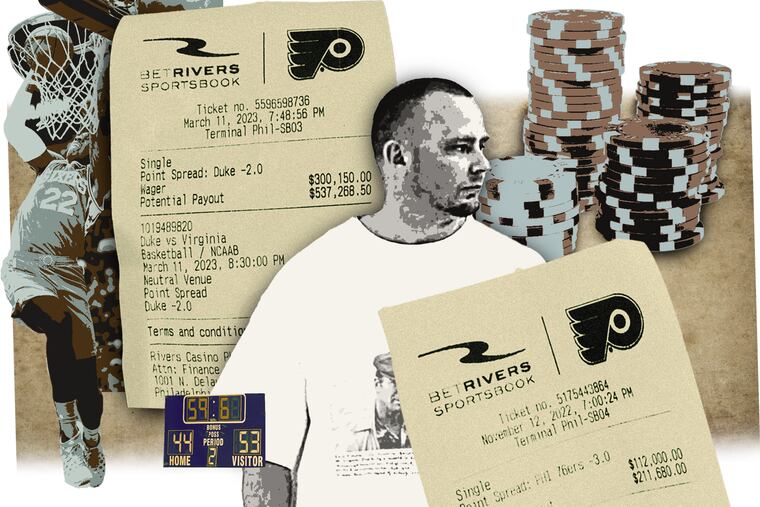
For Shane Hennen, the house of cards keeps folding.
A federal indictment unsealed Thursday accuses the Philadelphia-based professional gambler of acting as a ringleader in a sweeping sports-betting conspiracy now involving the NCAA and the Chinese Basketball Association. Hennen was first arrested last January in connection with a gambling case involving a former Toronto Raptor, and was also charged separately in an October indictment in New York focused on the NBA.
The latest charges against Hennen, known as “Sugar Shane,” brought an international angle to the existing portrait of a high-stakes gambler who prosecutors allege was willing to bribe athletes to throw games, provide devices to fix backroom card games tied to the New York mafia, and use insider betting information to place fraudulent wagers.
In all, federal prosecutors have accused Hennen of conspiring to place fraudulent bets on ex-Raptors forward Jontay Porter and NBA guard Terry Rozier, bribing the top-scoring player in the CBA to throw games, and recruiting college basketball trainers to help rig dozens of NCAA games — much of it orchestrated from Hennen’s favorite Philly casino, Rivers. On top of it all, he is also alleged to have participated in the rigging of mob-linked poker games in New York City.
And while the list of implicated players and conspirators continues to grow by the dozens, Hennen has remained a central figure to the bet-fixing scandals that have rocked the sports world over the past year.
Rise of a “betfluencer”
On social media, Hennen has cast himself as rising from a hard-luck Pennsylvania town to a self-styled “betfluencer,” flying on private jets from Las Vegas to Monte Carlo and gambling up to $1 million a week on sports and card games.
But Hennen’s earlier record for criminality came into clearer view as result of the federal investigations. While growing up in the Pittsburgh area, he did time for drug and gambling related charges that now serve as a kind of prelude to his role in the bet-fixing scandals.
In 2006, the Washington, Pa., native received probation in Allegheny County for charges linked to a gambling scheme. According to court records, Hennen and an accomplice rented adjacent rooms in a Pittsburgh area hotel to hold underground dice games. While gambling in one room, a partner in the next room employed a magnetic device to flip loaded dice to preferred numbers.
Then, early one morning in 2009, a former Duquesne University basketball player was found bleeding from a stab wound in Pittsburgh’s South Side neighborhood, a popular nightlife area. The man survived and later told police that Hennen had stabbed him in the neck after the athlete confronted him about cheating in a card game. Hennen was also picked up on a DUI less than two weeks later, but was released.
Not long afterward, Hennen was charged with two more felonies after he was caught in a parking lot with 500 grams of cocaine down the street from the Meadows Casino, near Pittsburgh.
In subsequent court filings, Hennen revealed that he had been working with a local drug dealer for more than a year. Facing well over a decade of jail time between the drug and assault charges linked to the stabbing, Hennen agreed to testify against his dealer and participated in a federal drug sting involving a different narcotics supplier based in Detroit, court records show.
He served just less than two-and-a-half years in prison, plus four years of supervised release.
According to court transcripts published by Sports Illustrated in October, Hennen admitted five times under oath that he cheated other people out of money.
During a cross-examination, Lee Rothman, an attorney for his associate drug dealer he was testifying against, stated bluntly that Hennen made “a living out of cheating people out of things.”
“That’s correct,” Hennen said.
After his release in 2013, Hennen traveled to Pensacola, Fla., purportedly to work as a sales rep for a seafood wholesaler. Court records show he almost immediately went back to gambling, even violating his probation to travel out of state to participate in the 2014 World Series of Poker in Las Vegas.
When Hennen landed in Philadelphia in 2015, it was seemingly to start over. He leased an apartment near the Rivers Casino in Fishtown.
The small casino would become Hennen’s unlikely staging ground for a new, more lucrative gambling scheme that would come to span the globe.
From Philly to China
Local gamblers said Hennen worked the poker and baccarat tables at Rivers, using the action to build a reputation with the house and pave the way for six-figure sports bets, the kind only gamblers with money and a track record at the casino are allowed to make.
By 2022, Hennen had launched an online betting consultancy via an Instagram page called “Sugar Shane Wins.” On social media, Hennen posted his sportsbook picks along with glamorous photos jetting around to Vegas or Dubai, or sitting courtside at Sixers games.
Although he marketed bets on teams familiar to U.S. gamblers, his focus — and income — was overseas, according to federal prosecutors.
He posted courtside photos of himself at Sixers games with a Mississippi-based sports handicapper named Marves Fairley, who prosecutors say connected the gambler with Antonio Blakeney, a former Louisiana State University shooting guard who had done a brief stint on the Chicago Bulls.
Blakeney had subsequently bounced around different international teams, including Hapoel Tel Aviv, in Israel, and the Nanjing Monkey Kings and Jiangsu Dragons, both in China. According to a federal indictment, while playing for the Dragons, Hennen and Fairley bribed Blakeney to underperform in Chinese basketball games in order to fix high-stakes bets against the team and recruit others to do the same.
Suddenly, the slots parlor on the Delaware was seeing six-figure bets placed on multiple Chinese basketball games through its sportsbook, BetRivers, sometimes for upward of $200,000. Representatives for the casino declined to comment Thursday on the latest federal indictment.
The gambit proved reliably lucrative. In a 2023 text message obtained by federal authorities, Hennen reassured an accomplice who had placed big bets against Blakeney’s team.
“Nothing gu[a]rantee[d] in this world,” Hennen wrote, ”but death taxes and Chinese basketball.”
The model would also serve as a template for a similar racket the duo would orchestrate within the NCAA.
By 2024, the duo had recruited basketball trainers Jalen Smith and Roderick Winkler to help convince dozens of college basketball players to rig matches on their behalf.
Ultimately, 39 players on more than 17 Division 1 NCAA teams would participate, with bettors wagering millions on at least 29 rigged games.
Hennen took a behind-the-scenes role, authorities alleged, texting a network of straw bettors who placed big wagers on games featuring star players bribed by the trainers, and sometimes moving bribe money or splitting up winnings back in Philly.
His rising profile started to draw unwanted attention.
Shortly after Hennen relocated to Las Vegas in 2023, he was accused of rigging poker matches by Wesley “Wes Side” Fei, another professional gambler who claimed in social media posts that Hennen had scammed him out of millions.
The next year, gambling industry watchdog Integrity Compliance 360 began flagging bets placed on six Temple University basketball games. One, against Alabama-Birmingham in March 2024, saw the Borgata, in Atlantic City, cancel bets for the game due to suspicious betting activity. Before the end of 2024, the National Collegiate Athletic Association had launched an investigation into the games, as rumors swirled that federal authorities were questioning Temple player Hysier Miller as part of an alleged point-shaving scheme.
Then Porter, the Raptors center, was banned for life from the NBA, after it emerged that the league was investigating yet another bet-rigging scheme. A few months later, Porter pleaded guilty to gambling charges — the first hint at the true scope of a sprawling federal investigation that went on to consume the NCAA and NBA.
Beginning of the end
In January 2025, Hennen’s luck ran out.
Authorities stopped him in Las Vegas as he was boarding a one-way flight to Panama, en route to Colombia. He had $10,000 in his pocket and claimed he was headed to South America for dental treatment.
But investigators had already zeroed in on Hennen as the main orchestrator of the prop betting scheme involving Rozier, the former Miami Heat guard. In October, federal prosecutors in the U.S. District Court for the Eastern District of New York unsealed an indictment, accusing Hennen of working with Fairley to have Rozier throw games for a profit, sometimes using Philadelphia as a meeting point to dole out the proceeds to other bettors.
Court records show that since then, Hennen has entered plea negotiations with federal prosecutors and relocated to a residence in South Philadelphia. (His attorney did not respond to a request for comment.)
During the Thursday news conference unveiling the latest indictment, Wayne Jacobs, a special agent in charge of the FBI Philadelphia field office, said that Hennen and his conspirators’ actions had undermined faith in professional sports writ large.
“We expect athletes to embody the very best of hard work, skill, and discipline, not to sell out to those seeking to corrupt the games for their own personal benefit,” he said. “The money that’s used as a tool to influence outcomes does not just taint a single game, it tears up the trust and the results that we cherish.”

The Inquirer’s journalism is supported, in part, by the Lenfest Institute for Journalism and readers like you. News and editorial content are created independently of The Inquirer’s donors. Gifts to support The Inquirer’s high-impact journalism can be made at inquirer.com/donate. A list of Lenfest Institute donors can be found at lenfestinstitute.org/supporters.