What the colorful markings on Philly-area streets and sidewalks reveal about what’s underground
The symbols might look like gibberish, but they have important safety purposes.
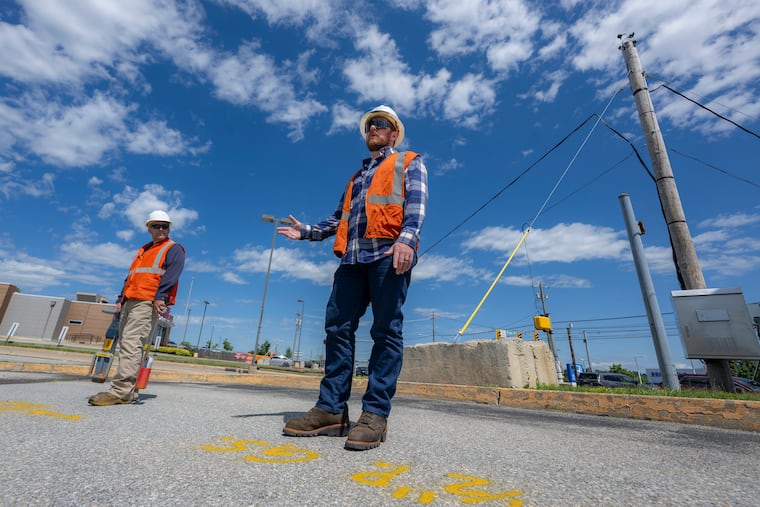
On a hot Thursday morning, two Peco workers arrived in Conshohocken, tools in hand, to spray-paint brightly colored letters and numbers onto the sidewalk.
The symbols might look like gibberish; but they are the language of utility companies that let anyone doing work in the area know what utilities are underground.
The process starts when a business owner, contractor, or homeowner calls 811, the free Pennsylvania line that must by law be called before any digging work to prevent damage in utility lines.
The call center takes in the who, when, where, and whys of the job, and the corresponding utility companies make sure their lines are labeled in the area.
“If somebody is digging and they don’t know where our gas and electric lines are, there is a potential for property damage, loss of life, or injury — anything from cuts and scrapes to a fatality,” said damage prevention inspector Bryan Lloyd.
This marking is usually a one-person job, but if the digging spans miles, a team will be sent out.
In Conshohocken, the project near a plaza on a commercial strip is large enough for gas supervisor Michael Onimus to accompany Lloyd on this request.
The men got out of their truck and put on protective gear, white Peco helmets, and reflective orange vests.
Lloyd leaned into his truck, moving a 2½-foot-long blue bag with equipment out of the way, to reach a red metal marking wand that will later be loaded with spray paint to help him make the marks.
Inside the bag, Lloyd keeps radiodetection equipment capable of locating cables, pipes, and lines of multiple materials.
The machine has a box called a transmitter with two cables, and a current locator that works similar to the metal detectors folks use to scope the sand down the shore.
Lloyd creates a circuit connecting a red clip to the gas meter. A black grounding tool — which looks like a long metallic turkey baster— is inserted into a dirt patch to complete the circuit.
Lloyd pushes it into the soil, sending a current to detect precisely where the line was located.
The type of soil, amount of rock, and pipe materials can change how easily the locator can pick up the signal.
In this case, the locator picked up a signal about 20 steps from the meter.
Locator in the right hand and marking wand with yellow spray paint in the left, Lloyd walked around the perimeter of an empty restaurant, following the frequency and spraying yellow spots along the way.
The yellow color was not his choice. It’s part of a color-code system that lets contractors know which lines are in the areas they are digging. According to Onimus, each service has its own pigment:
Yellow: gas pipes
Red: electric lines
Blue: water pipes
Green: sewer lines
Luckily, paint isn’t the only way to mark things. In areas where painting would be difficult, like grass, they can place small flags with the same color-coding system.
Once Lloyd has circled the area, he walked along the path of dots making long Z-shaped lines to connect them, before writing “½ P. GS. Peco” in yellow spray paint. This is called labeling the utility line.
“You have the size of the facility, which is half an inch in this case. The material type, which here is plastic, so P. Then you have the service, in this case GS for gas. And then Peco to let everyone know this is our facility,” Onimus said.
The order in which those elements are written down always follows the same pattern, but the information changes depending on how big the pipes are, type of line, utility company, or material they are made of.
For example, “S” means the line is made out of steel, while “CI” stands for cast iron, Onimus said.
With the gas all mapped out, it was time for the electric. The process is not much different, but the current-detection system does vary, since gas pipes are usually made of plastic, but electric lines have steel or metal inside the cables.
Like with the gas line, he follows the signal, this time leaving bright red dots on the ground.
The electrical current led them to a pole inches away from where digging is already taking place — markings of a light red spray from a different utility company already branded the concrete.
Picking up the frequency from the electric line, Lloyd drew what looks like a red H on the ground. The mark signaled multiple electrical lines were connected to the nearby street light post, three in this case.
Tracing back his steps, Lloyd drew more H’s in between the previously marked red dots. Before arriving back at the meter, he wrote: “Peco. Ele. Primary,” meaning a primary electrical line that belongs to Peco.
Twenty minutes later, their work in Conshohocken is wrapped up. But not before Onimus stressed the importance of calling 811 before any digging job, even gardening, no matter how small it may seem.
“People say ‘I was doing a couple inches,’ but before you know [it], you are 12 inches deep in the ground, and hitting a gas or electric line,” Onimus said. “If you hit a gas line, it may not necessarily injure you, but it could implicate a kind of injury to somebody else in the community, so calling makes sure everyone in the community is safe because we are all in this together.”