‘Hands Off Venezuela’ protesters in Philly call for a stop to U.S. aggression amid attacks on alleged drug-smuggling boats
The U.S. has been conducting military strikes against boats in the Caribbean Sea and Pacific Ocean since September.
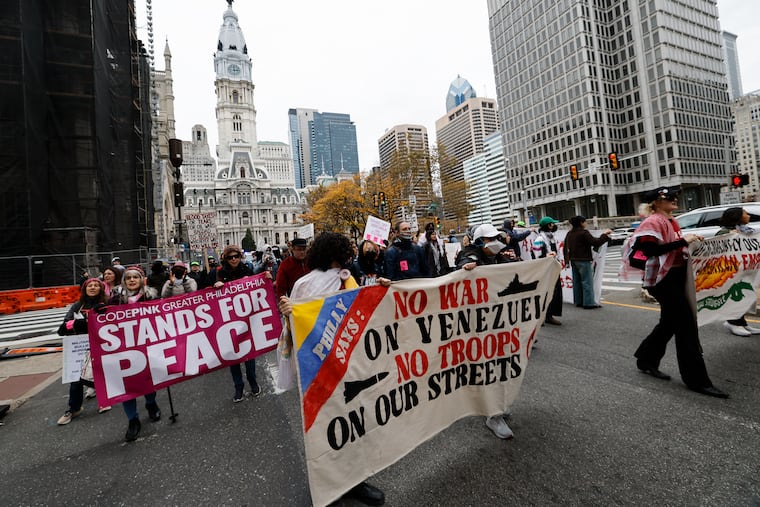
More than 60 people gathered on the north side of Philadelphia City Hall Saturday afternoon and then marched through city streets to protest what they called the U.S. war on Venezuela.
“Long live Venezuela, long live the Venezuelan people, enough Yankees, enough, Venezuela will live on,” the protesters chanted.
The “Hands off Venezuela” demonstration comes two days after Secretary of Defense Pete Hegseth put a name to the military strikes against suspected drug-smuggling boats in the Caribbean Sea and eastern Pacific Ocean that the U.S. has been conducting since September: Operation Southern Spear.
“This mission defends our Homeland, removes narco-terrorists from our Hemisphere, and secures our Homeland from the drugs that are killing our people,” Hegseth announced on X. “The Western Hemisphere is America’s neighborhood — and we will protect it."
Since the start of the operation, more than 21 vessels have been hit by U.S. strikes, killing at least 80 people.
The latest attack, on Monday, killed four men aboard a vessel in international waters, according to the U.S. Southern Command, which alleged the men were trafficking narcotics in the Caribbean.
Calling for a diplomatic solution and the respect of Venezuela’s right to self-determination, a coalition of local peace organizations marched in Center City Saturday afternoon to protest the Trump administration’s escalation of military aggression.
“CodePink Greater Philadelphia proudly adds our voice to the call to end the U.S. government’s attempt to meddle in the affairs of yet another sovereign nation, militarily or otherwise,” CodePink Philadelphia organizer Steve Malloy said in a statement.
Some of the protesters expressed support for the Venezuelan militia, the very forces that have prompted many Venezuelans to flee the country over the years, and were critical of U.S. capitalism.
After about 20 minutes of remarks by two speakers, the protesters filed onto Broad Street, marching north and chanting “Viva, viva Venezuela. U.S. out of Venezuela.”
They carried banners and signs that read “No war on Venezuela, no troops on our streets,” “Militarized bullies and murderers do not result in peace for anyone,” and “Hands off Venezuela and Cuba.”
On Friday, Venezuela’s president, Nicolas Maduro, addressed his citizens in Spanish at an international meeting of jurists to protest the U.S. military deployment in the Caribbean: “It is to the people of the United States that I am addressing at this moment: Stop the mad hand of those who order bombing, killing, and waging war in South America and the Caribbean. Stop the war, say no to war.”
“Peace, peace, peace. The order is peace, war no,” he later added in English.
President Donald Trump has accused Maduro of being involved in drug trafficking, and Attorney General Pam Bondi has announced a $50 million reward for information leading to Maduro’s arrest.
Though the amount has changed, the Justice Department has been offering a reward for Maduro since 2020, when he was formally charged with narco-terrorism, corruption, and drug trafficking, along with 14 other Venezuelan officials.
In a meeting Thursday in the White House Situation Room, national security officials and Trump reviewed possible future action against Venezuela, including airstrikes on military and government facilities and suspected drug-trafficking routes, according to a CNN report.
On Friday, Trump told reporters aboard Air Force One: “I sort of have made up my mind — yeah. I mean, I can’t tell you what it would be, but I sort of have."
Such a threat was part of what brought Geo Maher, who lived in Venezuela in 2006 and now lives in Philadelphia, to the protest in Philadelphia Saturday: “I am here to make it clear that I oppose any U.S. intervention in Venezuela.”
Maher condemned U.S. economic sanctions on Venezuela.
“The U.S. has made it almost impossible for Venezuela to take care of its people,” he said.
For Fernando, who declined to provide a last name since his family still lives in Venezuela, coming to the protest felt like one of the few things he can do to help them.
“My family has a bakery; they don’t have enough flour; they don’t have enough food because of the U.S. economic sanctions placed on the Venezuelan government,” the 22-year-old said.
Born in the U.S., Fernando said the recent boat strikes are pushing people in Venezuela to fear the U.S. and the possibility of a land attack.
“They don’t want the U.S. because they don’t want their military force bombing their houses, their schools, their hospitals,” Fernando said.
Saturday’s march ended shortly before 4 p.m. at 15th and Spring Garden Streets, outside the Armed Forces Career Center.
Protesters vowed to return, if necessary.
“If they start a war abroad, we are going to start a war on Broad,” said one protester, as others cheered.