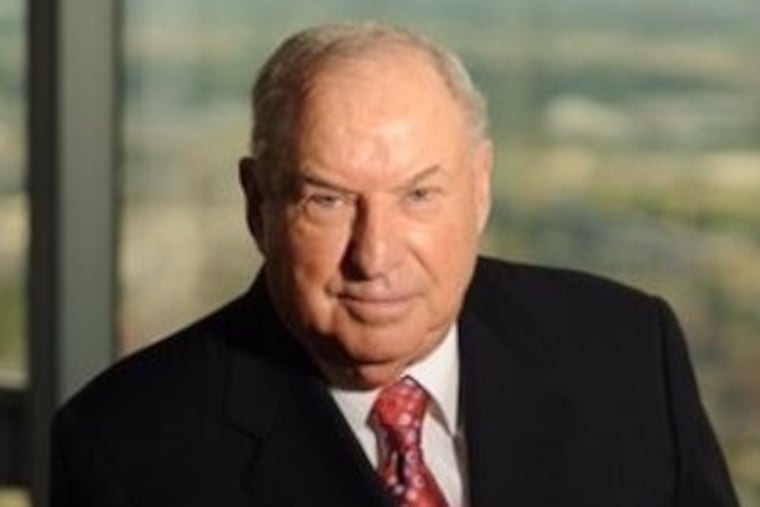
Gary Graffman, pianist and former Curtis faculty member and president, has died at 97
He first came to Curtis as a student at age 7. In 1980, he returned as faculty and then became director and president. He taught superstar musicians like Yuja Wang and Lang Lang.
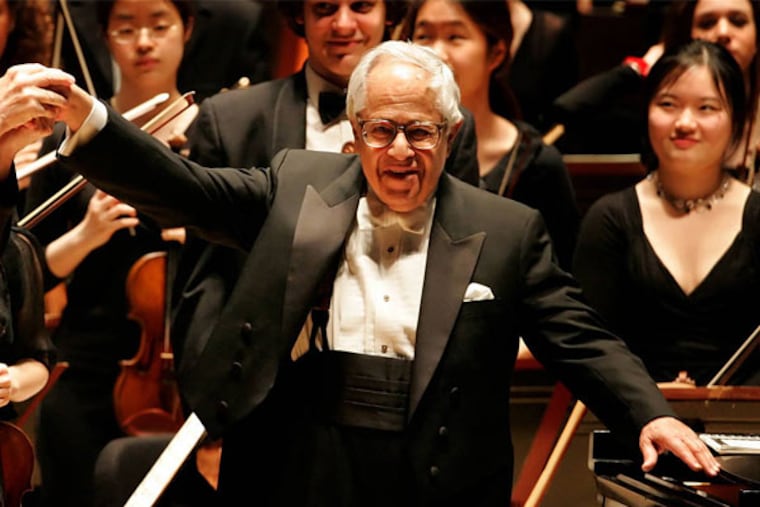
While the classical music world knew Gary Graffman as a distinguished visiting concert pianist, Philadelphia was his launching pad and artistic home over roughly eight decades. He was both a student and president at the Curtis Institute of Music, nurturing young talents to international fame before his death on Saturday in New York. He was 97.
His death was confirmed by his longtime publicist.
The New York City-born pianist arrived at Curtis at age 7. He graduated at age 17 and played roughly 100 concerts a year between the ages of 20 and 50 before retiring from touring due to a compromised right hand. Diagnosed with focal dystonia (a neurological disorder), he went on to premiere works for the left hand by Jennifer Higdon and William Bolcom.
Mr. Graffman returned to Curtis as a teacher in 1980, became director in 1986, and the president of the conservatory in 1995, with a teaching studio encompassing nearly 50 students, including Yuja Wang and Lang Lang among others. He performed on numerous occasions with the Philadelphia Orchestra from 1947 to 2003.
He stepped down from the faculty at age 92 in 2021, mainly due to travel challenges, having commuted for years between New York and his Philadelphia home at the Wanamaker House on Walnut Street. Yet he maintained a family-like association with students at his longtime 57th Street Manhattan home that was filled with antiques he acquired over many visits to China. He joked that he had cleaned out the continent, saying (with his characteristic humor), “There’s no more left. All gone!”
Mr. Graffman’s interest in nonmusical matters helped ease his transition out of full-time touring. Often accompanied by his wife, Naomi (who preceded him in death in 2019 at age 90), he projected a been-there-done-that attitude and was relieved not to have more comprehensive ailments, having been diagnosed with Parkinson’s disease. “It’s only your hand,” he told commentator Zsolt Bognár in an extended, candid interview for Living the Classical Life, a distinguished series of podcasts.
Having started playing piano at age 3 under the guidance of his Russian-heritage parents, Mr. Graffman began studying in earnest in 1936 at Curtis. Though he went on to study at Columbia University and to win the Leventritt Competition, his career effectively began at age 17 after winning the Rachmaninoff Fund competition, as documented in a short squib in the New York Times, dated March 28, 1947:
“Gary Graffman of 226 West Ninety-seventh Street, New York, made his debut this afternoon with the Philadelphia Orchestra, conducted by Eugene Ormandy, playing Rachmaninoff’s Second piano concerto. The 18-year-old pianist was recalled to the stage several times, amid shouts of ‘bravo’ from the more than 3,000 persons in the Academy of Music.”
Years of less-formal studies followed with the legendarily strong-minded Russian pianist Vladimir Horowitz, from whom Mr. Graffman learned how to bring out the individual voice of a student. During lessons, Horowitz never went to the keyboard to demonstrate how he would play a particular phrase.
From there, Mr. Graffman had a top-of-the-line career. He recorded much of the romantic-era piano literature for RCA and Columbia, and with some of the great orchestras of the United States. Most notably, he recorded his signature Rachmaninoff Piano Concerto No. 2 with the New York Philharmonic under Leonard Bernstein.
But while recording Tchaikovsky’s Piano Concertos 2 and 3 in Philadelphia with Eugene Ormandy, Mr. Graffman began noticing finger problems that, at the time, he was able to work around.
Like many musicians experiencing such difficulties, it was initially assumed (even by his wife) that he wasn’t practicing enough.
At age 50, he canceled engagements but managed to record Gershwin’s Rhapsody in Blue, which was used for the soundtrack of the Woody Allen movie Manhattan, and pursued various treatments.
Back then, focal dystonia was little known or understood. Mr. Graffman’s colleague Leon Fleisher had been struggling with the ailment for years, finally having a late-in-life resurgence as a two-handed pianist. Not Mr. Graffman.
He made the Ravel Piano Concerto for the Left Hand the center of his repertoire, explored other left-hand works commissioned by the Viennese pianist Paul Wittgenstein (who lost his right arm in World War I) and performed new left-hand works, including concertos by Bolcom, Daron Hagen, and Ned Rorem.
Though he is often characterized as having been limited to repertoire for the left hand only, the practical truth is that Mr. Graffman maintained some use of his afflicted hand, allowing him to perform works that made limited use of the right hand, such as Alfred Schnittke’s Piano Quintet and Jennifer Higdon’s 1999 Scenes from the Poet’s Dream, commissioned by the Philadelphia Chamber Music Society.
Returning to Curtis, Mr. Graffman was good to his word in teaching each student as an individual whose journey was yet to be discovered.
Ignat Solzhenitsyn, who graduated in 1995, became a conductor with Chamber Orchestra of Philadelphia and the Kirov Opera. Yuja Wang (2008) has pursued a mixture of new and traditional repertoire, also giving marathon concerts of the Rachmaninoff piano concertos all in one day. Though Mr. Graffman was generally against piano competitions, Hao Chen Zhang (2012) had trouble establishing his career until entering and winning the Van Cliburn Competition.
Most interesting among Mr. Graffman’s students was, perhaps, Lang Lang (2002). His career seemed to be launched by filling in for Andre Watts at Chicago’s Ravinia Festival. Mr. Graffman maintained that event only sped up the inevitable.
For years, Mr. Graffman had Lang Lang trying out repertoire in private events, starting small with Mendelssohn and working his way up to bigger repertoire. When Lang Lang was sidelined by tendinitis around 2017, he reportedly turned to Mr. Graffman to find his way back to the concert stage.
Financially, Curtis thrived during Mr. Graffman’s tenure. From 1985 to 2005, annual giving rose from $300,000 to $1.8 million and the endowment went from $45.5 million in to $140 million.
The major blot on Mr. Graffman’s administrative career, however, was considerable. In 2019, violinist Lara St. John came forward with reports of faculty rape during her mid-1980s student years at Curtis. Investigations concluded that Mr. Graffman had failed to take appropriate action on her reports of sexual assault.
No doubt, Mr. Graffman will be most remembered as a pianist. Truly a child of the post-Arturo Toscanini generation, Mr. Graffman played with a deep respect for the letter of the score. Often, Mr. Graffman’s Russian heritage could roar into the fore during, say, cadenzas of a Beethoven piano concerto. His impish wit could often be heard in performances of Rachmaninoff’s Rhapsody on a Theme of Paganini. And not surprisingly.
Offstage, Mr. Graffman projected a sense of fun, which is often apparent in his 1981 memoir, I Really Should be Practicing. When Japanese-born pianist Mitsuko Uchida declared having great artistic affinity for the Central European Jewish community, Mr. Graffman began sending her Hanukkah cards. Regarding Wang, he said that she was fascinated by arts beyond the music saying, with mock incredulity, that she went to museums “because she really wants to!” When recordings by the British pianist Joyce Hatto were scandalously discovered to have been stolen from other pianists in 2007, Mr. Graffman quipped that he would be ”deeply offended” if his recordings weren’t among them.
Mr. Graffman leaves no immediate survivors. Memorials will be announced at a later date.