Carlo Petrini, whose Slow Food movement transformed how we eat, dies at 76
His embrace of seasonal foods, sustainable farming, and traditional cooking had a global reach.
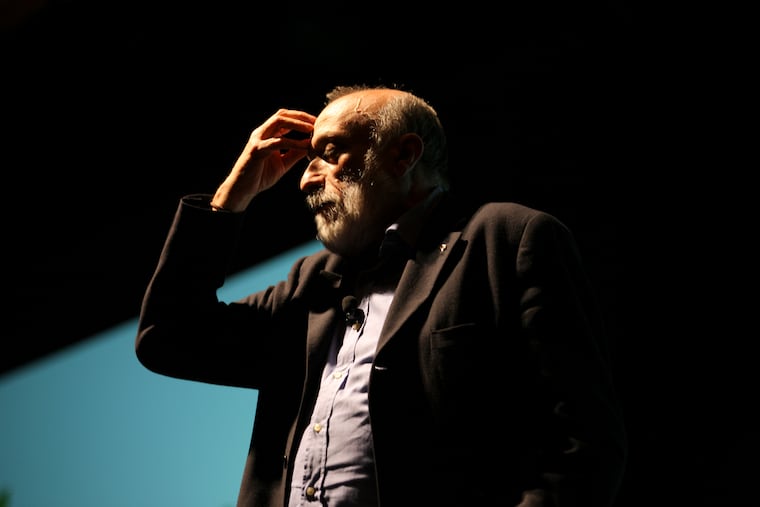
Carlo Petrini, whose embrace of seasonal foods, sustainable farming, and traditional cooking as the founder of the Slow Food movement helped transform the way millions of people think about what they grow, how they cook, and how they eat, died at his home in Bra, Italy, south of Turin, on Thursday. He was 76.
Slow Food, the organization he founded in 1986 and led until 2022, announced the death, from prostate cancer.
It can be hard to remember a time when grocery stores didn’t offer much beyond frozen, processed foods, or when fast-food restaurants were the only option in town. The plethora of alternatives today — organic brands, farmers’ markets, restaurants that prioritize fresh ingredients — is due in large part to decades of work by Petrini.
He did not promote food as a luxury item, nor did he agree with those who fetishized, say, heirloom arugula for its own sake. But he was a pioneering voice in calling for an end to the worldwide conveyor belt of cheap, low-nutrient foods, which dealt an enormous cost to the planet, human culture, and our bodies. Instead, he urged people at all points in the supply chain to embrace food that was, he said, “good, clean, and fair.”
Slow Food, based in Bra, is the heart of a global grassroots network of farmers, chefs, policy experts, and politicians. Petrini connected them through books, magazines, seminars, and Terra Madre, a sprawling annual conference in Turin.
More than an organization, Slow Food is a movement, with Petrini as its chief engineer. Today thousands of restaurants around the world declare their adherence to buying local, regenerative foods by featuring Slow Food’s logo — a snail, of course — in their windows.
“Carlo was always not just speaking forth, but he was connecting with the person who is on the ground,” Alice Waters, owner of the restaurant Chez Panisse in Berkeley, Calif., and a close friend, said in an interview.
Petrini’s campaign began in 1986, following the announcement that a McDonald’s would soon replace a beloved coffee shop in the Piazza di Spagna in Rome. He rallied his friends and stood outside the location, handing out pasta and giving speeches denouncing fast food.
What did he stand for, if not fast food? one onlooker asked, as writer Fred Plotkin, who happened to be there, recalled.
“Slow food!” Petrini replied, on the fly.
What’s that? someone asked.
“When I know, I will let you know,” he answered.
But Petrini likely already had a good idea. Slow food was everything that McDonald’s wasn’t: local seasonal produce, traditional recipes, communal eating. Getting people to embrace it was the challenge — and Petrini was the right person to take it on.
The organization was originally called Arcigola — a blend of Arci, a type of Italian cultural club, and “gola,” Italian for throat (and perhaps a play on “agricola,” Latin for farmer) — but Petrini changed it to the more direct Slow Food as the movement gained international traction.
A former radio journalist, he had a flair for dramatic presentation, beguiling charisma, and an ability to package big ideas in simple, persuasive declarations.
“You cannot separate food production from the environment,” he told the Guardian in 2007. “We need to relocalize food and avoid food miles.”
Petrini was an avowed leftist, but he was also a master at building coalitions among divergent bedfellows. He drew support from left- and right-leaning Italian governments and from a wide range of politicians and cultural figures across Europe, including Pope Francis and King Charles III of Britain.
People often compared Petrini to religious figures, casting him as an apostle of sustainable farming or as a Noah trying to rescue cuisines from going extinct under a flood of processed foods. Like Noah, he had his own ark, the Ark of Taste, akin to an endangered species list for foods and dishes, which Slow Food encouraged chefs and diners to cultivate.
In 2004, Petrini opened the University of Gastronomic Sciences, an accredited institution in Pollenzo, Italy, not far from Bra. The school says more than 4,000 people have come there to study subjects like food cultures, cooking and agricultural management.
“It sounded like the Hogwarts of food,” David Prior, a travel and food writer, said in an interview.
Prior was working in a restaurant in Sydney when he first heard of it. He immediately wrote to the university for admission, and a month later he was in Pollenzo.
“Carlo managed to make gastronomy not just for the elite, not just about indulgence, but for everyone,” he said.
Carlo Petrini was born on June 22, 1949, in Bra, in the Piedmont region of Italy. His father, Giuseppe, was a railway worker who had fought as an anti-fascist partisan during World War II. His mother, Maria (Garombo) Petrini, worked in a grocery.
Bra remains a small town, but during Petrini’s childhood he saw it swept up in the rapid modernization of postwar Europe that was demolishing centuries-old traditions, including how food was grown, sold, prepared, and consumed.
“Food was and still is an essential aspect of festivities, conviviality, of Piedmont traditions like singing and dancing,” he told Yes! magazine in 2013. “And thus growing up I became aware of this cultural, social, historical aspect of food, which was starting to be threatened by a false idea of modernity.”
After studying philosophy at the University of Trento, he became involved in left-wing politics as an activist and journalist. He began reporting on food and agriculture issues, and through the 1970s and ’80s built a name for himself as an advocate of regenerative agriculture around Turin.
He is survived by a sister, Chiara Petrini.
Petrini saw food as central to the human experience and a critical part of how people communicate, and he feared that those fundamental connections were being destroyed by modernity.
“A firm defense of quiet material pleasure is the only way to oppose the universal folly of Fast Life,” he wrote in Slow Food’s founding manifesto. “May suitable doses of guaranteed sensual pleasure and slow, long-lasting enjoyment preserve us from the contagion of the multitude who mistake frenzy for efficiency.”
This article originally appeared in the New York Times.