A N.J. congressional candidate’s ties to a convicted terrorist mastermind deserve a careful look
Adam Hamawy, a candidate in the 12th Congressional District, provided translation for Omar Abdel-Rahman, known as the “Blind Sheikh,” in the 1990s. His critics, he says, are guilty of anti-Muslim bias.
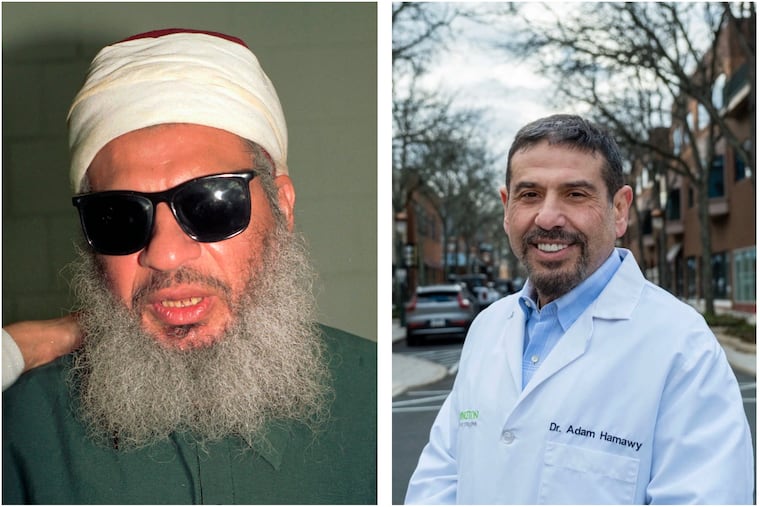
Two months after six people died in the bombing of the World Trade Center in 1993, Sheikh Omar Abdel-Rahman, the infamous “Blind Sheikh,” held a news conference at his Jersey City, N.J., home to deny his guilt.
Standing with him that day was a young medical student from New Jersey who had followed the sheikh’s teachings, traveled with him, and had graciously agreed to translate the sheikh’s press release from Arabic to English.
The young man was Adam Hamawy, now considered a front-runner in the crowded Democratic primary race to replace U.S. Rep. Bonnie Watson Coleman in New Jersey’s 12th District.
“I would disagree that after he was a suspect, I did anything for him,” Hamawy told me. “Just the translation.”
And that, he says, was perfectly innocent. “A blind man has a piece of paper and says, ‘What does it say on there?’” Hamawy said. “It’s more about that than a nefarious action here.”
This is troubling stuff, to put it mildly. Hamawy is an admirable man in many ways. He served with distinction as an Army combat surgeon in Iraq for two years. He was at ground zero on Sept. 11, 2001, doing what he could for the cops and firefighters who were hurt. He’s volunteered in crisis zones all over the world, in Haiti, Syria, Sarajevo, and Gaza. Who can match that?
But his association with the Blind Sheik deserves a careful look. According to testimony at the 1995 trial, the sheikh was openly advocating terrorism during the period Hamawy was following him, preaching that Muslims have a duty to attack Americans, along with Jews of any nationality. This was a genuinely bad guy, on par with leaders of the Ku Klux Klan.
Hamawy concedes he personally heard the sheikh advocate violence. “He did speak about violent things that I think most people disagree with and most people condemn, including myself,” he told me. “But it wasn’t the only thing he spoke about.”
But what drew him to the sheikh in the first place? And why did he stick with him, even after the bombing?
I sat with Hamawy for an hour at his West Windsor, N.J., office, where he now practices plastic surgery, and I got no clean answers.
Why didn’t he object when the sheikh advocated violence? “I was a young man,” Hamawy said. “I wasn’t like a large person in the community to go up and talk to them, you know?”
Why did he stand with the sheikh at that April news conference? “He was a well-known figure in the community at the time. There were many people there.”
Why did he join the sheikh at a conference on Islamic economics in Detroit, sitting with him in a van for 13 hours? “From what I remember, it was a last-minute carpool. I was in there with several community members.”
Does he regret his association with the sheikh? “Yes, I mean, I regret not saying something. Again, I condemn the violence … But I didn’t do anything wrong, so I don’t know how I could have regret.”
Hmmm.
When Graham Platner, the Democratic candidate for U.S. Senate in Maine, was scorched over a tattoo that evoked Nazi imagery and a series of offensive social media posts, he came clean and apologized, saying it all happened when he was young, drunk, and in emotional chaos after service in Afghanistan and Iraq. That made it easier for many voters to believe he had genuinely changed.
Hamawy gave me none of that. In fact, he thinks some of the criticism he’s gotten over this reflects a bias against Islam. “As a Muslim, they’re always going to find something to attack,” he told Insider NJ. “I’m used to it.”
The 12th is a solidly blue district centered on Trenton, where Hamawy’s progressive politics make a good fit. He wants Medicare for All, an end to all aid for Israel, including missile defense weapons, and higher taxes on the rich. He’s been endorsed by Sen. Bernie Sanders, along with Reps. Ilan Omar, Ro Khanna, and Rashida Tlaib. And he’s being lavishly supported with a $2 million spend by a pro-Palestinian super PAC called American Priorities. His toughest competitor, most say, is Sue Altman, a progressive activist with deep experience in New Jersey politics.
I’m surprised Hamawy’s history with the sheikh isn’t causing him more trouble. If he had precisely this history with a leader of the Klan, my guess is he’d be laughed out of the race. I’m struggling to see why this should be any different.
Tom Moran is the author of the Substack Jersey Lowdown and former editorial page editor of the Star-Ledger in Newark.