Other Black people criticized me, but here’s why I was proud to march in the ‘No Kings’ protest
To stay home would have betrayed the entirety of the Rev. Dr. Martin Luther King Jr.'s dream, which is often deceitfully parsed, but included economic justice for all people, writes Michelle Flamer.
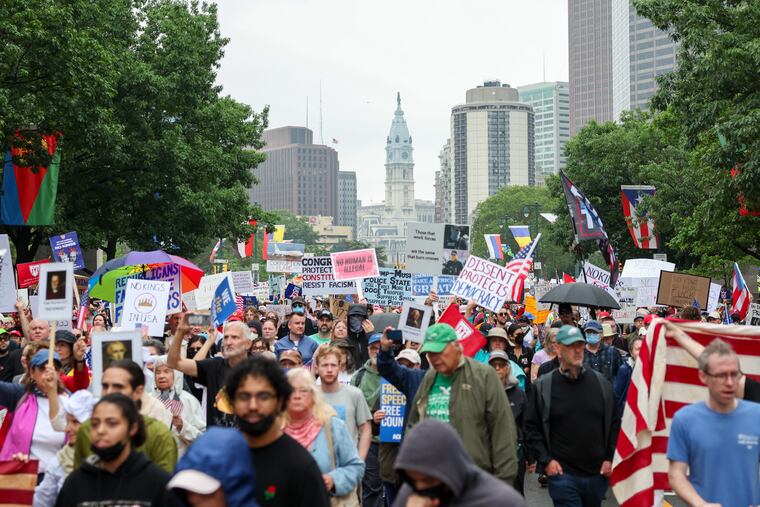
I marched in Saturday’s “No Kings” protest because that’s where I needed to be.
On Father’s Day weekend, I remembered the sacrifice of my dad serving in the Pacific theater during World War II. In fact, the men in my family have participated in American conflicts abroad, including World War I, the Korean and Vietnam Wars, and the Gulf conflicts. These were Black American men fighting for their country, believing in the concept of democracy, the benefits of which often eluded them as Black men.
This weekend I had Black friends critical of my decision to march. Why would you march when you have been betrayed by your white sisters, who do not support your economic advancement? Why would you march when you have not benefited from the American dream as fully as the white people marching beside you?
I marched because I hang on to the same hope that my ancestors held. A hope for a better and more just country. By marching, I acknowledge and honor their vision and sacrifices.
I cannot sit and accept the dismantling of the Civil Rights Act of 1964. That would betray the memory of the violent murder of the Birmingham girls.
To stay home would have betrayed the entirety of the Rev. Dr. Martin Luther King Jr.’s dream, which is often deceitfully parsed, but included economic justice for all people, especially the poor.
I refuse to say that affirmative action and diversity, equity, and inclusion efforts did absolutely nothing to advance racial equity in this country. That would be an abject lie and the false conclusion that my ancestors’ work — and my own — was futile.
Have we reached a place of restorative justice and is systemic racism gone? Certainly not and that’s why I marched.
Maybe some people protest for a restoration of the things removed by the Trump administration. For me, I look beyond that. I do not want to return to Nov. 4, 2024, or even Nov. 4, 2008, when America elected its first African American president. The promise of a level playing field has never been achieved in this country for the Black people who built it.
The time we are in now represents for me an opportunity to redress long-standing injustices and atone for this nation’s sin of slavery. Some have called this a “third Reconstruction,” but I hope for even more.
I will not wallow in despair and have my hope diminished by this current reign of cruelty, which is designed to inspire apathy, hopelessness, and submission. I continue to believe in a better way.
My faith and my history guide me toward that North Star.
Yes, I’ll continue to march.
Michelle Flamer served as a senior attorney with the city of Philadelphia for four decades before she retired. She serves on two boards — 1838 Black Metropolis and the Library Company of Philadelphia — and is an accomplished art quilter with work in museum collections.