Backgammon clubs in Philadelphia are on life support. This Gen Zer wants to change that.
Jefferson played backgammon while drafting the Declaration of Independence. For Darwin, it was a nightly marital ritual. As the old-time Philly clubs dwindle, a new generation is warming to the game.
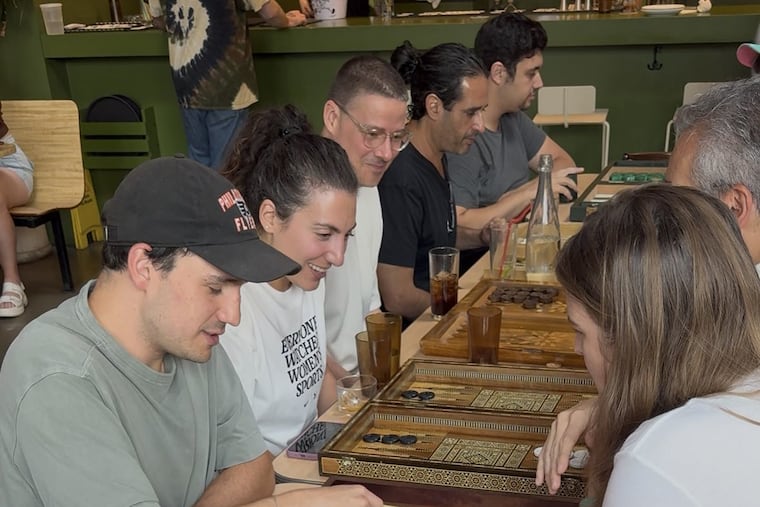
I’m going toe-to-toe against Dan Heisman, the best player at one of the last remaining backgammon clubs in the metropolitan area. A coterie of roughly 15 enthusiasts meets Monday nights at 7 p.m. at the wanly lit Barnaby’s Restaurant and Pub in Havertown.
After I seize one of his checkers, Heisman takes a bite of his crab cake and stares at the board. Years ago, he says, he beat the former No. 1 player in the world, Ed O’Laughlin, at a local tournament. “I got lucky that day,” he says, shaking the dice cup.
Heisman is better known in the chess world. He’s an author and instructor to thousands of students, among them radio personality Howard Stern. But he also has a soft spot for backgammon — the dice game at the fulcrum of skill and luck, dating back to Mesopotamia, 5000 BCE. Globally, the game is immensely popular in the Middle East and eastern Mediterranean region, where a number of countries consider it their national board game.
Where chess can feel too austere, backgammon invites a kind of pas de deux of joyful surrender. For Thomas Jefferson, it scratched his gambling itch while drafting the Declaration of Independence. For Charles Darwin, it was a nightly ritual shared with his wife, Emma.
In the 15-day interregnum between my mother’s supposedly routine brain surgery and her death, it was an anodyne against grief. The dice, a luck portal of endless outcomes.
“I can easily win this game,” Heisman tells me midway through our contest. “But I could also get crushed.”
The club is the last one remaining in the meets-area codified under the U.S. Backgammon Federation. In 2016, Ray Pasternak, a bookkeeper from Drexel Hill, formed the club simply because he missed having it as a source of community.
Pasternak and a majority of his patrons grew up in the “Backgammon Generation” of the 1970s and ’80s, when the pastime ballooned in popularity in the United States.
James Bond, for example, had wagered a Fabergé egg against an Afghan prince while playing backgammon in the 1983 film Octopussy. Blue-chip musicians such as Mick Jagger, Tina Turner, and Bob Dylan have all been pictured playing the game, while the late Hugh Hefner threw notorious backgammon-themed bacchanals at his Playboy Mansion.
“I started playing to meet girls,” Pasternak says. “It was like a supernova back then.”
A member named John Bowman, clad in a fly-fishing vest, tells me that 50 years ago he met his wife playing backgammon at “PT’s,” a former Philadelphia watering hole that frequently hosted backgammon social events.
“I lost in backgammon,” he tells me, grinning. “But I ended up winning the war — my wife.”
After poker overtook it as the go-to game in the 1990s, backgammon’s waning popularity didn’t really come as a surprise. “We were all in our 20s, and then the same people just kept on playing,” Pasternak says. “And now we’re all in our 60s and 70s.”
“Backgammon is on life support,” Pasternak adds. “Eventually, we’re all going to die, and my club will disappear.”
After moving to Conshohocken last year, Florentina Sergiou, 26, was eager to revive the local scene.
Sergiou traces her love of backgammon to her Cypriot grandfather, who nudged her into playing tournaments run by the Greek Orthodox Youth of America.
With training in event planning from NYU MakerSpace, she recently founded the Philly Backgammon Club, which will soon become the latest outpost of Backgammon Social. It’s a pop-up hangout that takes place across the region, where mostly younger players gather to sip mocktails and schmooze over the clatter of the dice.
“Gen Z is the least drinking age group right now,” Sergiou says. “So I think people are looking to discover new avenues of socialization. And this is something fun and healthy for the mind.”
Sergiou doesn’t have any interest in joining the U.S. Backgammon Federation. It’s not the kind of community she wants to build.
“Those events are typically like, ‘Here’s your player, don’t speak while you play,’” she says. “And I just want to do what I want.”
Is Sergiou’s club a herald of things to come? Or another flavor of the month?
Back at Barnaby’s — a bastion of the old guard — my game is coming to an end. Heisman is muttering invectives under his breath. I’ve rolled three doubles in a row, slipping past his sound defense.
We play again, though this time he cleans my clock.
That’s the bad thing about good luck — it’s bound to run out.
Ezra Solway’s writing has been nominated for a Best of the Net anthology and Pushcart Prize. You can follow his work on Instagram.