Black History Month teaches us to learn from our past, flaws and all
How America’s history, including its unpleasant truths, has been taught to students has changed for the better. But today, the progress in telling the true story of American history has been reversed.
When I studied American history in 11th grade, African American history was barely discussed, except for slavery. I took it upon myself to read about Black history to learn what my class hadn’t included.
Since then, I’ve always looked forward to Black History Month, as scholars of African American history and culture present new research on what had been an understudied aspect of American history.
After the Civil War ended, Confederate diehards, in a successful effort to memorialize “the lost cause,” reframed America’s deadliest conflict as the War of Northern Aggression. For over a century, this falsehood included textbooks that claimed plantation owners treated their slaves decently, and that the North’s interference in the South’s internal affairs caused the Civil War.
In the early 1900s, the bodies of Confederate soldiers, buried in various Washington cemeteries, were disinterred and reburied in Arlington National Cemetery, America’s most hallowed ground. Shortly thereafter, the massive Confederate Memorial was installed near these graves, as if it were another shrine to Americans who fought for our country.
With the increase in the Army’s man power during both world wars, new forts were established. The War Department named 10 of them to honor Confederate generals. Mind you, these generals led their forces in a rebellion against the United States that killed American servicemen.
During President Joe Biden’s presidential term, the Confederate Memorial was removed from Arlington, and Army bases were renamed for American military leaders who fought for the United States, not against it.
More importantly, federal and state governments were willing to acknowledge past mistakes in the treatment of America’s Black citizens.
During Biden’s administration, the unjust treatment of Black soldiers following the 1917 Houston Riot and of Black sailors convicted in the 1944 Port Chicago Mutiny was recognized. Although these men were dead, awarding them posthumous honorable discharges was an acknowledgment that they had been unfairly treated.
These were signs of progress in race relations.
In early 2025, I marveled at the changes in relaying America’s history, including its unpleasant truths, to students. State and federal governments now emphasize the multiple contributions of Black Americans in all fields of endeavor.
The greatest aid in elucidating these contributions was the requirement to teach African American history in schools.
» READ MORE: Trump and Hegseth are doing our enemies’ work with their Confederate renaming ruse | Opinion
Today, it seems that progress is stopping, as advancements in telling the true story of American history are reversed. Army forts now bear the same names as Confederate generals, and the Confederate Memorial is scheduled to be reinstalled in 2027.
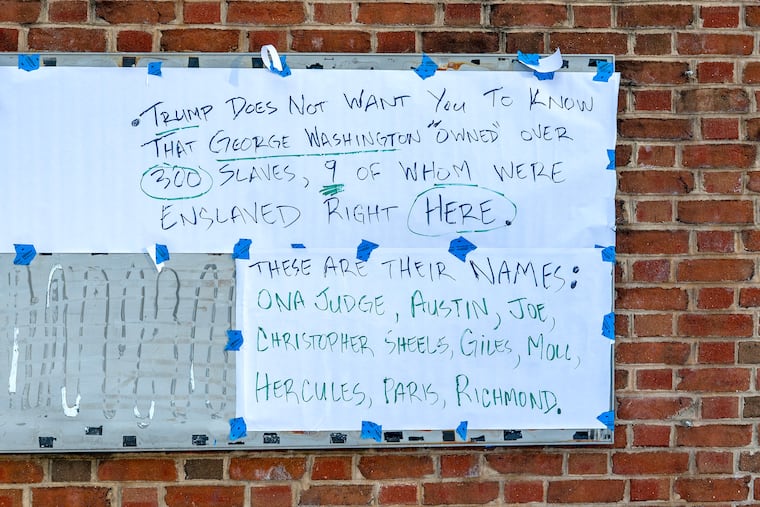
On Jan. 22, the National Park Service ordered the removal of slavery storyboards at the President’s House, the home of America’s first family. They’ve now been restored, awaiting a decision by the Third Circuit Court of Appeals.
For a month, visitors were deprived of learning true stories about the people George Washington enslaved, Washington’s circumvention of Pennsylvania’s manumission laws, the enslaved who escaped, and Washington’s failure to recapture them.
Having visited this site multiple times, I never saw any falsehoods on its signage. Instead, I saw an inconvenient truth. America’s first president — as well as the majority of our first 18 — owned human beings despite living 100 yards from where “all men are created equal” was adopted in our country’s founding document.
Mount Vernon, the Washingtons’ Virginia plantation, doesn’t hide their enslavement of hundreds. Nor do Thomas Jefferson’s plantation at Monticello, James Madison’s at Montpelier, James Monroe’s at Highland, and Andrew Jackson’s at Hermitage.
Americans can’t ignore the cruelty of slavery, the wealth enslaved people created for Southern plantation owners, and the Northern bankers, ship owners, and clothing/textile manufacturers who benefited, as well.
We cannot obfuscate the fact that slavery didn’t end in 1865, as throughout the South, convict leasing and debt peonage reigned for decades after the Civil War.
We cannot forget that federal and state governments failed to protect the voting rights of Black citizens for 100 years.
We cannot bury the fact that thousands of Black people were publicly lynched in full view of hundreds of men, women, and children.
The solution to teaching the unseemly side of American history is to look at Germany, the country whose Nazi regime murdered six million Jews and millions of Catholics, those physically and/or mentally challenged, Roma, gay people, Jehovah’s Witnesses, and political opponents.
Germany doesn’t hide its horrific past. Instead, it has erected monuments memorializing victims of an earlier German government. Germany’s past is not buried, forgotten, or ignored.
America is not Nazi Germany, but if we start to hide our flaws, we risk repeating history. Black History Month teaches us to learn from our past, flaws and all, and ensure they aren’t repeated.
Paul L. Newman is an amateur historian of African American history. He’s working on a miniseries docudrama on the African American civil rights movement of the first half of the 20th century.