In his first encyclical, Pope Leo apologizes for Vatican’s role in slavery. But what does it mean for Black Catholics?
To understand this moment for Black Catholics, we must grapple with the Catholic Church’s past.
Pope Leo XIV apologizing for slavery within his first encyclical, Magnifica Humanitas, was not on my bingo card.
As an African American and a fourth-generation Catholic (at least as far as I can go back), I have always had a testy, uneasy relationship with the church. After all, my extended family — who are Catholic and from Louisiana — knows we are probably Catholic because our ancestors most likely were held by a slave owner who professed that faith.
This has been part of my painful but engaged relationship with the church. The apology from the pope — in an encyclical largely concerned with artificial intelligence — is a bittersweet moment, but what does it really mean for Black Catholics, in particular, and all Catholics around the world?
To understand this moment for Black Catholics, we must grapple with the past.
Slavery was allowed by three papal bulls: Pope Nicholas V’s Dum Diversas (1452) and Romanus Pontifex (1455), and Pope Alexander VI’s Inter caetera (1493). These three decrees constituted what is called the Doctrine of Discovery, which gave the Catholic Church rights to any land that was inhabited by non-Catholics and allowed them to be enslaved.
Subsequent papal bulls tried to erase what the three cited bulls allowed, but by then it was too late — the Roman Catholic Church was complicit and part of facilitating not only the Atlantic slave trade, but the subjugation of Indigenous peoples around the world.
Papal bulls are formal papal documents, so-called because they are authenticated by a seal, or bulla. They are often issued in concert with an apostolic constitutions — the weightiest legal document a pope can issue — that deals with serious doctrinal matters.
Encyclicals, which is what Pope Leo issued on Monday, are not papal bulls. They are more pastoral in nature, bringing the pontiff’s teaching authority to bear on existing doctrine.
Pope Leo’s apology is an important step, given his own family tree contains both free and enslaved persons. He is a singular figure for many Black Catholics because of his connections to New Orleans and southern Louisiana.
In many ways, some of us view him as “one of us”— someone who has been part of the church, but who understands that belonging to the church comes with a painful history that sometimes rears its head.
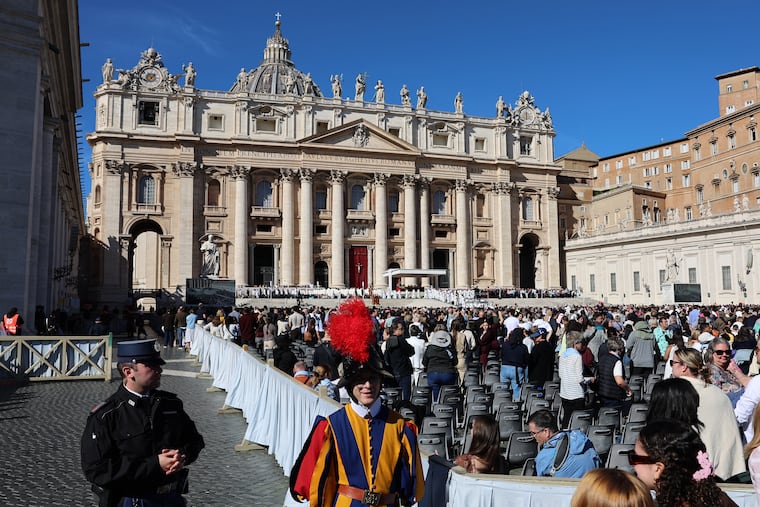
But placing the apology within the context of the encyclical on AI is a bit puzzling, given the pope was just in Angola visiting the Muxima Shrine on his papal trip in April to Africa. The shrine to Our Lady of Muxima is an important one because it is on the river, which was used to transport Africans out to the Atlantic coast to be sold as slaves.
During the visit, I was pressed by interested journalists who asked if an apology for slavery was warranted. At the time, I thought the apology would not occur, in part because it would take away from the other countries and their importance on the papal visit.
It was also something I believed would be fraught for the church to do, because it would acknowledge the church had been wrong, a bold move given it’s considered a divine institution.
While it is exceptional that this apology has now occurred, the apology is part of a larger conversation about what it means to be human and how the church has not always considered the humanity of people who were not Catholic. Frankly, historically, the Catholic Church did not consider the humanity of many groups of people, even if they were Catholic.
So to have the apology embedded in an encyclical about AI is a bit anticlimactic. The apology is not designed to assuage the feelings of people like me and others who are a part of the church, despite the times we have felt at odds with a church that historically enslaved and subjugated our ancestors.
So what is it, exactly?
It is a theological move by the pope that is important in the context of the church being able to speak clearly about what it means to be human. It is meant to align with what Pope Leo XIV, as the head of the Catholic Church, believes — which is that humanity may be subsumed by artificial intelligence that cannot feel, think, or express real emotions. As we rush to use AI, Pope Leo is asking us to consider what it means to be human.
That consideration cannot come unless the church comes to grips with the fact that many of our ancestors were not considered to be human by the Catholic Church because of our ancestry and culture or our indigenous religious beliefs.
While I and many Catholics who have enslaved ancestors or Indigenous backgrounds may welcome this apology, it is not the fulsome apology that is needed.
A standalone apology for slavery, outside of this encyclical, would be an important step in reinforcing the church’s commitments. After all, a pastoral letter outside this encyclical to address the issue could be a true moment of healing.
» READ MORE: Who’s afraid of the big, bad Trump? Not Pope Leo. | Sabrina Vourvoulias
For those of us in the American context who have been in the church for a long time, we remember all the initiatives conducted by the United States Conference of Catholic Bishops that were promoted in the hopes of healing the wounds of racism in American Catholicism — with various levels of success.
So, while I welcome this apology, again, like many Black Catholics, I still feel like I am grabbing the crumbs from the Communion table, hoping that one day, our painful history can be fully addressed and acknowledged.
Until then, I will have to hold on to this apology, buried in the pages of this encyclical, and hope for the best.
Anthea Butler is the Geraldine R. Segal Professor in American Social Thought at the University of Pennsylvania.


Inquirer Opinion Newsletter