What it means to be a pregnant Black woman in this country: A conversation
We need to expand reproductive justice beyond survival, toward a vision where Black women have equitable opportunities to thrive during pregnancy.

The experience of carrying and delivering a child for Black women in America was never just about joy and anticipation; it is survival wrapped in celebration.
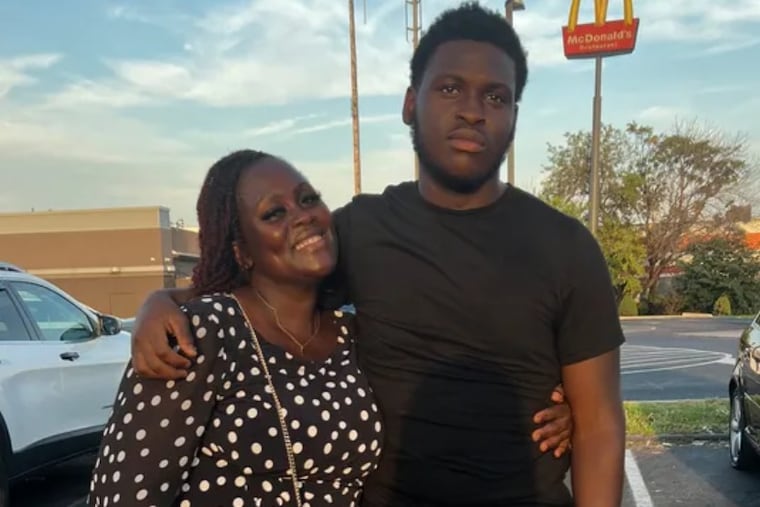
Kobe Abney and Samuelle A. S. Delcy, two doctoral candidates at the University of Pennsylvania — one studying Black maternal health, the other working to bridge science and policy — recently sat down to talk about how the experience of pregnancy in America reflects a broken system.
Delcy: I am a 25-year-old woman, so naturally, the burning question from my Caribbean family is, “When will you start having children?”
For context, I was raised in Haiti, surrounded by a community that supported mothers holistically. With that upbringing, I was certain I wanted children. Pregnancy, to me, meant standing on the shoulders of a supportive village and experiencing the joy of creating life.
But then I moved to the United States, and I began to learn what it means to be a pregnant Black woman in this country. So, to answer my family’s question: I am afraid of what pregnancy could mean for me in America.
I am afraid of what pregnancy could mean for me in America.
Now, let me be clear: Womanhood and motherhood are not synonymous, and do not need to coexist, so my answer could have simply been, “I don’t want children.” But as I grow in my role as a scientist and public health advocate, I realize the fear I feel isn’t just personal; it’s informed, and the numbers confirm that I’m not alone.
They tell us pregnancy is a natural, beautiful part of life — but for Black women, it can feel like a promised risk. In the U.S., we are three to four times more likely to die from pregnancy-related complications compared with white women. This disparity is exacerbated in Philadelphia, where Black women make up just 43% of births, yet account for 73% of pregnancy-related deaths.
These aren’t just numbers; they’re real people, daughters, sisters, mothers, unfinished stories that did not have to be cut short, lives that could have been saved.
Abney: “You’re so resilient” … but I wish I didn’t have to be.
“You’re always so well put together” … that, or be considered “unprofessional.”
“I wish I could be as strong and independent as you.” But I’d rather be in my “soft-girl era.”
This is what it means to be a Black woman in America: an experience overburdened with meeting societal expectations of unyielding strength and hyper-independence, all while remaining pleasing to the eye.
Well, the truth is I’m tired.
I’m tired of little Black girls growing up watching the women around them endure pain in solitude, work twice as hard to get half as far, and make ends meet with no means to get there.
I, too, am horrified — a feeling that no amount of preparation or education can erase.
That strength is not a badge of honor — it’s a survival mechanism, passed down intergenerationally from women who navigated a system that never saw us as full human beings. Only as a means for reproductive and domestic labor, for what our bodies could provide.
I carry that legacy not only in my body, but in my work as a women’s health scientist trained to interrogate the very disparities my foremothers endured in silence.
I, too, am horrified — a feeling that no amount of preparation or education can erase. This fear was never just Sammie’s. It was never just mine. It’s the echo of a broken system we are forced to endure.
Delcy: Sometimes I wonder if success or money could shield us. Maybe if I climb far enough, I’ll be protected.
Abney: Even our excellence fails to protect us. Look at Serena Williams, one of the most decorated athletes in the world. She had to fight to be heard as she experienced life-threatening postpartum complications.
Delcy: Exactly! She had to insist that her doctors take her concerns seriously and provide the care that should have been guaranteed. What terrifies me is that so many Black women are not aware that they can advocate for themselves, or if we try, our knowledge of our own bodies is questioned, and our concerns are dismissed as exaggeration or drug-seeking. Our ability to advocate for our health should not have to be undermined by biases that challenge our credibility.
» READ MORE: Collective action is needed to transform the painful legacies of Black maternal health | Opinion
Abney: Yes, implicit bias is so real and extremely dangerous. Stories like Serena Williams’, Torie Bowie’s, Porsha Ngumezi’s, Sha-asia Washington’s, and so many others remind me that even as I continue to immerse myself in the science of maternal and reproductive health, my credentials will not protect me from biases, nor shield me from dismissal.
In a delivery room, I’m still four times more likely to die from pregnancy-related complications, 1.4 times more likely to deliver preterm, and six times more likely to have a hypertensive disorder.
To understand this crisis, we should consider the social ecological model: Health is shaped at multiple levels — individual, interpersonal, community, institutional, and policy. Each of these layers is burdened by racism.
At the individual and interpersonal levels, bias and dismissal during clinical encounters leave Black women’s concerns ignored, undermining trust and care.
At the community level, years of intentional disinvestment create “maternal care deserts,” where hospitals close and prenatal services are taken away. At the institutional level, policies and practices within healthcare systems often prioritize profit over equitable care, leading to increased rates of high-risk procedures such as C-sections among minority individuals.
And at the policy level, decisions ranging from the dismantling of Roe v. Wade to chronic underfunding of public health infrastructures compound these disparities, leaving Black women at greater risk before, during, and after pregnancy. Each layer interacts with the others, creating a network of barriers that cannot be addressed by individual effort alone.
This broken system is reflected in public health researcher Arline Geronimus’ concept of “weathering,” which is the cumulative effect of systemic oppression on the human body. Over time, social stressors accelerate biological aging and increase susceptibility to illness, including complications during pregnancy and childbirth.
Delcy: For Black women, racism is not a single event; it is a daily stressor, showing up in everything — from being ignored by a doctor, to experiencing higher rates of job insecurity that make taking time off during pregnancy nearly impossible.
Diagnoses such as early-onset diabetes, hypertension, or high-risk pregnancy are not simply due to “bad genetics” or “poor choices”; they are the cumulative cost of living in a society that chips away at our health every single day. Our bodies are not failing; they are responding to an environment that never allowed them to rest.
Abney: So, where do we go from here?
First, we invest in Black-led care models — doula networks integrated into hospital systems, birth collectives, and community health workers.
Second, we train providers to unlearn bias through action, not blame. Community competency is key.
Third, we advocate for policies such as the Momnibus Act that protect reproductive rights and expand access to competent, uninterrupted care.
» READ MORE: America’s maternal care system dehumanized me. I became a doula to change it. | Opinion
But our call cannot end with programs and policies alone.
We must also affirm that Black women deserve tenderness and care, rather than the coping mechanisms we are often forced to acquire.
This means supporting maternal health research led by people of color who are living in the reality of what it is to be a minority and pregnant in America. It means building accountability systems so hospitals report and act on racial disparities in real time. It means reimagining workplaces so pregnancy does not cost women their careers or health insurance.
And it means expanding reproductive justice beyond survival, toward a vision where Black women have equitable opportunities to thrive during pregnancy.
Pregnancy for Black women is not just a medical issue — it is political, social, and about justice. We deserve more than survival. We deserve softness, safety, and sovereignty over our bodies.
Delcy: Until then, the question isn’t when we’ll have children, it’s why would we when America continues to fail us?
Samuelle A. S. Delcy is a doctoral candidate at the University of Pennsylvania working to bridge science and policy to amplify the voices of underrepresented communities. Kobe Abney is a doctoral candidate at Penn studying Black maternal health with a focus on advancing health equity.