100 years ago, they used violence to promote white supremacy. Now they resort to courts.
The Supreme Court’s conservative majority, appointed by conservative presidents, has been on a mission to diminish the impact of Black voters.
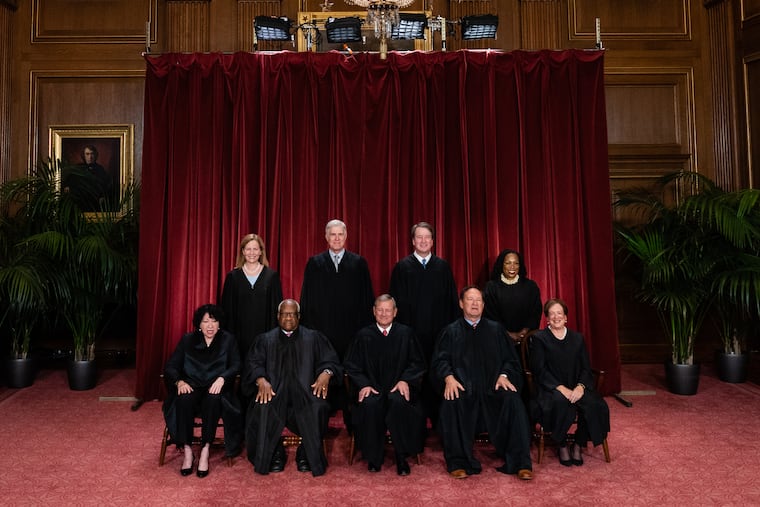
The U.S. Supreme Court’s voiding of Louisiana’s 2024 congressional map, which included two majority-Black districts, didn’t surprise me. The court’s conservative majority, appointed by conservative presidents, has been on a mission to diminish the impact of Black voters.
Our nation has a long history of that.
Violent suppression of Black voters began after the Civil War in South Carolina and other former Confederate states, but most notably in Louisiana.
As the war was ending, President Abraham Lincoln considered giving certain formerly enslaved men and free people the right to vote. John Wilkes Booth, already incensed by Lincoln’s actions during the Civil War and his beloved South’s defeat, was outraged when he heard the president’s final speech offering the franchise to Black veterans. The next day, Booth assassinated Lincoln.
Die-hard Louisiana Confederates couldn’t abide that their formerly enslaved property were their equals and eligible to vote. During 1866’s Mechanics’ Institute Massacre, 34 Black supporters of a new Louisiana constitution, which granted them the franchise, were murdered. An additional 119 were wounded.
In 1868, this racist reign of terror continued in Opelousas, La., where an estimated 250 voters, mostly Black, were murdered. That same year, more than 30 Black citizens were murdered in St. Bernard Parish, La., over voting issues.
Despite this violence, in 1868, Black Louisianans were instrumental in electing African Americans Oscar J. Dunn as lieutenant governor and John W. Menard as a congressman. Menard’s election was contested; he was never seated. After Dunn’s death, African American P.B.S. Pinchback assumed his office and briefly served as Louisiana’s governor.
In 1873, white segregationists continued violently opposing Black politicians and voters by murdering between 62 and 80 Black men in Colfax, La., and 10 others during the Coushatta Massacre.
In 1874, during the Battle of Liberty Place, the White League failed to violently overthrow Louisiana’s duly elected integrated government. But after the Compromise of 1877, federal troops left Louisiana, and afterward, Black political power withered away.
Large massacres were no longer needed to curb Black voting. From 1882 through 1968, there were 391 lynchings in Louisiana. Most were unrelated to voting, but their ubiquity would make Black voters hesitant to challenge the status quo and societal strictures.
In 1898, to solidify the continuation of white political control, Louisiana, like all Southern states, adopted a new constitution, effectively disenfranchising its Black citizens by the imposition of strict voting requirements, including a grandfather clause, property ownership, poll taxes, and literacy tests. After these restrictions, Black voter registration fell from 135,000 in 1896 to less than 1,000 in 1907.
From 1923 to 1944, Louisiana, an overwhelmingly Democratic state, maintained an all-white primary — eliminating the impact Black voters might have on the electoral process when the November election results were predictable.
To celebrate the end of Reconstruction and white political ascendancy, New Orleans dedicated the Battle of Liberty Place Monument in 1891. In 1932, these words were added to it: “… but the national election of November 1876 recognized white supremacy in the South and gave us our state.”
The Voting Rights Act of 1965 required seven states, including Louisiana, with its history of racial discrimination, to request preclearance from the U.S. attorney general or the U.S. District Court of Washington, D.C., before any changes in voter registration laws could go into effect. When the law was passed, there were six Black men in Congress; today, African Americans comprise 58 representatives and five senators (including Rep. Eleanor Holmes Norton, who, as the representative of the District of Columbia, cannot officially vote).
The Voting Rights Act of 1965, set to expire in 1970, was amended and extended five times through 2006.
But the descendants of those who a century earlier had used violence to promote white supremacy now resorted to the courtroom.
In 2013, believers in the Lost Cause rejoiced when the Supreme Court decided Shelby County v. Holder, which nullified the act’s preclearance requirement for states with a history of voting restrictions.
These 21st-century die-hards used that victory to further erode other aspects of the law and to promote stringent voter ID requirements and oppose mail-in ballots. They also championed redrawing congressional districts to weaken Black representation in Congress, which was recently sanctioned by the conservative justices in Louisiana v. Callais.
Recently, Tennessee altered its congressional districts, making it more difficult for a Democrat, let alone a Black Democrat, to represent the state in Congress. Never mind that 16% of the state’s population is Black.
Other Southern states, most notably Texas and Florida, have also altered their congressional maps.
As we approach our country’s Semiquincentennial, it seems that one of the arguments for our breaking away from England, “no taxation without representation,” is meaningless 250 years later. When I’m asked who won the Civil War, I reply: Militarily, the North succeeded, but the subjugation of African Americans continues unabated.
Paul L. Newman is an amateur historian of African American history. He’s working on a miniseries docudrama on the African American civil rights movement of the first half of the 20th century.