In the face of terror, one man’s courage shows us the way forward
When hatred struck a Hanukkah celebration in Sydney, a Muslim bystander ran toward danger instead of away from it. His actions offer a crucial lesson.
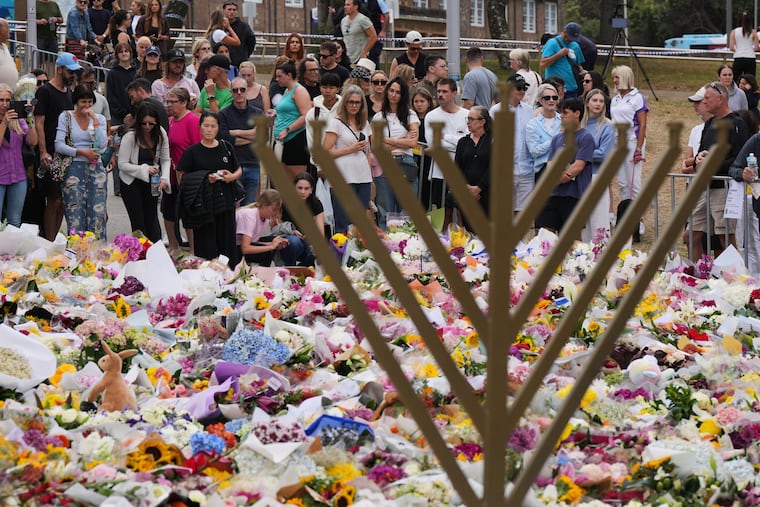
This Hanukkah season, as Jewish families gathered at Sydney’s Bondi Beach to celebrate the Festival of Lights, terrorists opened fire. At least 15 people were killed and dozens more injured in an attack that has sent shockwaves through Jewish communities worldwide.
For many Jewish families, this attack feels horrifyingly familiar. I know that fear personally. As I wrote in these pages last year, I had to hire armed security for my son’s bar mitzvah — a celebration that should have been filled with only joy, but instead required armed guards and threat assessments. That shouldn’t be our reality. But it is.
Since that bar mitzvah, the situation has only intensified. The Anti-Defamation League documented more than 460 antisemitic incidents in Pennsylvania in 2024. Nationally, the numbers are equally alarming. Jewish families are making calculations our grandparents hoped we’d never have to make: Is it safe to go to synagogue? Should we display our menorah in the window? Will our children be targeted for wearing a Star of David?
But amid the horror of Bondi Beach, there emerged an image we cannot ignore: Ahmed al-Ahmad, a civilian, tackling one of the gunmen to the ground and saving countless lives.
When hatred showed its ugliest face, Ahmed didn’t calculate the risk. He didn’t hesitate. He ran toward danger to protect people he didn’t know, celebrating a holiday he didn’t observe, from terrorists who claimed to share his faith.
This matters — not as a feel-good footnote to a tragedy, but as a fundamental truth we must hold onto in these dark times.
The alleged attackers reportedly followed ISIS ideology. But Ahmed al-Ahmad, a Muslim man, risked his life to stop them. This is precisely why we cannot — we must not — paint entire communities with the brush of their worst actors.
When individuals commit acts of hatred, we should hold specific perpetrators accountable — not entire identity groups. Yet, these days: Often Jews are blamed collectively for events in the Middle East and Muslims are blamed for the actions of terrorists, like what occurred at Bondi Beach.
Resisting communal blame is essential to defeating hate. Because here’s the truth: Neither courage nor hatred belongs to any one group. There are heroes and villains in every community. The sooner we recognize this; the sooner we can build the coalitions necessary to fight antisemitism, hate, and extremism in all its forms.
Creating moments of solidarity matter as much as the hate incidents themselves, perhaps more. I am personally grateful for the phone calls and emails that I did receive from allies following the attack at Bondi Beach. They show that the voices against antisemitism and hate are greater in number and in moral force than those who traffic in it.
Resisting communal blame is essential to defeating hate.
But solidarity requires more than social media posts and attendance at rallies. It demands courage. Ahmed al-Ahmad showed us what that looks like.
Here’s what each of us can do:
Become an active bystander. When you witness hatred or harassment, you have the power to intervene safely — to distract, delegate, document, or directly address the situation.
Reject collective blame. When acts of terror occur, resist the urge to blame entire communities. Hold perpetrators accountable while standing with those who share a background but not the hatred.
Show up. Share in Hanukkah and Christmas celebrations, attend a Ramadan iftar, join in a Juneteenth event. Our presence in each other’s celebrations builds the relationships that sustain us through dark times.
Report hate incidents. Whether it’s antisemitism, Islamophobia, racism, or any other form of bias, report it to law enforcement and organizations like ADL that track incidents. Silence allows hate to fester.
As we light the menorah this Hanukkah, we commemorate the ancient victory of light over darkness. That light endures not because it was never threatened, but because in every generation, people chose to protect it — people from all backgrounds, all faiths, all walks of life.
Ahmed al-Ahmad chose to be one of those people. The question for the rest of us is: Will we?
Andrew Goretsky is the senior regional director of the Anti-Defamation League’s Philadelphia office, serving Eastern Pennsylvania, Southern New Jersey, and Delaware.