The first CARE box shipped from Philly 80 years ago. The world still needs us.
The architecture of international generosity Americans helped build in the postwar era — the one that began with a box of rations shipped from this city — is being tested as it hasn’t been before.
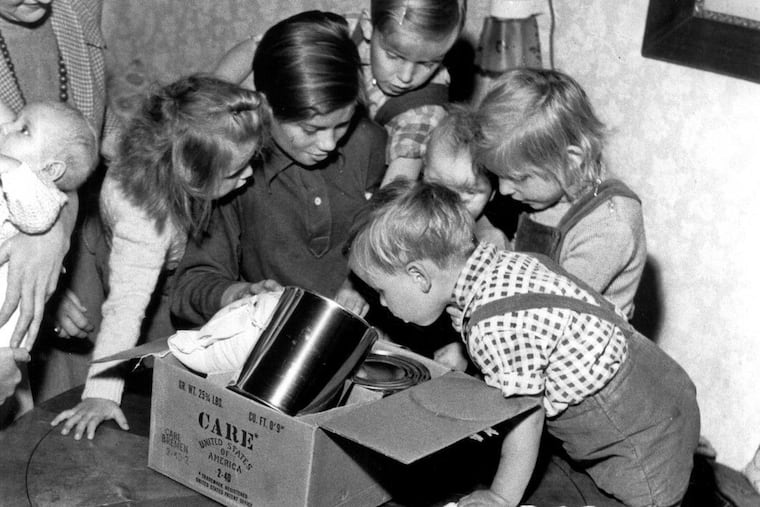
Eighty years ago, in a city whose very name means brotherly love, someone packed a box. It held simple things like canned meat, dried milk, a little sugar, and was sent across an ocean to a stranger in a war-torn land who had next to nothing.
That first CARE Package, shipped from Philadelphia in 1946, was not a political act or a diplomatic gesture. It was something older and simpler: an act of humanity, of one human being reaching out to help another.
Eighty years later, as the world again strains under the weight of conflict, displacement, and division, that first humble box from Philadelphia speaks to us from the past and asks us a question I believe America, as it turns 250, would do well to answer: Who are we willing to help?
The story of CARE is like the story of America, rooted not in governments or grand institutions, but in citizens. In 1945, a few visionaries spearheaded the coming together of 22 American organizations, including labor unions, religious groups, and civic associations, with a straightforward conviction: that the people of a recovering Europe needed help, and that ordinary Americans could provide it.
The first packages shipped the following year contained U.S. Army surplus rations.
They were practical, even humble. But what they carried beyond calories was something no logistics manifest could capture: the message that someone, somewhere, was looking out for you, and had not looked away.
Philadelphia was the perfect place for this altruistic effort to begin.
William Penn founded this city on the radical idea that a community built on mutual respect and goodwill was not just a noble dream, but a practical one. Penn’s “Holy Experiment” was always about more than religious tolerance. It was a wager that people of different backgrounds, beliefs, and origins could build something together; that the ties binding a community need not be sameness, but shared commitment to one another’s dignity.
The Quakers who shaped this city’s early character understood mutual aid not as charity, but as covenant. To care for a stranger was not exceptional. It was the baseline of a decent society.
That spirit did not stay contained within Philadelphia’s borders, and it was never meant to.
Philadelphians know something about the work of building community against the odds.
Today, CARE works in more than 100 countries, reaching close to 60 million people a year, the vast majority of them women and girls. The crises we respond to have changed in scale and complexity since 1946: protracted conflicts, climate-driven displacement, food systems pushed to the breaking point.
But the fundamental logic of that first box has not changed at all. Resources and stability are not distributed equally across the world. Where they are lacking, people suffer unnecessarily. And where communities near or far extend a hand, lives change.
What has changed is the urgency. At this moment, humanitarian funding has been dramatically cut in the United States and is under serious pressure globally, even as conflicts and disasters increase, and the need continues to grow.
The architecture of international generosity Americans helped build in the postwar era — the one that began, in its way, with a box of rations shipped from this city — is being tested as it has rarely been tested before.
The question Penn posed by naming this place for “philos adelphos” is no longer abstract. It is operational.
Philadelphians know something about the work of building community against the odds. This is a city that has long had to hold its founding ideals up against the harder facts of inequality, poverty, and injustice. A city that has chosen, again and again, to keep reaching.
Our neighborhoods are full of mutual aid networks, food pantries, parishes, synagogues, mosques, and community organizations doing quietly what that first CARE shipment did 80 years ago: refusing to let distance — whether of geography or circumstance — become indifference.
The circle of who counts as a neighbor has simply grown wider.
That local impulse and the global one are not separate. They are the same instinct, operating at different scales.
When a Philadelphian volunteers at a community kitchen, they are practicing the same covenant Penn described and CARE embodies. When CARE delivers emergency food in Sudan or flood relief in Bangladesh or North Carolina, it is acting on the same principle that moved those 22 organizations in 1945 to pool their resources for strangers they would never meet.
The circle of who counts as a neighbor has simply grown wider.
This anniversary is worth marking, not for nostalgia’s sake, but because anniversaries are invitations to recommit.
Eighty years on, the CARE Package has become a metaphor so common we barely notice it anymore. We send “care packages” to college students, to kids at sleepaway camp, to friends going through hard times, to soldiers deployed abroad. The phrase has traveled so far from its origins that most people don’t know it began with a specific act, in a specific city, in a specific moment of postwar reckoning with what humanity owed itself.
I think it’s worth knowing. Because embedded in that origin story is a reminder that generosity is not a personality trait belonging to unusually kind individuals. It is a collective capacity: something communities build, sustain, and, when necessary, rebuild.
Philadelphia built it once. CARE has carried it forward for eight decades. The need, today, is as real as it has ever been. So we return to the question that first box poses: Who are we willing to help?
The answer, I believe, is easy: those in need, those we can. I think William Penn would agree.
Michelle Nunn is the president and CEO of CARE USA.

Inquirer Opinion Newsletter