Banning cell phones would fix a problem that doesn’t exist
Reducing time spent on social media doesn’t improve well-being, loneliness, or mental health, writes clinical psychologist Christopher Ferguson.
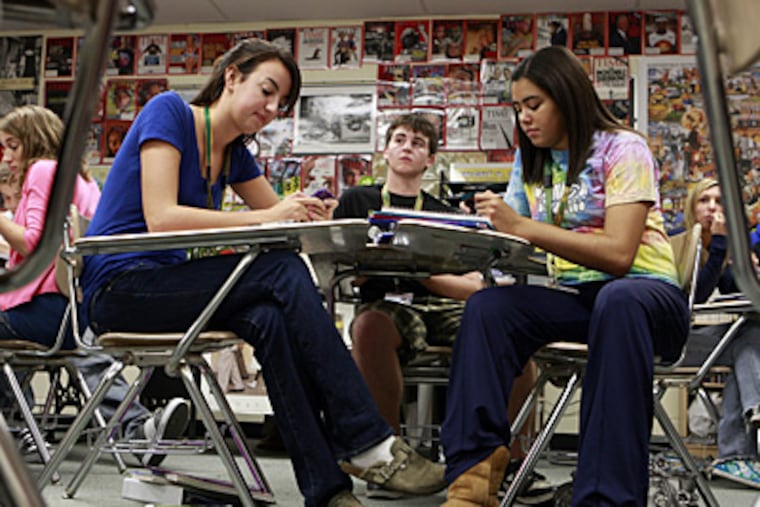
Like many states, Pennsylvania is weighing a “bell-to-bell” mandatory ban on cell phones in school.
Like a social contagion, these laws have spread despite lack of evidence that they are useful. For many people they are intuitive. We want our students paying attention to teachers, not distracted by phones.
As a college teacher myself, I know the disheartening feeling of waxing poetic on the topic of the day, only to see students checking their phones. As a matter of etiquette, I see no problem with individual teachers setting cell phone policies that work for their classes.
Big promises
However, states have adopted a one-size-fits-all approach, with big promises that such bans will not only improve grades, but promote student mental health or reduce bullying.
Some administrators have claimed remarkable improvements immediately after cell phone bans were enacted. After implementing an all-day cell phone ban, Orange County in Florida reported a “remarkable” positive change within just a few months. However, a follow-up investigation using public records requests revealed student bullying and mental health got worse, whereas grades remained mostly unchanged.
What evidence we have on school cell phone bans’ ability to deliver on these big promises is not encouraging. A large study of school cell phone bans in the United Kingdom found that even the most restrictive bans did not improve grades, mental health, or behavior.
As one recent scientific review concluded: “Our consolidated findings showed little to no conclusive evidence that ‘one-size-fits-all’ mobile phone bans in schools resulted in improved academic outcomes, mental health and well-being, and reduced cyberbullying.”
This may conflict with many people’s understandable intuition on the topic. Indeed, I often hear people say, “I don’t need science to tell me cell phones are bad for kids.” Yet, our intuition is often wrong, which is why we need good science studies.
In past generations, many adults felt the same suspicions about video games, Dungeons and Dragons, rock music (including the late Ozzy Osbourne who was sued, unsuccessfully, for causing youth suicide), comic books, radio, and regular books. We now know those concerns were unfounded, but people felt passionate about them at the time.
Contrary to many parents’ fears, using smartphones doesn’t reduce youth time spent with real-life friends, exercise, or sleep… it mainly displaces watching television.
Cell phone bans may be trying to fix a problem that doesn’t exist. For instance, according to the National Center for Education Statistics, youth bullying, even with cyberbullying included, went down during the era of the smartphone and social media.
The challenge may be that, just as with past media panics, smartphones and social media don’t have the impacts we tend to think. Research has clarified that time spent on social media is not related to youth mental health. Reducing time spent on social media doesn’t improve well-being, loneliness, or mental health. Contrary to many parents’ fears, using smartphones doesn’t reduce young people’s time spent with real-life friends, exercise, or sleep … it mainly displaces watching television.
Even my own intuition was surprised by research that the presence of a smartphone doesn’t reduce people’s memory or cognition. Perhaps the problem with schools isn’t the distraction of smartphones. Yet smartphones are an easy target for schools to blame.
People sometimes ask, even if the evidence for smartphone bans is thin, what is the harm in employing them. My thought is if individual teachers want to ban phones in their classes, I’m fine with that.
But banning them altogether prevents other teachers from using them creatively as part of class. Some parents worry they can’t communicate with their kids, some evidence (such as from Orange County) suggests they could result in increased use of suspensions, etc.
Moral panic
As with most moral panics, I suspect the biggest downside to this controversy is simply distracting society from real problems and leaving those unaddressed. Teachers have difficult jobs, and they bring their best selves to a challenging career. But American schools have been struggling for a very long time.
In my day, we did not have cell phones. But we didn’t pay attention to teachers, either. We talked, slept, doodled, daydreamed, sometimes roughhoused, all under teachers’ noses.
The problem with schools is schools, not cell phones.
Far from being exemplars of a utopian past, kids of the 1970s and ’80s actually were the worst on record for most outcomes, including suicide, violence, drug use, and pregnancy. Today’s cell phone kids are doing comparatively well. Even their mental health is now improving.
Overregulation of schools has likely made them worse these past few decades, as did the COVID-19 shutdowns. By fixating on cell phones, administrators and policymakers are not addressing the very real problems with schools. Youth tell us that schools are a toxic mixture of boring and stressful.
The problem with schools is schools, not cell phones.
In the past few years, much of our nation has experimented with school cell phone bans. In response, national testing scores got worse. Fixing schools by getting rid of cell phones was a reasonable hypothesis. But the data are already in: It was the wrong path.
Let’s hope Pennsylvania will reject a failed moral panic solution and turn its attention to real efforts to improve schools.
Christopher J. Ferguson is a professor of psychology at Stetson University and a clinical psychologist with more than 20 years experience working with youth and families.