Charlie Kirk and the unbearable cost of political violence in America
Democracy is an agreement — an agreement that words will substitute for weapons, that ballots will substitute for bullets. The killing of a political figure tears at the fabric of that covenant.
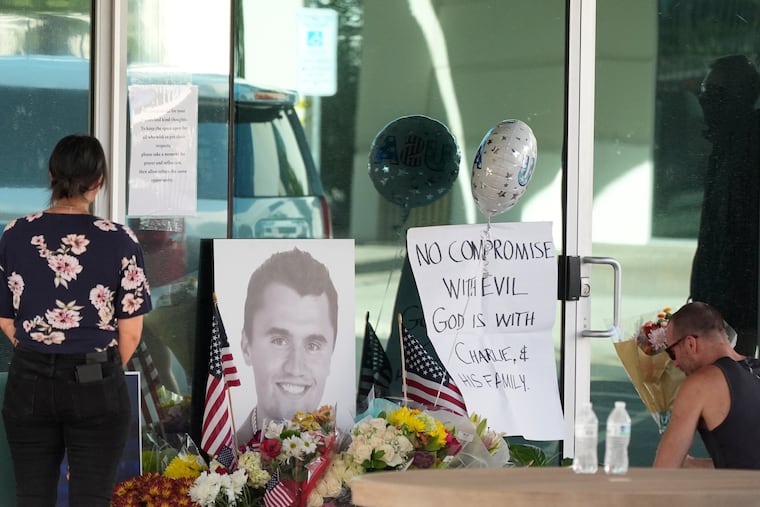
I never agreed with the viewpoints of Charlie Kirk, the 31-year-old close ally of Donald Trump and perhaps the most notable evangelist of Trumpism. I thought he was a gifted communicator, but also masterful at spin. At times, I found myself enraged by his social and political pronouncements — particularly his opposition to affirmative action and his cavalier rhetoric about people of color in America.
And yet today, I write in disgust. Charlie Kirk has been assassinated.
It is impossible to overstate the moral horror of that sentence. The very idea that in this nation — a nation founded on debate, on the clash of argument and ideas — someone should lose his life because of what we can assume is his politics, is an indictment of us all. As the Rev. Dr. Martin Luther King Jr. said when Malcolm X was assassinated in 1965, we seem unable to disagree without being violently disagreeable. While I’m not contending or comparing Kirk to these iconic figures of history, I have to contend that Kirk was the intellectual star of the right-wing conservative Trump movement.
This is not merely a right-wing tragedy or a left-wing one. This is an American tragedy. I’m broken by the knowledge that we are, once again, permitting blood to seep into the cracks of our political life.
Once murder is treated as a form of politics, then no one is safe — not on the right, not on the left, not in the center.
The United States is the product of its history — a history that contains as much blood as parchment. Our national character is built from custom, forged from experience, and enshrined in law and practice. But woven through it all is the story of political violence.
Abraham Lincoln was gunned down in a theater. John F. Kennedy in Dallas. Robert F. Kennedy in Los Angeles. Malcom X in New York. King in Memphis. Each killing was not just an individual loss, but a collective rupture, a reminder that Americans often reach for the gun when their arguments fail them.
This nation was not birthed into tranquility. Political violence, whether by mobs, militias, or lone actors, has always been one of our shadow traditions. And yet, every act like this is not just a crime; it is a desecration of democracy itself.
We tell ourselves that America is exceptional. But we are not exempt from the human condition. The destructive force of political and sectarian violence has scarred nations across the globe: Islamist fundamentalists, Hindu extremists, Serbs and Croats, Hutu and Tutsi, Bosnians, Armenians, Albanians, Chechens. The list is endless. When words become insufficient, too often, humanity starts to go for blood.
Think about where we are today: campaign finance systems corrupted by vast sums of money; a political culture addicted to poll-tested messaging; media empires run by conglomerates that prize spin over substance. The consequence is distrust, alienation, and resentment.
In that atmosphere, demagogues thrive. Kirk thrived. And while I may have disagreed with nearly everything he stood for, I could never doubt his conviction in the power of ideas. He was unflinching in his belief that intellectual combat mattered.
That is what makes his murder so grotesque. Because at bottom, democracy is an agreement — an agreement that words will substitute for weapons, that ballots will substitute for bullets. The killing of a political figure, any political figure, tears at the fabric of that fragile covenant.
The death of Kirk demands of us not just sorrow but reflection. What kind of nation are we becoming when assassination reenters the bloodstream of political life?
I confess I fear a contagion. Violence is mimetic; it breeds imitators. Once the taboo is broken, once murder is treated as a form of politics, then no one is safe — not on the right, not on the left, not in the center.
The path forward is not merely institutional but moral. We need a renewal of the ancient ethic of civility — a recognition that to destroy another’s body because you despise their words is the most profound form of cowardice. We need leaders across the spectrum to model disagreement without dehumanization, conflict without contempt.
The present moment is a point on a line. That line can trend toward chaos, or toward renewal. History shows us the direction — but it does not dictate it. It is for us to decide whether the assassination of Charlie Kirk becomes another stone in the avalanche of national decline or a crossroads that reminds us what is sacred.
We are not required to like each other. We are not required to agree. But if democracy is to survive, we must be required — all of us — to keep our conflicts within the realm of words, never bullets.
That is the covenant. And God help us if we forget it again.
Jack Hill is a regular Inquirer contributing opinion writer. He is a diversity consultant, child advocate, journalist, and writer.

- Let’s talk about blagony: What it means to be the only Black person at work
- Trump isn’t battling crime — he’s stress-testing the state
- Charlie Kirk and the unbearable cost of political violence in America
- The American history of Black fatherhood demands a new narrative
- Let’s talk about Carla Hayden and America’s discomfort with Black women in positions of authority