What the citizenship test tells us about what it means to be American
Two-thirds of native-born Americans can’t pass the test that new citizens are required to take. On the nation’s 250th birthday, an invitation to try it and to reflect on what citizenship really asks of us.
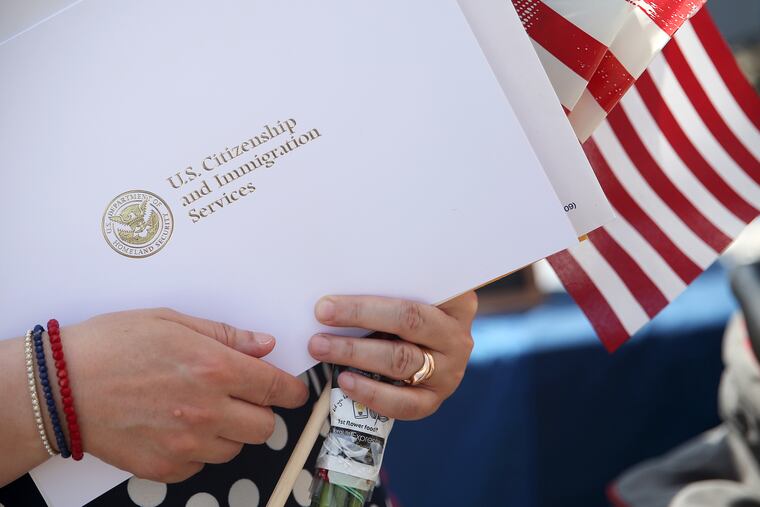
Independence Day is one of my favorite holidays. Not for the parades, pageantry, and fireworks, though I love those, too — even more so in the year of the nation’s Semiquincentennial.
I love the day for what it celebrates: the birth of an audacious experiment. The idea that a nation could be built not on shared race, religion, or ancestry, but on a shared belief in human dignity, and the right to pursue a life of your own making. E pluribus unum. Out of many, one.
That idea is how my family became Americans. My parents came to the United States as exchange students from Iran, intending to return home. The Iranian Revolution happened the day my dad was defending his doctoral dissertation. It extinguished the future my parents had imagined, especially for me. His Jewish dissertation advisers wrapped their arms around our young Muslim family, and America took us in.
I have spent my career seeking to be worthy of that welcome, serving my country — the United States — at some of the highest levels of government. My diplomatic counterparts in the Middle East thought I was a unicorn: How could the first-generation daughter of a country that is the sworn enemy of the United States be seen as so American as to represent it? My experience is not unique — just ask the many first-generation troops who serve in our military. I’m not the unicorn. Our country is.
President Ronald Reagan said it best, in his final speech as president: “A man wrote me and said: ‘You can go to live in France, but you cannot become a Frenchman. You can go to live in Germany or Turkey or Japan, but you cannot become a German, a Turk, or a Japanese. But anyone, from any corner of the Earth, can come to live in America and become an American.’ … We lead the world because, unique among nations, we draw our people — our strength — from every country and every corner of the world. And by doing so, we continuously renew and enrich our nation.”
Our founders knew that their radical idea would take work from all of us. George Washington spelled out the covenant of citizenship when, writing to a Jewish congregation in 1790, he said that America “gives to bigotry no sanction, to persecution no assistance” — and in return “requires only that they who live under its protection should demean themselves as good citizens, in giving it on all occasions their effectual support.” Welcome extended. Citizenship expected.
So every Fourth of July, I find myself thinking about what citizenship should demand of us today. This year, with our 250th upon us and citizenship debated in courts and in the press, the question is more urgent than ever.
Right now, hundreds of thousands of aspiring Americans are studying for the naturalization exam — 128 questions on the history, values, and structure of the country they have chosen. They are doing it after working long hours, after putting their kids to bed, in their second or third language. They chose this country on purpose, and they are earning their place in it the hard way.
Which raises a humbling question for the rest of us: Could we pass the same test?
Most of us — native-born Americans, myself included — would struggle to keep up with them. Two-thirds of Americans can’t pass the civics test that new citizens are required to pass, and this year, it got twice as hard.
The path these aspiring Americans walk has seldom been more fraught. In recent years, families have been separated by enforcement actions, legal pathways to citizenship are increasingly unclear, and communities that once felt settled now live in a persistent state of uncertainty. The people studying those 128 questions are doing so under a shadow most of us will never know. They wonder: Are they still even welcome here?
The path these aspiring Americans walk has seldom been more fraught.
That is the full truth of this moment: that the people studying the hardest — who perhaps know the most about our country and what makes it extraordinary, who are perhaps the most committed to it — face an uphill battle for a prize most of us simply inherit and often fail to value.
Citizenship cannot be something we take for granted. It is something we practice by learning our history, contributing to our communities, and strengthening them for the next generation.
That’s why I find so much hope in the many Americans who have stepped forward in recent years to help newcomers build their lives in this country. Veterans who know what civilians suffer in war. Pastors in small towns who organized their congregations. Neighbors who decided that the covenant Washington described was theirs to keep.
Now, many of those people are stepping up again to help newcomers succeed in their dreams of becoming American citizens. I lead a nonprofit, Welcome.US, that has created a new citizen guide program, through which Americans can help aspiring citizens study for the civics exam, practice English, and prepare for the live interview that many newcomers find most daunting. One neighbor and one aspiring American at a time, sitting down together over the questions that define this country.
Through our organization’s work with more than two million volunteers, I’ve seen that the learning goes both ways.
When Americans help someone prepare for the citizenship test, they don’t just teach. They remember. They are reminded why the First Amendment matters, what the Civil War settled, how generations of Americans — from suffrage to the Civil Rights Movement to American tribes — made our Constitution more real for more people. Welcoming someone into citizenship turns out to be one of the most reliable ways to renew your own.
So here is my invitation on America’s 250th birthday: Take the test. Welcome.US has put the civics questions online. See how you do. Let yourself be surprised by what you know and humbled by what you’ve forgotten.
And if you find that mix of humility and renewed awe that I find every time I try my hand at the test — consider doing something with it. Become a citizen guide and help someone else prepare for it. Spend a few hours with someone who has chosen America on purpose, and let them remind you why it was worth choosing.
Two hundred and fifty years after our founding, the American Experiment remains unfinished. That’s not a failure; that’s the design. The founders left it to us — all of us, newcomers and native-born alike — to keep working on that ever more perfect union. On this momentous national anniversary, let’s renew that charge.
Take the citizenship quiz and learn about becoming a citizen guide at Welcome.US.
Nazanin Ash is the CEO of Welcome.US, a nonpartisan nonprofit that has mobilized more than two million American volunteers across 26,000 zip codes to welcome and support newcomers.
Take the test
Here are a few sample questions from the U.S. citizenship test. See more examples at interact.welcome.us/civics:
1. How many voting members are in the House of Representatives?
2. There are four amendments to the U.S. Constitution about who can vote. Describe one of them.
3. How many amendments does the U.S. Constitution have?
4. The Federalist Papers supported the passage of the U.S. Constitution. Name one of the writers.
5. The Nation’s first motto was “E Pluribus Unum.” What does that mean?
Answers
1. Four hundred thirty-five (435).
2. Citizens eighteen (18) and older (can vote). You don’t have to pay (a poll tax) to vote. Any citizen can vote. (Women and men can vote.) A male citizen of any race (can vote).
3. Twenty-seven (27).
4. (James) Madison; (Alexander) Hamilton; (John) Jay; Publius.
5. Out of many, one; We all become one.

Inquirer Opinion Newsletter