The Trump Justice Dept. has forfeited the benefit of the doubt. Act accordingly.
When judges, attorneys, and academics no longer believe the government’s lawyers, something fundamental breaks in the American legal system, write Joe Goldman and Ian Bassin.
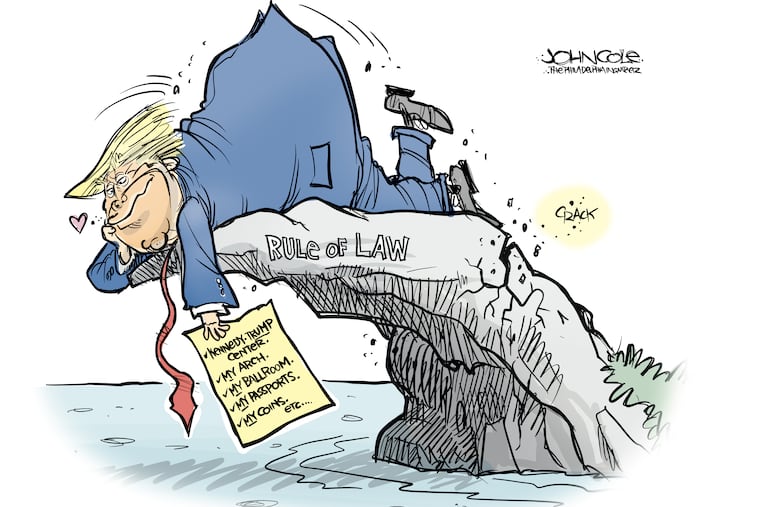
For nearly as long as American courts have existed, they have extended the federal government a quiet courtesy. It is called the presumption of regularity. It holds that when government officials act, judges should assume they did so lawfully and in good faith, absent clear evidence otherwise. It rests on a simple bet: that the people enforcing the law are trying to follow it.
That bet no longer looks safe, and the people best positioned to know are saying so out loud.
A new survey from Bright Line Watch and the Safeguarding Democracy Project at UCLA Law asked more than 300 legal experts — sitting federal judges, elite lawyers, and law professors — to assess the state of the rule of law in America. The findings should unsettle anyone who assumes the system will police itself. Only one in five legal experts agreed that the federal government still merits the presumption of regularity in court. Among elite lawyers, the figure was 24%. Among law professors, 17%. Even among federal judges, less than half, just 41%, said the presumption was still warranted.
The doctrine that courts should trust the government’s word is now rejected by a majority of the legal professionals who built their careers inside that system, and by most of the judges who apply it.
The reasons are not mysterious. Nine in 10 legal experts said the current administration has used the Department of Justice to target enemies and reward allies. Likewise, 86% said political appointees at the DOJ mislead federal judges. And 80% said federal officials fail to comply with court orders. More than 90% viewed the prosecutions of New York Attorney General Letitia James and former FBI Director James Comey as politically motivated. These are not the impressions of activists. They are the considered judgments of people who have clerked at the Supreme Court, run U.S. Attorney’s Offices, and served as general counsels to major institutions.
Judges are not just saying this in response to a survey. They are saying it from the bench.
In a Maryland courtroom this past summer, a federal judge, Paula Xinis, told a government lawyer, “You have taken the presumption of regularity, and you’ve destroyed it.” A judge in Washington, D.C., wrote that “blind deference to the government” was “no longer a thing,” explaining that “trust that had been earned over generations has been lost in weeks.” By March 2026, three New Jersey and Oregon judges had separately declared, in unrelated cases, that the deference long extended to the U.S. Attorney’s Office had been “undeniably eroded.”
Pattern of bad behavior
A study by the legal publication Just Security has now cataloged more than 200 instances in which courts have voiced concern over the government’s noncompliance with orders, distrust of its representations, or findings that its actions were arbitrary and capricious. One judge, surveying six months of the administration’s conduct, concluded the president “may have forfeited the right to such a presumption of regularity.”
When the watchdogs of the legal system conclude that the government can no longer be taken at its word, the question stops being abstract. It becomes practical. What are the rest of us supposed to do?
Consider what happened to the Southern Poverty Law Center. In April, the Justice Department indicted the civil rights organization on charges of wire fraud and money laundering, alleging it concealed payments to informants who had infiltrated extremist groups. The SPLC denies the charges and outside experts have called them weak and politically motivated. Members of Congress have pointed to whistleblower reports that the DOJ pressed prosecutors to rush the indictment despite doubts about its strength. No court has weighed the evidence. The organization remains in good standing with the IRS. An indictment, as more than one community foundation has had to remind the public, is an allegation, not a verdict.
And yet the consequences arrived immediately, delivered not by a judge but by three financial institutions. Fidelity Charitable, Vanguard Charitable, and DAFgiving360, the philanthropic arm of the investment bank Charles Schwab, together three of the largest sponsors of donor-advised funds in the country, blocked their account holders from sending grants to the SPLC.
Donors who rushed to support the group’s legal defense found their requests denied, in some cases learning of the freeze only when the transaction failed. The sponsors cited internal policies permitting them to pause grants to organizations under investigation.
The administration does not need to win in court to inflict the punishment. It only needs to bring the charge and then rely on a web of private institutions to treat the charge as conclusive. The indictment becomes the sentence.
Weaponizing the law
Each firm acted within its legal rights. The money in a donor-advised fund, or DAF, is legally controlled by the sponsor, not the donor. Yet the result is troubling. Three private companies, applying a rule that treats a politicized indictment as if it were a finding of guilt, did to the SPLC what no court has done: They cut off its lifeline at the moment it most needed resources to defend itself. The sponsors of the DAF extended the SPLC’s accuser precisely the deference that judges, in case after case, have been withdrawing.
The mechanism this creates for the weaponization of the rule of law is worth understanding. The administration does not need to win in court to inflict the punishment. It only needs to bring the charge and then rely on a web of private institutions to treat the charge as conclusive. The indictment becomes the sentence. The presumption of regularity, eroding inside the courtroom, is being smuggled back in through the side door, as private actors continue to defer to government accusations that the legal profession itself no longer trusts.
We do not believe the Fidelity, Vanguard, and Schwab affiliates acted in bad faith. We believe they applied old rules to new circumstances without recognizing that the circumstances had changed. A policy that pauses grants to indicted organizations can make sense in a world where indictments reflected the impartial judgment of career prosecutors. It makes far less sense in a world where the leading scholars and judges of American law have concluded that the same Justice Department weaponizes its charging power against political targets.
The norms that govern civil society and industry were built on an assumption that is no longer reliable. They assumed regularity. They now need to account for its absence.
This does not mean private institutions should ignore genuine wrongdoing or bankroll proven fraud. It means they need standards calibrated to the actual environment rather than an imagined one.
A donor-advised fund sponsor could, for instance, distinguish between an indictment and a conviction, maintain grant-making to organizations that retain their tax-exempt status, and reserve suspension for cases where independent evidence, not a government press release, establishes a real problem. Banks, law firms, insurance companies, and professional associations face versions of the same choice. Each can decide whether to be an instrument of political pressure or a check against it.
Strained guardrails
The financial industry already has standard procedures for exercising independent judgment. It conducts due diligence. It weighs reputational and ethical risk. We are asking it to extend that same judgment to a new kind of risk: the risk of becoming the enforcement arm for accusations that the legal profession has flagged as suspect.
The Bright Line Watch data tell us that the formal guardrails, the courts, the separation of powers, the presumption of good faith, are strained. The legal experts surveyed do not expect this to change materially over the next several years — if the current trajectory holds, it likely may get worse.
That is sobering. But it also clarifies the assignment. When official institutions falter, the informal ones, the norms and standards that private actors set for themselves, become load-bearing.
Civil society and industry cannot restore the rule of law on their own. But they can refuse to be the means by which it is dismantled. They can decline to treat an accusation as a conviction. They can ask, before they act on a government charge, whether that government still deserves the benefit of the doubt.
The legal profession has given its answer. It is time for the rest of our institutions to listen.
Joe Goldman is the president of Democracy Fund. Ian Bassin is co-founder and executive director of Protect Democracy.

Inquirer Opinion Newsletter