Were the Democratic senators who voted to end the shutdown sellouts or statesmen?
Wide swaths of the party have been critical of the lawmakers, but were they actually practicing a kind of bygone bipartisanship that has long helped propel the nation forward?
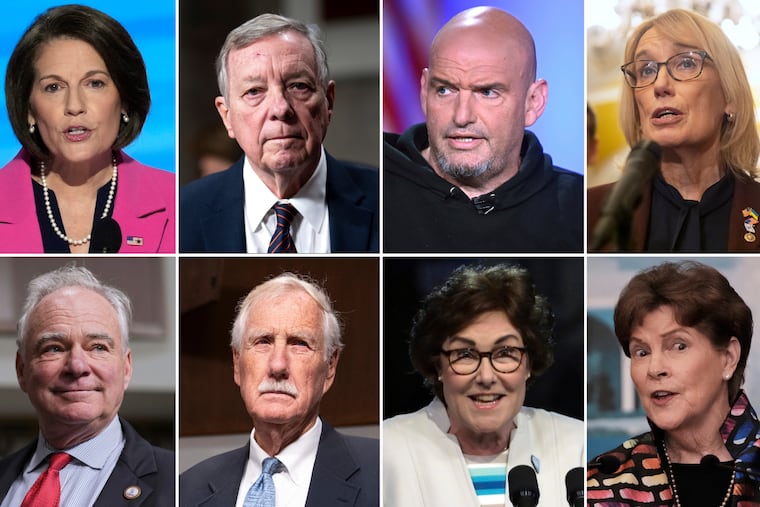
John Fetterman of Pennsylvania, Jeanne Shaheen and Maggie Hassan of New Hampshire, Dick Durbin of Illinois, Tim Kaine of Virginia, and Catherine Cortez Masto and Jacky Rosen of Nevada are the seven Democratic U.S. senators who, along with independent Angus King of Maine, broke ranks with the Democratic caucus to spur the end of the six-week government shutdown.
The senators cited the shutdown’s impact on the U.S. economy when they voted Tuesday with the Republican majority. The Republican-dominated House reciprocated late Wednesday night, and a boasting President Donald Trump immediately signed legislation to fund the government, but only through January, so who knows what happens next?
The 650,000 federal workers sidelined by the shutdown have lost $16 billion in wages. Airlines scrapped thousands of flights to reduce the workload of overburdened air traffic controllers, who were not being paid, and tourism agencies said the shutdown cost the travel industry $2.6 billion.
Democrats in the Senate and House had vowed not to reopen the government unless Republicans agreed to extend tax credit subsidies made available through the Affordable Care Act, which are set to expire at the end of the year. Without those credits, millions of Americans will likely see their health insurance payments double or triple in 2026.
History will decide whether the senators who caved were dupes to make a deal favoring Trump, who has a long track record of breaking promises and making shady business deals. Or should they be called statesmen, an accolade once given to public officials whose selfless actions were in the best interest of their country?
Statesman is a little-used term these days. It sounds misogynistic in 21st-century America, with women holding leadership roles in virtually every segment of our society save the presidency. But the bigger reason the word statesman has fallen out of use may be because so few people holding public office have earned that distinction.
Neither the president nor anyone in Congress wielded the necessary statesmanship to prevent the longest federal government shutdown this nation has ever endured. With Democrats and Republicans unable to work together for the common good, the debilitating shutdown wreaked havoc for weeks and simply set the stage for whatever the next partisan imbroglio will be.
You don’t have to go too far back in America’s history to find the type of bipartisan cooperation that pushed our country forward rather than backward. Sen. Bob Dole (R., Kan.) not only worked with Sen. George McGovern (D., S.D.) to pass the 1977 Food Stamp Act, in 1983 he teamed up with Sen. Daniel Patrick Moynihan (D., N.Y.) to pass crucial legislation that kept Social Security solvent.
Sens. John McCain (R., Ariz.) and Russ Feingold (D., Wis.) worked closely to pass the 2002 federal campaign finance act, an effort that must be replicated given recent U.S. Supreme Court decisions that restored big money’s impact on elections by classifying political spending by corporations as protected expressions of free speech.
McCain also crossed the aisle in 2005 and worked with Sen. Ted Kennedy (D., Mass.) to write a credible bill that would overhaul this nation’s immigration system. Their legislation included a path to citizenship that would have avoided the current mass deportations of people who have lived in this country for years without proper documentation. Instead of being deported, they would pay fines for that offense, but would be eligible to stay in America.
No Republican of McCain’s stature has similarly put aside partisanship to collaborate closely with Democrats on crucial issues since Trump began his second presidency last year. In fact, Sen. John Cornyn (R., Texas), who has a track record of bipartisanship, is trying to escape that reputation by running reelection TV ads claiming he has voted for Trump-supported bills 99% of the time.
Having lived in Texas since 2018, that doesn’t surprise me. The Republican Party so thoroughly controls Texas politically that you wouldn’t know it birthed one of the nation’s greatest masters of bipartisan politics. As president, Democrat Lyndon B. Johnson successfully pushed the 1964 Civil Rights Act and the 1965 Voting Rights Act through Congress, with both bills receiving more yes Republican votes than noes.
Those historic bills passed because there were enough members of Congress, and enough people in our nation, who believed that what the legislation would accomplish was much more important than any party label. The bills were also passed amid a mass awakening in this country brought on by the civil rights movement’s crusade against the evils of segregation and more sinister racist practices that included lynchings.
In a sense, the nation has gone backward. We are experiencing the same type of divisiveness, regional and racial, that preceded the Civil War. Some might argue that those divisions never really went away. An organization called the Texas Nationalist Movement claims it has hundreds of thousands of members who support the Lone Star State’s secession from the United States, though that’s not legally possible.
Is it going to take another war or national disaster for Americans to find unity? There is little evidence today of the community exhibited after the 9/11 terrorist attacks on our nation in 2001. Too many politicians have found it more to their advantage to stress our differences rather than what we have in common. The way those politicians see it, people arguing with each other aren’t paying attention to them. Elections are how Americans prove them wrong. Pay attention. And vote!
Harold Jackson spent two decades at The Inquirer and served as editorial page editor from 2007 to 2017. He was awarded the Pulitzer Prize for editorial writing in 1991 and retired from the Houston Chronicle in 2020. His memoir, “Under the Sun: A Black Journalist’s Journey,” was published in April by the University of Alabama Press.