With driverless taxi service a part of Philly’s very near future, I went to Las Vegas to see what the fuss is about right now
With robotaxis currently being tested in Philadelphia, I decided to give one a try. The car's ride was smooth, and I didn't even mind that it went a little over the speed limit — hey, it’s Vegas.
LAS VEGAS — Why were we whispering?
We were riding amid the neon lights of The Strip, evaluating the comfort and safety of our trip.
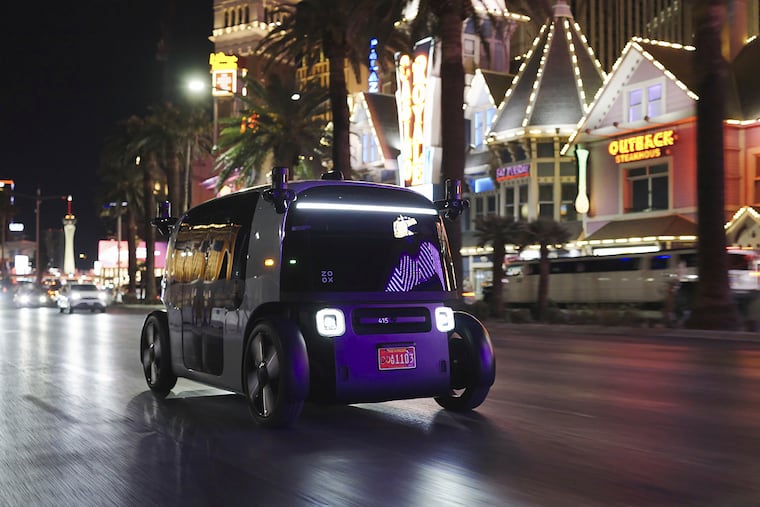
We were in a Zoox (rhymes with “spooks”), Amazon’s driverless car now being test-marketed here. There was no one in the front seat. There was, in fact, no front seat, just a small section separated by a partial panel. There wasn’t even a fake steering wheel to grant the illusion of emergency control.
Yet we were whispering, as if we didn’t want to offend our driver. Old habits die hard.
Zoox’s current Vegas setup is a loop to seven casinos or tourist attractions. We booked our free ride from the northernmost destination, Resorts World, to the southernmost, the Luxor.
The app showed our ride would arrive in 19 minutes. (Meanwhile, nearby, we could see old-school taxicabs waiting to whoosh us to our destination.)
» READ MORE: I can’t shake the feeling that my new car thinks I’m an idiot | Opinion
As we waited, we pummeled the Zoox representative with questions:
What if it got a flat tire? Zoox mechanics — actual people — would instantly respond.
What if you were traveling alone and had a heart attack? Humans monitor rides via a camera in the ceiling, as well as “gently listen” to what’s going on. (Zoox is, after all, the corporate sibling of Alexa.) There is a “Help” button, as well as a “Help” touch screen.
What if there were a power outage? Google’s Waymo robotaxis in San Francisco created gridlock when traffic lights didn’t work. We were assured Las Vegas doesn’t get power outages. My husband countered with, “Have you seen Ocean’s Eleven?”
Our designated Zoox arrived, and we used the app to open the doors. The cars are a pastel mint green, with sensor pods on all four corners that look like little chipmunk ears. They’re adorable.
The uncarpeted interior seats four on two benches facing each other. It has sliding doors, more like a subway than a car. A starry pattern was projected onto the ceiling, where a moon roof added to the feeling of spaciousness. The ambience was completed by a our selection of spa music from something called “Zoox FM.”
The electric-powered ride was smooth and quiet, with a map displaying our progress, along with our speed. Ours reached 41 m.p.h., above the state-approved limit of 35 m.p.h., but hey, it’s Vegas.
The only glitch was its failure to perceive speed bumps within a casino access road. The painted markings were faded, but we felt a real driver would’ve noticed them.
Zoox is currently offering free rides in Las Vegas as part of its rollout. One of its competitors, Google with its Waymos, announced in December that it has begun testing its own autonomous vehicles in Philadelphia.
Driverless car companies claim they are actually safer than humans because they don’t get distracted or tired.
My own concerns have been tempered by news a friend is hospitalized with at least nine broken bones because her Uber driver miscalculated, turning left while the light was yellow. (Zoox says its robotaxis will proceed through a yellow light only if they calculate they can cross the intersection before the light turns red.)
Our robotaxi didn’t head straight to the Luxor, sticking instead to its programmed loop. That took us through the grounds of the nearby Excalibur, eventually reaching the valet entrance.
Both lanes were blocked by loading and unloading vehicles, like the departure level of a busy airport. While traffic in the lane closest to the curb eventually moved forward, ours went nowhere. For several long minutes.
A human driver would’ve cut into the other lane. Or exited the car to determine the cause of the holdup. Our “driver,” however, did nothing. After all, the program cannot feel impatience. The passengers? We could. And did.
Finally, someone behind us leaned on the horn.
“See? Now that’s a person,” said my daughter.
Until Zoox announces its pricing, it’s impossible to say if driverless cars make sense for consumers.
You would save the cost of tipping your driver because … oh, right, no driver.
But they aren’t quicker to arrive, and for now their itinerary is limited. You can’t announce, one block from your destination: “You know what? Just drop me off at this corner.” (Well, you could say it, but no driver would hear it.)
Sad to say, there is one situation in which driverless cars are superior, and we humans have no one but ourselves to blame: If you’re a woman traveling alone, sometimes the riskiest part of the trip is the driver himself.
Until Zoox announces its pricing, it’s impossible to say if driverless cars make sense for consumers.
Both Uber and Lyft are on the hot seat for sexual assaults committed by their inadequately screened drivers. For that reason, both now offer the option of selecting only women drivers.
But with Zoox, you run zero risk of getting a creepy driver. It’s impossible to be sexually assaulted by … nobody.
In theory, maybe someone could hack the robotaxi’s feed to send a Zoox careening into the desert, but to what purpose? It’s the makings of a great Steven Spielberg movie, but that’s about it. (And yes, I do expect to be listed in the credits should he run with my concept.)
We’d planned to Zoox it back to Resorts World, but facing a 20-minute wait, we summoned a Lyft.
Our abundantly human driver was chatty and non-creepy. He did, however, almost hit two jaywalkers.
Kathleen O’Brien is a retired newspaper columnist based in northwest New Jersey.